
What AI-Moderated Interviews Are (2026 Guide)
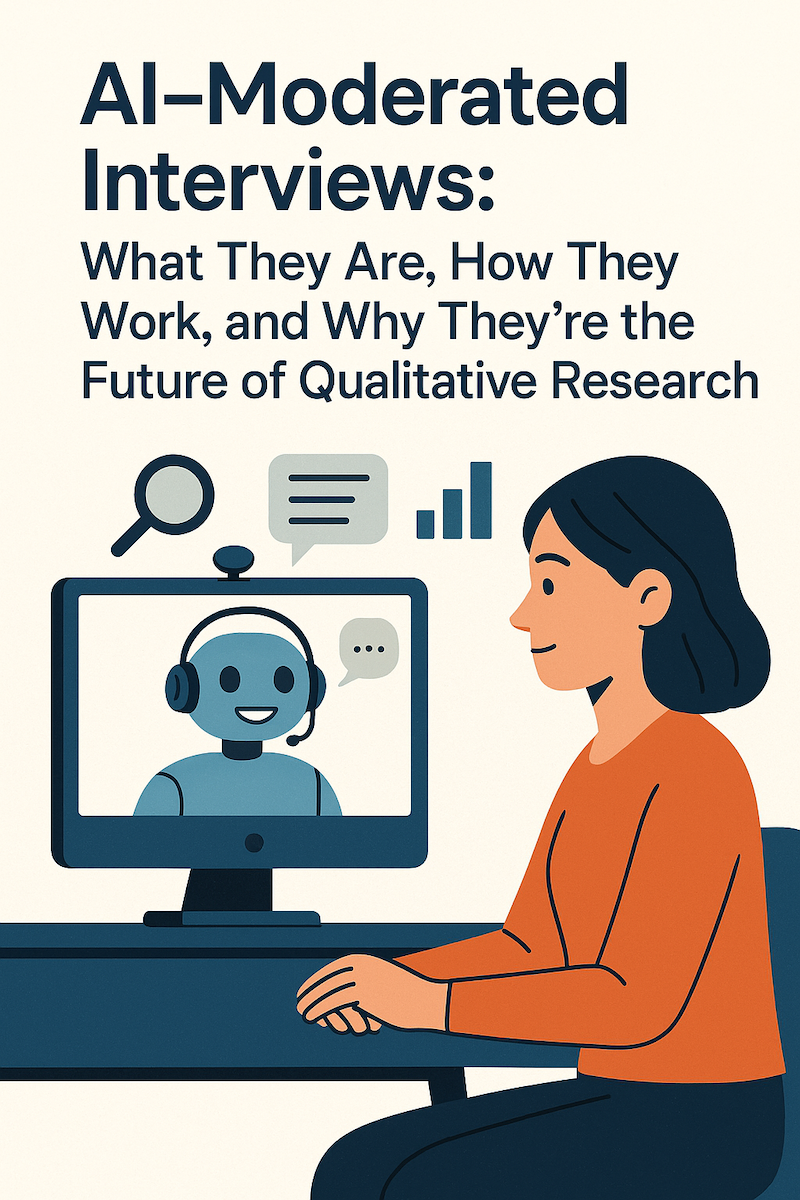
In brief: AI-moderated interviews allow research teams to conduct adaptive, conversation-based qualitative research at scale by replacing human moderators with AI systems that probe, follow up, and analyze responses in real time. This eliminates scheduling friction, reduces manual coding burden, and enables asynchronous participation across markets without sacrificing the depth that distinguishes interviews from traditional surveys. The result is faster, more consistent qualitative insight that was previously out of reach for most teams due to cost and coordination constraints. A recent example: 90 AI-moderated interviews across 7 markets in one week, including recruiting.
AI-moderated interviews are reshaping how research teams gather qualitative insights. Instead of coordinating schedules, managing time zones, conducting dozens of sessions manually, and spending days coding transcripts, researchers can now deploy an AI interviewer that handles the entire conversation end-to-end. The result is deeper, more reliable insight at a scale that used to be impossible for most teams.
But despite the excitement, many questions remain:
How do AI interviewers actually work? Where do they outperform humans? Where do humans still matter? And how should you integrate AI-moderated interviews into your research workflow without losing rigor?
This guide breaks it all down, linking out to related resources across survey design, qualitative methods, data analysis, and customer research so you can build a robust, modern research practice.
Need evidence fast on a specific decision? Usercall's Consumer Interview Sprint runs 15 to 30 AI-moderated interviews in 48 to 72 hours — no demo call required.
What AI-Moderated Interviews Are (And Why They Matter)
An AI-moderated interview is a real-time conversation where an AI system leads the discussion, probes for clarity, asks adaptive follow-up questions, and captures nuanced participant responses. Unlike surveys, which rely on predetermined questions, AI interviews can adjust based on what the participant says.
That distinguishes it from three adjacent methods people often conflate it with: a traditional human-moderated IDI (in-depth interview), which offers the same adaptive depth but doesn't scale past a moderator's calendar; a survey, which can't follow up on an unexpected answer; and synthetic users or AI personas, which simulate a respondent rather than talk to a real one. An AI-moderated interview keeps the real participant and the adaptive probing, and removes the human moderator as the bottleneck. See synthetic users vs. real AI-moderated interviews for that distinction in more depth.
This approach aligns with recent shifts toward smarter, conversational research methods. To understand the broader trend, see AI Surveys: How Smart Surveys Are Transforming Customer Feedback and Market Research
AI-moderated interviews matter now because:
- They reduce recruitment bottlenecks by allowing asynchronous participation
- They eliminate scheduling friction
- They deliver depth without requiring human moderators
- They accelerate analysis through integrated automated coding
- They scale across markets without compromising consistency
For the context behind this shift toward voice-first research, see our guide to voice feedback and voice surveys and From Surveys to Voice: How AI Is Reshaping Customer Feedback
How AI-Moderated Interviews Work
AI interviewers combine structured research design with real-time natural-language understanding. That means they follow the intent of your interview guide while adapting moment-to-moment.
Structured or Branching Interview Guide
Researchers define the goals, topics, and pathing logic. This is where your research design choices matter.
See How to Choose the Right Research Design for Qualitative Research
Adaptive Probing and Follow-Ups
AI interviewers generate follow-up questions instantly, based on participant responses. This mirrors best practices described in:co
How to Ask Better Follow-Up Questions in Qualitative Research (With AI Support)
Context-Aware Interpretation
The AI parses meaning, emotion, and ambiguity in participant replies. It detects missing context, contradictions, or opportunities to probe deeper.
Real-Time Transcription and Structuring
Every response is captured and prepared for analysis, reducing manual burden later.
This complements workflows described in How to Analyze Qualitative Data with AI (Without Losing Nuance)
Researcher Guardrails
You still control tone, topic boundaries, sensitivity filters, and question structure. The AI handles the interaction; you control the rigor.
When to Use AI-Moderated Interviews
AI interviews are a strong fit when you need depth quickly, across many users or markets, and without the variability of human moderators.
Use AI interviews for:
- Early discovery research
- Concept, multi-modal research and prototype tests
- Ad or UX flow evaluations
- Voice-of-customer insight
- Longitudinal feedback cycles
- Pre-survey exploratory work
For broader customer research context, see Customer Research Surveys: How to Get Clear, Honest Insights
When Human Moderators Are Still Better
- Highly sensitive emotional topics
- Research requiring relationship-building
- Sessions where negotiation or persuasion occurs
- Executive or political interviews
For comparison of traditional methods, see Interviews vs Focus Groups
Proof: 90 AI-Moderated Interviews Across 7 Markets in One Week
A recent campaign concept test ran 90 AI-moderated voice interviews across 7 markets, end-to-end, in one week — including recruiting. That's the capacity/timeline case for what's described above: no local moderators, no translators, no multi-week scheduling chain. See the full campaign concept testing case study — 90 interviews, 7 markets, one week.
What's Trending in AI-Moderated Interviews for UX Research in 2026
AI moderation is becoming truly multimodal.
Early tools were mostly text chatbots with voice added on. The newer shift is different: AI moderators can interpret voice, text, and screen behavior together.
For UX teams, this means the moderator can react to more than words. If a participant hesitates, pauses before clicking, or gets stuck in a flow, the AI can ask a follow-up in the moment.
The clearest use cases are concept validation, onboarding research, and continuous discovery. Teams can test ideas with dozens of participants, probe confusion as it happens, and embed lightweight interviews directly into product flows.
Synthesis is getting faster too. Platforms like Usercall combine AI-moderated interviews with thematic analysis, turning sessions into findings, themes, and quotes within minutes.
The bigger shift is that qualitative research can become a faster feedback loop, not just a quarterly project.
There are still limits. AI moderators can misread emotion, redirect awkwardly, and struggle with highly exploratory or sensitive research. Human moderation still matters when nuance and trust are critical.
The next step is study-level adaptation: AI moderators that adjust the guide as patterns emerge across interviews. That could turn AI research from a fixed guide at scale into a living research process.
AI vs Human Moderators: Strengths and Tradeoffs
AI interviewers bring several structural advantages:
Where AI Excels
- Consistency across every interview
- Zero fatigue, zero bias drift
- Instant probing
- Fast turnaround from interview to insight
- Minimal operational overhead
- Works across time zones and 50+ languages
For an analysis of what AI does well (and not so well), see:
AI Market & User Research: 5 Things It Does Well — and 5 It Can’t Do Yet
Where Humans Excel
- Deep emotional attunement
- Relationship building
- High-stakes or politically sensitive interviews
- Interpretation and synthesis
AI doesn’t replace craft. It removes manual obstacles so researchers can spend more time interpreting data and shaping strategy.
How AI Interviewers Improve Data Quality
AI interviewers are less likely to:
- Lead participants
- Skip follow-ups due to time pressure
- Mishear or misremember details
- Introduce unconscious bias
They also encourage more open, reflective responses by removing social pressure from human-to-human conversation.
To sharpen question quality before deploying AI interviews, see:
7 User Research Survey Question Tips to Reduce Bias
And examples such as:
35 Powerful Qualitative Questions for Research
45 Qualitative Research Question Examples
AI-Moderated Interviews vs Traditional Surveys
Surveys are ideal for scale and quantification. Interviews are ideal for nuance. AI-moderated interviews blend both by adding scalable nuance.
For designing smarter surveys that complement AI interviews, see:
Qualitative Surveys: Research Questions That Reveal Real Stories, Not Just Numbers
For analytics workflows, see:
The Easiest Data Analysis Software for Qualitative Research
Using AI-Moderated Interviews for Concept, Messaging, and UX Testing
AI interviewers can show users:
- Images
- Prototypes
- Ad copy
- Landing pages
- UX flows
- Videos
Then probe for reasoning, perceptions, expectations, and confusion.
For broader methodological context, see:
12 Proven Market Research Techniques (With Examples)
And tools often used in UX workflows:
17 Essential UX Research Tools
Scaling AI-Moderated Interviews Across Markets
Traditional research often avoids multi-market qualitative work because it requires local moderators, translators, and logistical coordination. AI eliminates these constraints.
This solves the challenge described in:
We Don’t Have Time to Do Research
And it fits into multi-method research strategies such as those outlined in:
The 9 Types of Customer Research Every Team Needs
How AI-Moderated Interview Data Is Analyzed
AI interviews create structured data automatically:
- Transcripts
- Auto-applied codes
- Suggested themes
- Sentiment analysis
- Quotes and summaries
- Theme-level frequency views
Supporting resources include:
Thematic Coding in Qualitative Research
And frameworks in:
Top 5 Challenges With Qualitative Analysis (And How to Overcome Them)
Researchers still guide interpretation, refine themes, and synthesize findings. Better yet, AI can run automated thematic analysis with full researcher controls.
Combining AI Interviews With Other Qualitative Methods
The most effective workflows blend:
- AI interviews for scale and early depth
- Human-led interviews for refinement
- Surveys for quantification and validation
For hybrid methodologies:
Mixed Methods Research
And for grounding in traditional collection techniques:
Qualitative Data Collection—Methods, Examples & Tips
Who Benefits Most From AI-Moderated Interviews
Product & UX Teams
Useful for usability discovery, onboarding friction, flow testing.
Related context:
Online Customer Research: Understand Your Customers Without Leaving Your Desk
Marketing Teams
Great for messaging tests and value proposition clarity.
See:
Customer Research Analysis: How to Decode What Your Users Actually Want
CX & VOC Teams
Captures emotion and nuance text surveys miss.
See:
Customer Feedback Analysis: How to Turn Every Comment Into Actionable Insight
Market Research Agencies
Scale qual depth without increasing moderator headcount.
See:
Customer Research Services: What They Are, Why They Matter
What to Look for in an AI-Moderated Interview Tool
Key capabilities include:
- Intelligent follow-up questioning
- Strong control over the interview guide
- Branching logic support
- Multimodal stimulus handling
- Stable transcription
- Automated thematic analysis
- Researcher review and override tools
- Compliance and security
Relevant comparisons:
10 Best Qualitative Research Software in 2025 (And How AI Is Changing Everything)
And vendor comparisons such as:
Atlas.ti vs NVivo vs Usercall
Common Pitfalls in AI-Moderated Interviews (And How to Avoid Them)
- Vague or ambiguous questions
- Multi-barreled questions
- Overloading the interview guide
- Assuming AI can replace research design judgment
- Skipping pre-screening or sample controls
- Relying solely on auto-analysis without review
Helpful references for improving question clarity:
The Problem With Open-Ended Questions
And diagnosing flawed insight generation:
Why Our Survey Didn’t Work (And What You Can Do About It)
The Future of AI-Moderated Interviews
The next wave of AI moderation is less about sounding human and more about connecting to the research stack.
AI interviews will increasingly be triggered by behavior: a drop-off, a failed task, or a moment of hesitation. The tool can then probe while the experience is still fresh.
That makes continuous discovery easier to run. AI handles lower-stakes interviews at higher frequency, while researchers focus on better questions, interpretation, and follow-up.
Human moderation still matters for sensitive topics, executive interviews, accessibility work, and deep exploratory research.
The real question is no longer “Can AI moderate?” It is “Which parts of research should be automated, and which still need a human?”
Final Thoughts: AI Expands the Researcher’s Reach
AI-moderated interviews don’t replace researcher judgment. They replace the manual bottlenecks—scheduling, probing, transcription, initial coding—so teams can focus on interpretation, storytelling, and decision-driving insight.
By combining AI interviews with thoughtful research design and rigorous analysis, teams unlock a new era of qualitative depth: faster, scalable, and more consistently insightful.
Try AI-Moderated Interviews Yourself
The fastest way to understand AI-moderated interviews is to run one. Start a free trial — no sales call, no demo required. You can have your first AI-moderated study live in minutes.
To see the product, read about AI-moderated user interviews in Usercall.
Need evidence fast on a specific decision instead of an ongoing self-serve setup? Usercall's Consumer Interview Sprint runs 15 to 30 voice interviews across up to 5 markets in 48 to 72 hours. Contact us to scope one.
Find qualified participants for your research
Describe participants to recruit for your research study. You'll get a recruiting plan, screener, and cost/feasibility estimate instantly—then we'll contact you with details on sourcing the right participants for you.
Related Guides in This Series
AI moderation changes the mechanics of interviews, but the fundamentals of good research still apply. If you want a grounding in those fundamentals alongside the newer approaches, the user interview playbook is a solid place to start. Usercall is built specifically for AI-moderated interviews at scale—if what you've read here resonates, it's designed for exactly this use case.
Related: how to run remote user interviews at scale with or without AI · recruiting participants in a way that works for async and AI-moderated formats · interview question templates you can adapt for AI-moderated sessions · are AI-moderated interviews reliable? · best AI-moderated interview software in 2026 · a full AI-moderated interview example · synthetic users vs real AI-moderated interviews · AI-moderated interviews vs focus groups
Frequently Asked Questions
What are AI moderated interviews?
AI moderated interviews are real-time conversations led by an AI system that asks adaptive follow-up questions, probes for clarity, and captures nuanced participant responses. Unlike traditional surveys with fixed questions, the AI adjusts based on what participants say, delivering qualitative depth without requiring a human moderator to be present.
How do AI moderated interviews work?
AI moderated interviews combine a researcher-defined interview guide with real-time natural language understanding. The AI follows structured topic logic while generating adaptive follow-up questions instantly, parsing meaning and emotion in responses, transcribing everything automatically, and structuring data for analysis — all within a single end-to-end conversation.
What is the difference between AI moderated interviews and surveys?
Surveys rely on predetermined, fixed questions and cannot adapt based on answers. AI moderated interviews adjust dynamically to what each participant says, generating contextual follow-ups that uncover deeper insight. This makes AI interviews better suited for exploratory or discovery research where nuance and depth matter more than standardized responses.
What are the main benefits of AI moderated interviews for research teams?
AI moderated interviews eliminate scheduling friction, allow asynchronous participation across time zones, reduce manual transcript coding burden, and scale qualitative research across multiple markets without human moderator variability. Research teams gain faster, more consistent qualitative insight at a scale that was previously out of reach due to cost and coordination constraints.
Where do AI moderated interviews outperform human moderators?
AI moderated interviews outperform human moderators in scalability, consistency, and speed. They remove recruitment bottlenecks by enabling asynchronous participation, eliminate interviewer variability across sessions, conduct simultaneous conversations across markets, and accelerate analysis through integrated automated coding — all without the scheduling and coordination demands of human-led sessions.
What are the limitations of AI moderated interviews?
AI moderated interviews still require researchers to define goals, topic boundaries, sensitivity filters, and question structure upfront. The AI handles the conversation interaction, but rigorous research design remains a human responsibility. Complex emotional topics or highly sensitive research contexts may also still benefit from skilled human moderator judgment and rapport-building.
When should you use AI moderated interviews instead of traditional qualitative research?
AI moderated interviews are best suited for early discovery research, large-scale qualitative studies across multiple markets, and situations requiring fast turnaround without sacrificing conversational depth. They are especially valuable when scheduling dozens of individual human-moderated sessions is impractical due to time, budget, or geographic coordination constraints.
Related: see the best user interview platforms in 2026 compared side by side.