
Consumer Insights Analytics: Why Your Dashboard Can’t Explain Lost Customers
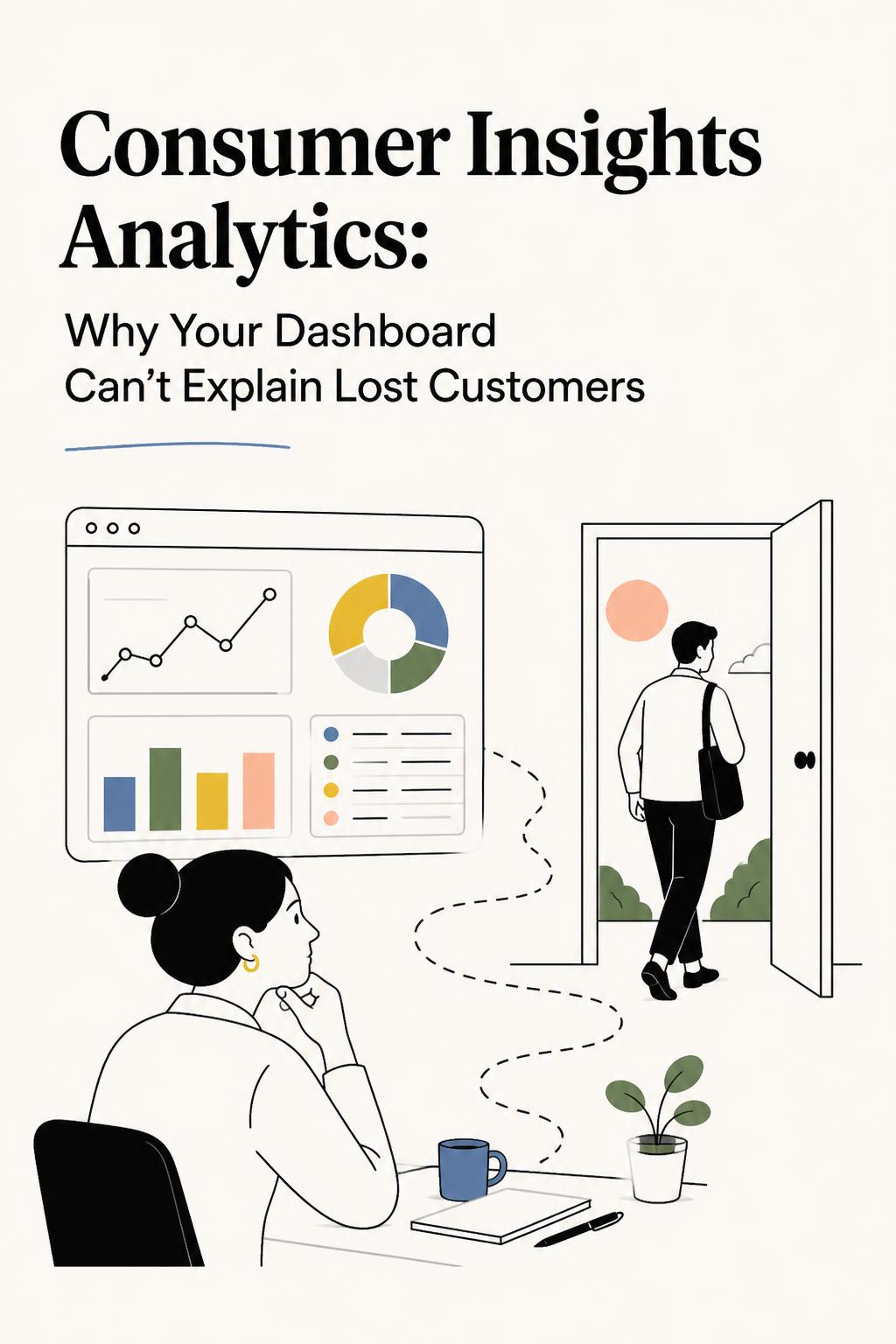
Your dashboard tells you 11% more shoppers abandoned checkout this month. By Friday, someone has proposed a larger CTA, a new payment badge, and a discount test. That is the familiar ritual of consumer insights analytics done badly: a metric moves, the team spots the nearest screen, and a costly redesign begins before anyone knows what actually changed for the customer.
I have watched teams spend entire quarters optimizing the wrong moment. In one retail study, checkout abandonment was real, but checkout was innocent. Customers had already decided to leave when the cart disclosed a delivery date after the birthday, trip, or event that triggered their purchase. The conversion funnel showed where they exited. Only customer conversations revealed the mechanism: the brand had allowed them to browse, compare, and commit emotionally before making the timing constraint visible.
That is the uncomfortable truth: most consumer insights analytics programs produce precise descriptions of behavior but weak explanations for it. They create dashboards full of signals and organizations full of confident guesses. The job is not to report that customers left. The job is to identify the tradeoff that made leaving feel like the rational choice.
Consumer Insights Analytics Is a Decision Discipline, Not a Dashboard Category
Consumer insights analytics combines behavioral data, customer voice, and market context to explain consumer choices and guide a specific business decision. The phrase is often used to mean survey reporting, social listening, web analytics, or segmentation. Those are inputs. None is an insight on its own.
A useful insight has three parts: an observed behavior, a credible explanation of the behavior, and a decision implication. “Mobile conversion fell among new visitors” is an observation. “New mobile visitors interpret our plan comparison as a commitment because cancellation terms are hidden below the fold, so they delay rather than start a trial” is an insight. “Move cancellation terms beside the CTA and test a no-card trial for high-intent mobile visitors” is a decision.
I am deliberately strict about this distinction because vague insight language is expensive. Statements such as “customers want convenience” or “trust matters” survive meetings because nobody can disagree with them. They also fail to tell a product manager what to build, a marketer what to say, or a commercial leader what tradeoff to make.
The better question is always more specific: which consumer is struggling to make what progress, in what situation, because of which friction or perceived risk?
Why Most Consumer Insights Analytics Fails Before Research Even Starts
Most weak consumer insight work is not caused by poor analysts. It is caused by a poor starting point. Teams begin with the data they happen to have rather than the decision they need to make.
- They start with a dashboard instead of a decision. A funnel is opened because it is available, not because the team has stated the choice it needs to make. The result is exploratory analysis that produces interesting patterns but no accountable next step.
- They mistake stated preference for future behavior. Consumers can describe a frustration well. They are far less reliable when predicting whether they will adopt a feature, pay more, switch brands, or change a routine. Asking “Would you use this?” invites politeness and imagination. Observing the real tradeoff reveals demand.
- They aggregate away the trigger. A satisfaction average can combine people furious about a billing surprise with people who paused because they were on holiday. Both may select “not using the service enough,” but their situations, recovery paths, and commercial value are entirely different.
- They code feedback into generic themes. Labels such as price, UX, and trust are too blunt to guide action. “Price felt deceptive after a late fee appeared” and “price exceeded the value of a once-a-year use case” are both price-related, but they demand different interventions.
The common response is to collect more data: another tracker, another NPS wave, another heatmap. That usually adds volume, not clarity. Better consumer insights analytics narrows the question first, then collects evidence that can disprove competing explanations.
The Mental Model That Makes Consumer Behavior Make Sense
Consumers do not choose the product they say they prefer. They choose the option that creates the best acceptable tradeoff in that moment.
Use this equation as a diagnostic tool:
Choice = desired progress − money, time, and effort − perceived risk − switching cost.
Every sudden movement in a consumer metric can be investigated through these four forces. Has the consumer’s desired outcome changed? Has a sacrifice become more visible? Has uncertainty increased? Has acting become harder than continuing with the current workaround?
This is more useful than treating behavior as a simple expression of attitudes. A customer may genuinely like your brand and still abandon because your return window creates risk. They may value a new product feature and still not use it because learning it threatens their identity as someone who is already competent. They may say price is the issue when the deeper concern is fear of being trapped in a subscription.
In a digital wellness study I led, the company believed early cancellations were caused by poor content discovery. The behavioral data seemed to support it: customers who cancelled had sampled fewer sessions. We interviewed recent joiners within days of their first use and heard a different story. The growing library made people feel they had to choose the perfect session. Many chose nothing, then felt they had already failed at a wellness habit. More filters and more recommendations would have made the problem worse.
We advised the team to replace an open library experience with one clearly recommended action per day during the first week. This was not a discovery improvement; it was an anxiety reduction intervention. First-session completion rose because the service removed the emotional cost of making a wrong choice.
Find Insight at the Moments Where Consumers Commit or Hesitate
The most valuable consumer insights analytics does not live in a quarterly PowerPoint. It is captured around decision moments: the customer’s first search, a product comparison, a confusing setup step, a failed payment, an upgrade, a cancellation, or a support contact after something goes wrong.
These moments contain fresh evidence. The consumer still remembers the alternative they considered, the expectation they carried in, and the detail that created doubt. A retrospective survey sent three months later captures a rationalized version of the experience, not the choice architecture that shaped it.
For product and UX teams, this means connecting event data to in-context qualitative research. If activation drops after a workflow change, do not only review session recordings. Invite people who abandoned at that exact point to explain what they believed would happen next. If a feature is used once but not repeated, ask after the first use, not during a generic quarterly interview.
A Five-Step Consumer Insights Analytics Workflow
Use this process whenever a behavioral metric creates uncertainty, disagreement, or a high-stakes decision.
- Write the decision in one sentence. For example: “Should we change the trial offer, simplify plan selection, or fix the activation flow?” If the team cannot state the decision, it is not ready to research.
- Define the behavioral signal precisely. State the affected population, baseline, timing, and commercial consequence. “New mobile visitors converting from paid search fell from 3.8% to 3.1% after pricing changed” gives researchers a real boundary.
- Build competing hypotheses. Require at least three plausible explanations, including one that challenges the executive team’s preferred narrative. This protects the work from becoming quote collection in support of a preselected answer.
- Recruit around contrasting behavior. Talk to people who completed, hesitated, abandoned, and recovered. Averages conceal the mechanism. Contrasts reveal it. Compare customers who faced the same delivery delay but repurchased with those who defected.
- Translate findings into a prediction. A recommendation should say what will happen if the team acts. “Showing delivery dates on product pages will reduce cart abandonment among event-driven buyers, while lowering add-to-cart slightly among customers who would otherwise discover the delay later.” That prediction can be tested.
Segment by Situation Before Demographics
Demographic segmentation is often where consumer insights go to become harmless. Age, income, and geography may help with media targeting, but they frequently fail to explain why a person chooses, delays, upgrades, or leaves.
I saw this in a financial-services project with a two-week deadline before a product launch. The team wanted the research organized around age bands. After interviewing customers, the meaningful division had nothing to do with age. One group was moving money for a planned purchase and wanted control, visibility, and confidence. The other was responding to an immediate cash-flow shortfall and wanted speed, privacy, and reassurance that they were not making a damaging decision.
The same product could serve both groups, but the same message could not. “Plan with confidence” worked for planned purchasers and felt irrelevant to urgent users. The launch team replaced demographic messaging with situation-based journeys, including different proof points and different next steps. That is the power of segmentation built around the job, trigger, and perceived risk rather than a profile label.
Turn Themes Into Mechanisms, Not Summary Slides
A theme tells you what customers mentioned. A mechanism tells you why behavior changed. The difference determines whether your insight can survive contact with a roadmap.
Consider the theme “customers are concerned about price.” It could mean the upfront price exceeds perceived value, competitors are easier to compare, a fee appears too late, the customer does not trust renewal pricing, or the purchase is too infrequent to justify a subscription. Each explanation changes the right response. A discount may help one and worsen another by signaling low quality or training customers to wait.
Code research at this level of causal detail. Capture the trigger, desired progress, alternative considered, friction encountered, emotional response, proof required, and outcome. Then connect these patterns back to behavioral segments. This is how teams move from a transcript full of anecdotes to a defensible explanation of a metric.
The Standard: Insight Must Change a Decision
Strong consumer insights analytics should make a team revise a belief it previously held. Perhaps customers are not loyal to your brand; they are loyal to a routine your product currently fits. Perhaps a feature is not undiscoverable; it is avoided because people fear making an irreversible mistake. Perhaps a high-value audience is not the loudest segment but the one with the clearest recurring trigger and the lowest cost to serve.
Do not judge insight work by the number of charts, interviews, tags, or AI summaries produced. Judge it by whether it reduces uncertainty around a consequential choice. The deliverable should make clear what happened, why it happened, who it affects, what tradeoff is in play, what the team should change, and what result that change should produce.
That is what consumer insights analytics is for: closing the dangerous gap between a dashboard alert and a human explanation before your organization spends another quarter optimizing the wrong thing.
Run the week on concept testing: 15 to 30 AI-moderated interviews, with quotes back in 48 to 72 hours.
Dashboards can tell you what happened, but they'll never tell you why your customers left. To close that gap, check out our guide to the 13 best Voice of Customer tools for platforms designed to surface the reasoning behind the numbers. Usercall pairs directly with your analytics stack to run AI-moderated interviews that explain the drop-offs your dashboard can only flag.
Related: Concept testing questions · Concept testing research · CPG packaging · Concept testing examples
Related: why most teams get the 'why' wrong in consumer insights research · consumer intelligence data that's lying to you · AI customer insights and your roadmap