
AI Customer Insights Are Lying to Your Roadmap—Unless You Do This
Your AI customer insights report says customers want a simpler dashboard. The product team begins planning a redesign. Then you watch five churned enterprise customers try to complete their monthly workflow and find the real issue: the dashboard is not too complex. It is too risky. They cannot tell whether a report includes the latest data, so they export it, reconcile it manually, and eventually stop trusting the product.
This is how teams waste quarters with AI. They mistake the most repeated customer language for the most important customer truth. “Simpler dashboard” is a reasonable description of frustration. It is also a terrible product decision unless you know what customers are trying to accomplish, what they fear will go wrong, and which segment’s behavior is actually affecting retention or revenue.
AI customer insights can make research dramatically faster. It can search thousands of conversations, compare customer segments, summarize interviews, expose recurring friction, and surface evidence that would take a lean research team weeks to find manually. But faster synthesis is not the same as better judgment. In my experience, teams get the most value from AI when they stop treating it as a theme generator and start treating it as an evidence system for high-stakes decisions.
What Most Teams Get Wrong About AI Customer Insights
The common workflow is deceptively simple: upload support tickets, survey responses, sales calls, product reviews, and interview transcripts; ask AI for key themes; sort those themes by frequency; hand the list to product leadership. It produces an impressive deck. It rarely produces a reliable priority list.
The problem is that customer feedback is not a vote. A complaint mentioned 40 times may represent an irritating edge case. A concern mentioned by six implementation managers at accounts worth $1.2 million may be the real expansion blocker. Frequency measures volume. It does not measure economic impact, workflow severity, strategic importance, or the likelihood that a product change will solve the problem.
AI also has a built-in tendency toward coherence. It wants to turn messy evidence into a clean story. Researchers should want the opposite at first: tension, exceptions, contradictions, and uncertainty. If customers say onboarding is easy but 38% never reach the first value event, the positive survey response is not proof that onboarding works. It may mean users can complete the steps without understanding why they matter. If power users request more customization but ignore existing settings, the need may not be customization at all. It may be poor discoverability, low trust in configuration, or an internal process that prevents experimentation.
That is why generic AI feedback analysis falls short. It answers, “What did people say?” Better AI customer insights answer, “What is happening, to whom, under what conditions, and what should we test next?”
The Core Principle: Do Not Analyze Feedback Before Defining the Decision
Every research project should start with a decision, not a dataset. This is the discipline most teams skip because collecting feedback feels productive. But without a decision frame, AI will return broad, plausible themes that nobody can confidently act on.
Before you ask for analysis, write a one-sentence decision statement: We need to decide whether to improve activation guidance, redesign the invite flow, or change our trial positioning for new workspace admins. That sentence gives the research a boundary. It tells you which customers matter, which journey moment matters, and what kind of evidence will be useful.
I use a four-part decision frame for AI customer insights:
- Decision: Identify the specific choice a product, UX, research, or business leader must make.
- Population: Define the customer group by role, account type, lifecycle stage, behavior, plan, or revenue profile.
- Moment: Name the exact moment where friction, hesitation, or value realization occurs.
- Proof standard: Decide what evidence would be strong enough to justify action, such as repeated qualitative patterns, behavioral data, and counterexamples reviewed.
Compare two prompts. “Summarize our customer interviews about onboarding” will produce a generic inventory of comments. “Compare admins who invited three or more teammates in their first week with admins who invited nobody. Separate product friction, comprehension gaps, and organizational barriers. Show disconfirming evidence.” That prompt creates an analysis capable of changing an activation strategy.
Use AI to Find the Differences That Metrics Cannot Explain
Product analytics tells you where a journey breaks. Customer research tells you why. The strongest AI customer insight workflow connects the two rather than treating qualitative feedback as a separate, softer source of truth.
Start with a behavioral split. Find users who succeeded and users who did not. Compare retained and churned accounts, teams that expanded and teams that stalled, customers who adopted a feature and customers who never returned to it. Then use AI to organize the qualitative evidence around that split.
In a B2B collaboration study I led, only 9% of eligible accounts activated a shared workspace feature. The immediate product assumption was that customers simply did not value collaboration. Early AI summaries reinforced that belief because users frequently asked for “more flexibility” and “more control.”
I narrowed the dataset to implementation administrators and compared accounts that activated the feature with those that did not. The difference was not appetite for collaboration. Non-adopters could not predict what invited external users would be able to view. They worried about exposing sensitive project details, so they avoided invitations altogether. “More control” was not a request for more features; it was a request for confidence before taking an irreversible action.
The team added a visibility preview, safer default roles, and clearer permission language. This was considerably cheaper than building the customization features originally proposed, and it addressed the actual adoption barrier. That is the value of AI customer insights when the analysis is anchored to meaningful behavioral variance rather than repeated phrases.
Build an Evidence Stack Instead of Dumping Everything Into One Prompt
AI can analyze mixed data sources, but researchers should never flatten their meaning. A support ticket, an interview quote, a session replay, a cancellation reason, and an event log are not interchangeable evidence.
Keep sources distinct and label context. A customer saying, “Reporting is difficult,” is an expressed perception. Repeatedly exporting data to a spreadsheet is observed behavior. A decline in weekly usage after a failed report setup is a behavioral pattern. A sales note about security review is an organizational constraint. Each may point toward the same problem, but each deserves a different level of confidence.
A practical evidence stack combines four layers:
- Behavior: Product events, funnels, usage paths, repeat attempts, and abandonment patterns reveal what customers actually do.
- Meaning: AI-moderated interviews, researcher-led interviews, open survey responses, and support conversations explain intent, confusion, and workarounds.
- Context: Role, company size, tenure, implementation model, industry, and purchasing constraints explain why the same issue affects customers differently.
- Consequence: Retention, conversion, expansion, support burden, time-to-value, and sales-cycle data establish whether the issue deserves priority.
The insight becomes credible when these layers converge. If users claim a workflow is confusing but continue to complete it quickly, investigate before redesigning. If users say a workflow is fine but repeatedly abandon it after viewing a particular field, trust the behavioral signal enough to probe deeper. Stated preference and observed behavior do not always agree, and that gap is frequently the research opportunity.
Intercept Customers When the Problem Is Still Happening
Post-hoc research has a serious limitation: memory edits experience. A customer who abandoned setup on Tuesday may give you a neat explanation on Friday, but it may have little to do with what blocked them at the moment. They may rationalize the choice, forget a confusing label, or describe a broader product opinion instead of the exact event.
This is why product teams should collect AI customer insights at key behavioral moments. Trigger a short interview or intercept after a failed import, repeated error, incomplete onboarding, downgrade, canceled checkout, first successful workflow, or sudden reduction in usage. The goal is not to ask, “How do you like our product?” It is to understand the decision, uncertainty, and context surrounding a real event.
I used event-triggered interviews during a checkout investigation after completion dropped by 6 percentage points following a pricing-page update. Leadership assumed the new price was too high. We spoke with users who viewed pricing, entered checkout, and left within five minutes. The dominant issue was not sticker shock. The annual billing option appeared first, and smaller teams interpreted the monthly equivalent as a mandatory per-user commitment. They were uncertain about contract structure, not necessarily unwilling to pay. Clarifying the billing language was a faster, lower-margin-risk intervention than discounting.
Make Every AI Finding Easy to Challenge
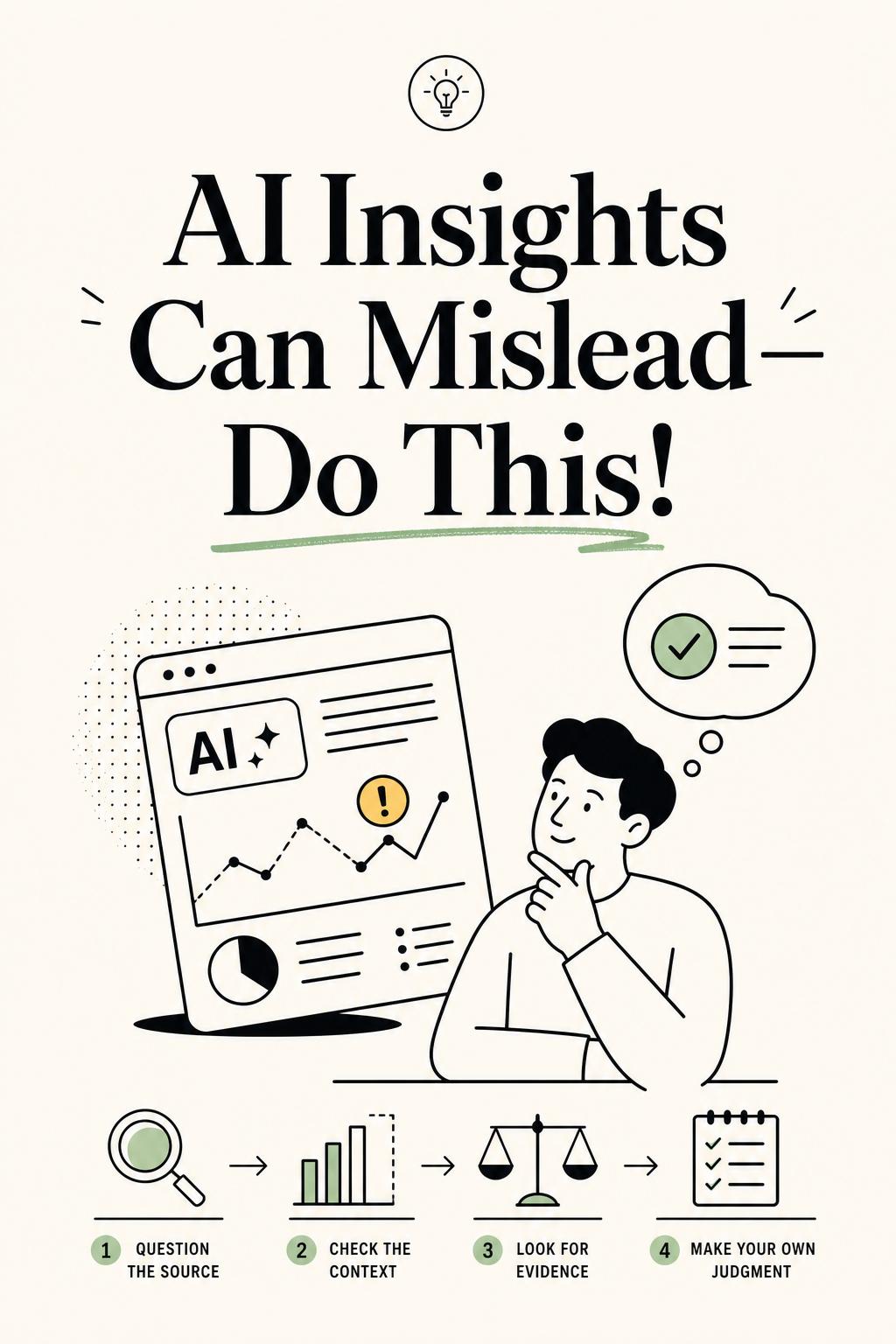
A polished synthesis is not evidence. Any important finding should show its source material, affected segment, sample depth, exceptions, and relationship to customer behavior. If an AI output cannot be challenged, it should not be used to make a roadmap decision.
For each major conclusion, ask five questions:
- Which customers does this represent, and which customers does it exclude?
- How many distinct participants or accounts support the pattern?
- What direct evidence supports it beyond the AI summary?
- What examples contradict or complicate the conclusion?
- What measurable behavior should change if the conclusion is correct?
In research reviews, I classify findings as high, medium, or exploratory confidence. High-confidence findings recur across relevant customer groups, align with behavior, and survive counterexample review. Medium-confidence findings are repeated but not yet connected to product outcomes. Exploratory findings are promising hypotheses, not priorities. This prevents vivid quotes from hijacking strategy merely because they are memorable.
AI should make your conclusions more auditable, not more authoritative.
Turn AI Customer Insights Into a Testable Decision Memo
The output should never be a theme library that dies in a research repository. Write a compact decision memo that names the segment, journey moment, mechanism, confidence level, recommended action, and success metric.
For example: New workspace admins at companies with more than 50 employees delay invitations because they cannot predict visibility for external collaborators. This creates perceived information-sharing risk and suppresses team activation. Test role previews and secure defaults. Measure invited teammates per workspace within seven days, plus downstream shared-workspace adoption.
That is more valuable than “Customers want clearer permissions.” It identifies who is affected, why the behavior occurs, what to change, and how to learn whether the explanation was right.
The promise of AI customer insights is not automated research. It is continuous, decision-ready learning. Teams that use AI to compare meaningful customer groups, preserve source evidence, intercept behavior in context, and test explanations against metrics will move faster without becoming careless. Teams that ask AI for prettier summaries will simply become more efficient at building from the wrong story.
AI can summarize feedback fast, but a roadmap built on shallow summaries is a roadmap built on guesswork. If you're evaluating tools that pair AI analysis with real customer conversation, our guide to the voice of customer software is a good next stop—or see how Usercall runs AI-moderated interviews that keep the human context AI summaries tend to strip out.
Related: customer insights AI · AI consumer research · consumer intelligence data