
Customer Experience Optimization: The Hidden Reason Customers Leave After a “Good” Experience
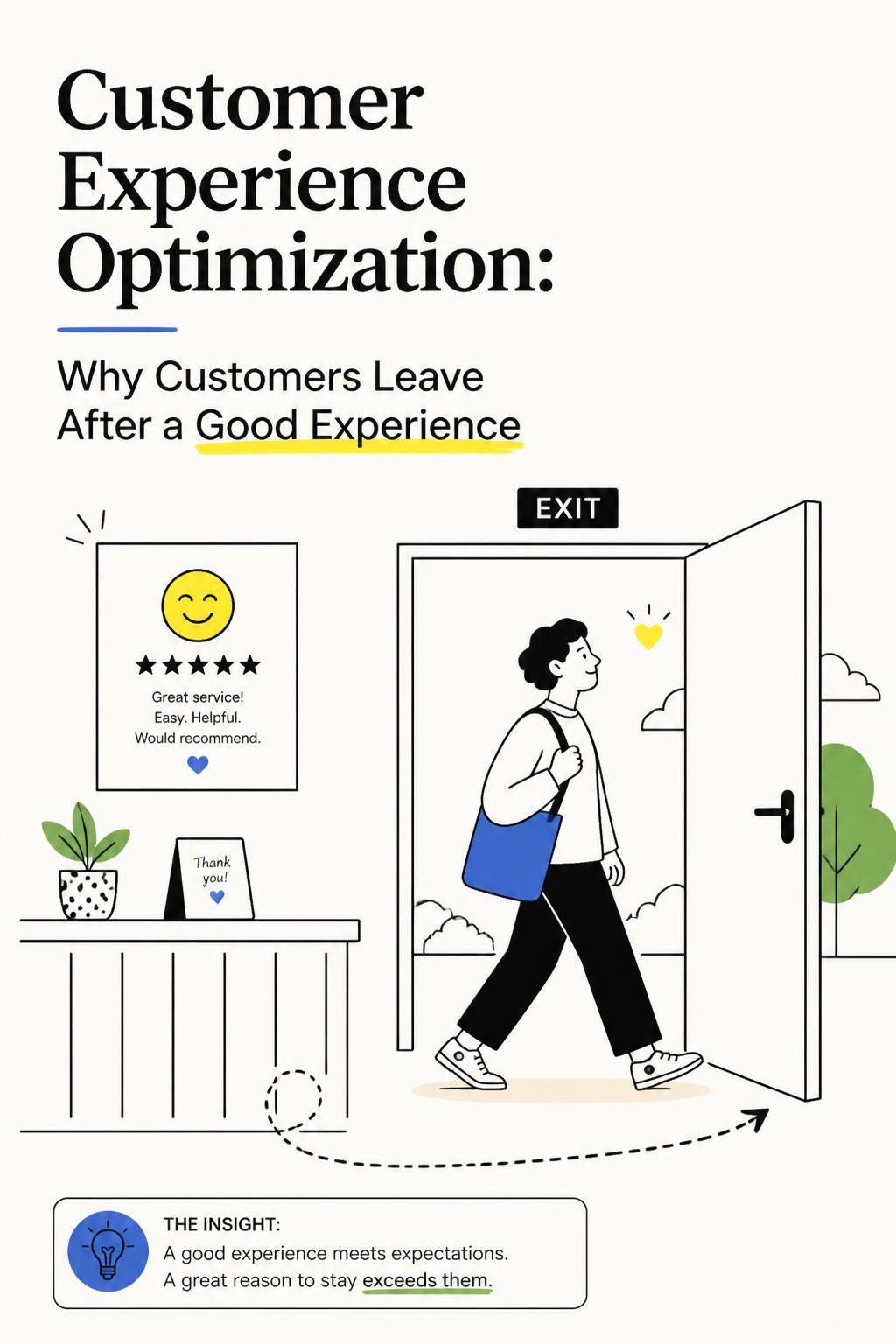
Your customer experience dashboard can look healthy while customers are actively deciding to leave. That is the mistake I see most often: a team sees a respectable NPS, stable CSAT, and a slightly improved conversion rate, then assumes its customer experience optimization work is paying off. Meanwhile, customers are opening support tickets after failed payments, delaying activation because setup feels risky, or silently choosing a competitor after one confusing renewal notice.
The problem is not that companies lack customer feedback. The problem is that they confuse completed tasks with customer confidence. A customer can finish onboarding and still believe the product is fragile. They can place an order and still feel misled about delivery. They can give a support agent a positive survey score and still decide they do not want to need support again.
Real customer experience optimization is not the pursuit of smoother screens or higher averages. It is the disciplined work of finding the few moments where effort, uncertainty, and perceived risk combine—and fixing those moments before they become churn, lost expansion, and damaged trust.
Why Most Customer Experience Optimization Programs Underperform
The standard approach sounds sensible: build a journey map, track NPS and CSAT, review support tickets, identify pain points, and prioritize improvements. The flaw is that this process often turns experience into a collection of disconnected touchpoints. Customers do not experience your company that way.
They experience a promise and then judge whether you kept it. Marketing says implementation is easy. The onboarding flow asks for technical permissions they do not understand. A sales representative says pricing is predictable. The first invoice includes a charge the buyer did not expect. To the customer, this is one experience: “They made this sound easier than it is.”
Three common customer experience optimization methods consistently fail because they obscure that judgment.
- Optimizing average survey scores: Average NPS and CSAT conceal the customers who matter most. A 4.3 out of 5 support score is not reassuring if new customers, high-value accounts, or customers at renewal are disproportionately represented among the unhappy minority.
- Treating funnel drop-off as an explanation: Analytics can show that 18% of customers abandon a billing page. It cannot tell you whether they distrust the total, need internal approval, cannot find their preferred payment method, or fear they will be locked into a contract.
- Fixing visible friction first: Teams remove steps, shorten forms, and simplify interfaces because these changes are easy to ship. But the customer may not need fewer clicks. They may need reassurance that an action is safe, reversible, or worth the effort.
The result is local optimization: a cleaner interface, a slightly faster workflow, and little change to the commercial outcome. The teams that improve retention do something harder. They study the decision customers are making at the moment friction appears.
The Better Standard: Optimize for Customer Confidence
Effort matters, but effort alone is a weak definition of experience. Customers will accept a demanding process if they understand why it matters, can see progress, and trust the outcome. They will abandon a technically simple process if they feel exposed or uncertain.
Think about a B2B customer connecting a data source to an analytics platform. The setup may require only three steps and eight minutes. Yet the customer may hesitate because they do not know which data will be shared, whether they can undo the connection, or when reports will be available. The effort is low. The confidence requirement is high.
In customer experience optimization, I use a simple confidence test for every consequential journey moment:
- Predictability: Does the customer understand what will happen next, including timing, cost, and consequence?
- Progress: Can the customer tell whether they are moving toward a useful outcome?
- Recoverability: If something goes wrong, can the customer fix it without starting over, contacting support, or fearing irreversible damage?
When one of these conditions is missing, customers slow down. When two are missing, they look for help or a workaround. When all three are missing, they often abandon the journey while giving you almost no usable explanation.
Find Commitment Moments, Not Every Pain Point
One of the most expensive mistakes in CX is treating every point of friction as equally important. It is not. Some friction is harmless. A customer may tolerate a 20-second delay while exporting a report they run once a quarter. They will not tolerate ambiguity when accepting a price increase, publishing information to their team, or submitting a claim.
The moments that deserve disproportionate attention are commitment moments: points where customers invest money, time, trust, personal credibility, or internal political capital. These are where an experience becomes memorable enough to influence loyalty.
Common commitment moments include first value, account verification, pricing selection, data migration, payment failure, delivery disruption, returns, support escalation, renewal, and cancellation. The right question is not “Where is the journey annoying?” It is “Where could a customer reasonably conclude that choosing us was a mistake?”
In one enterprise software study I led, the product team believed low setup completion was a usability problem. We recruited administrators who had begun configuration but had not launched. The team expected complaints about technical complexity. Instead, administrators repeatedly described a professional risk: one configuration step could notify hundreds of employees before the internal rollout team was ready. The interface was not the main issue. The customer feared looking careless in front of colleagues.
We recommended a private setup state, a visible launch checkpoint, and clear language explaining when notifications would be sent. Completion improved because the product reduced organizational risk, not because it eliminated fields. That distinction is the difference between surface-level UX cleanup and meaningful customer experience optimization.
Use Behavioral Data to Locate the “Why” Gap
Product and customer analytics are essential, but they are strongest when used as a trigger for research rather than a substitute for it. Metrics can identify a behavioral anomaly. They cannot reliably explain the human interpretation behind it.
Start by defining the gap in observable terms. Avoid broad statements such as “onboarding is confusing.” Use a statement that connects a journey behavior to a business consequence: “Accounts that do not invite three teammates within seven days renew at half the rate of accounts that do.” Now you know what to investigate.
Then segment customers by circumstance, not generic persona labels. For a stalled onboarding flow, recruit people who completed quickly, paused and returned, abandoned, contacted support, and succeeded through a workaround. This produces much sharper insight than interviewing a broad category such as “small-business owners.” The critical difference may be urgency, technical confidence, approval requirements, or fear of making an irreversible change.
I worked on a subscription experience where cancellation data pointed to price as the leading reason for churn. But event-triggered interviews revealed a more useful story. Customers were not necessarily objecting to the price. They were angry that an annual renewal charge appeared before they had received a clear reminder and a simple way to evaluate whether they had used the service enough to justify it. The metric said “price.” The experience mechanism was “loss of control.” Those are radically different problems.
Research-grade AI-moderated interviews are especially valuable at this stage because they can reach customers while the experience is fresh. Usercall enables teams to trigger user intercepts at key product analytics moments—after abandonment, repeated errors, downgrade behavior, or a support interaction—and uncover the why behind the metric. Its AI-native qualitative analysis and deep researcher controls let researchers probe for expectations, perceived risk, workarounds, and decision criteria rather than collecting another shallow open-text response.
A Practical Customer Experience Optimization Workflow
The strongest programs create a repeatable connection between behavioral data, qualitative evidence, and product decisions. Use this five-step workflow.
- Choose one business-critical behavior: Focus on activation, repeat purchase, self-service resolution, expansion, renewal, or recovery from failure. Do not begin with an abstract goal to “improve the journey.”
- Identify the moment of highest uncertainty: Look for retries, backtracking, long pauses, support contacts, repeat visits, or a mismatch between task completion and downstream retention.
- Interview customers immediately after the event: Ask what they expected, what they believed was happening, what they considered doing next, and what they feared would happen if they continued.
- Write findings as mechanisms, not quotes: Replace “customers found this confusing” with “customers interpret the missing confirmation as evidence that their request was not submitted, so they submit duplicates or contact support.”
- Test the smallest credible intervention: Add clarity, a progress signal, a safer default, a preview, or a recovery path before building a major feature. Measure behavior, confidence, and downstream business impact.
This workflow prevents a common failure mode: teams treating every customer comment as a feature request. Most comments are evidence of a deeper need. “I need a dashboard” may mean “I cannot tell whether my team is using the product.” “I want more notifications” may mean “I do not trust that important events will reach me.” Solve the underlying uncertainty, and you often avoid unnecessary complexity.
Design Recovery as Carefully as Prevention
Perfect customer journeys do not exist. Payments fail, inventory changes, integrations break, and users make mistakes. Yet many companies devote nearly all their design energy to prevention and treat recovery as an edge case. Customers see it differently: recovery is the moment they learn whether your company is dependable under pressure.
A credible recovery experience does four things. It acknowledges the issue in plain language, explains what happened without blaming the customer, sets a realistic expectation for what happens next, and gives the customer a meaningful action or status signal.
In a study for a subscription business, customers whose payment failed were less frustrated by the failure itself than by the vague instruction to “update billing information.” Many had already done so. They did not know whether the system would retry the charge, whether service would stop, or whether they needed to act immediately. A redesigned flow showed the retry date, offered an alternate payment method, confirmed continued access, and explained the next step. Support volume fell, but the more important change was qualitative: customers stopped describing the brand as unreliable.
Measure Whether You Improved the Relationship, Not Just the Screen
Every customer experience optimization initiative should be measured at three levels. First, assess immediate behavior: completion, successful recovery, activation, or self-service resolution. Second, assess customer interpretation: clarity, confidence, trust, and perceived control. Third, assess the business outcome: reduced contacts, repeat purchase, expansion, retention, or lower churn.
Do not mistake a short-term conversion lift for a healthier customer experience. A forced choice, hidden tradeoff, or aggressive prompt can improve completion today while increasing regret tomorrow. Equally, do not reject a change simply because it adds 30 seconds. If those 30 seconds prevent a costly mistake or make a high-stakes decision feel safe, they can create a far better long-term outcome.
The point of customer experience optimization is not to make every interaction frictionless. It is to make customers feel informed, capable, and protected at the moments where their confidence is on the line. Teams that optimize those moments do not merely earn better survey scores. They earn the far more valuable outcome: customers who have fewer reasons to reconsider the relationship.
Run the week on concept testing: 15 to 30 AI-moderated interviews, with quotes back in 48 to 72 hours.
For a broader look at how optimization fits into a full CX strategy, check out our customer experience CX strategy guide. And if you're tired of high satisfaction scores masking silent churn, Usercall helps you dig into the qualitative 'why' behind your numbers.
Related: Concept testing questions · Concept testing research · CPG packaging · Concept testing examples
Related: why your CX dashboard isn't showing you the real retention drivers · a retention-focused CX framework that replaces guesswork · the AI mistake most CX teams are making