
Interviews and Focus Groups: How to Choose the Right Method Before You Waste Your Research Budget
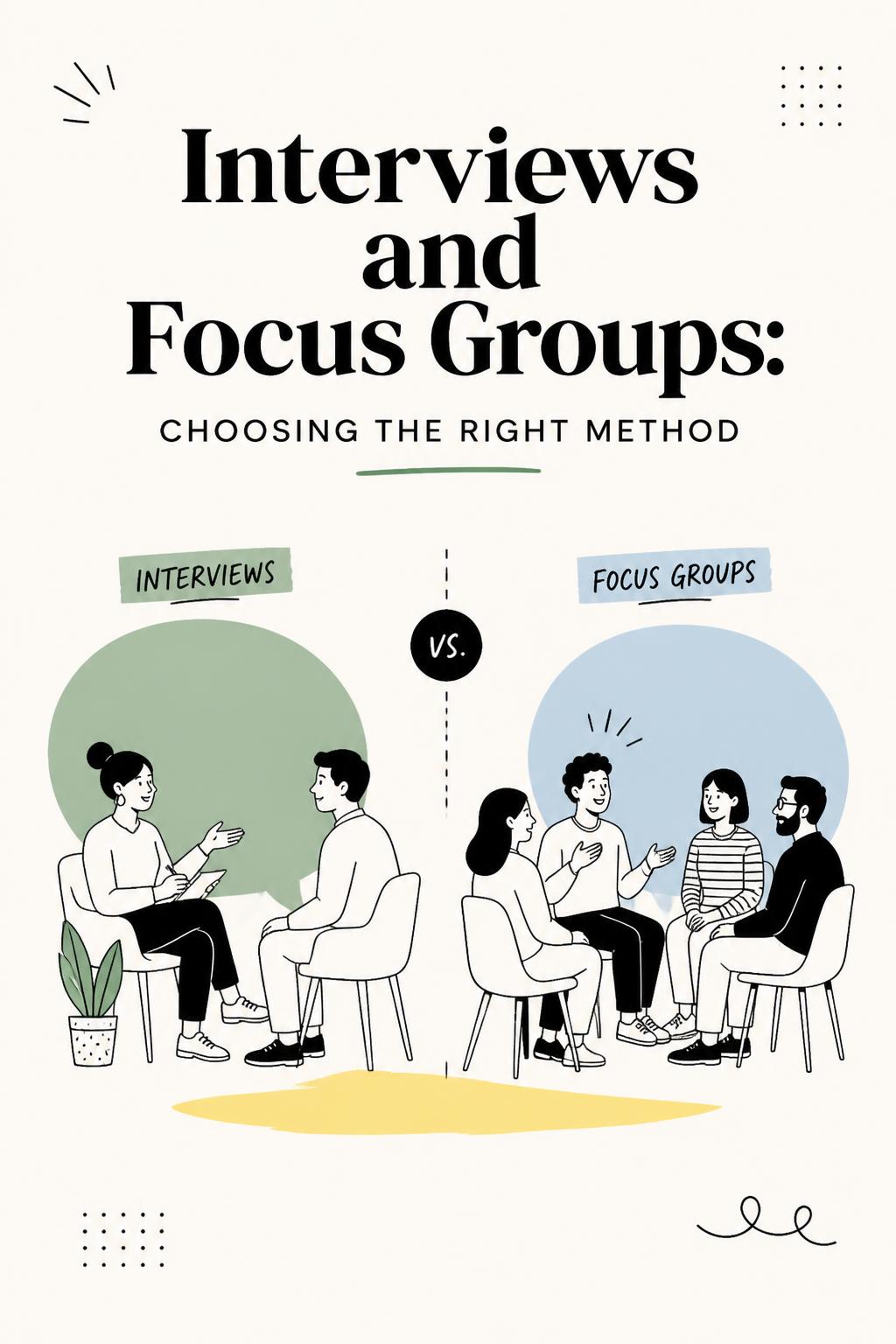
The costliest research mistake is not asking bad questions. It is choosing interviews and focus groups as if they are two ways to collect the same answer. They are not. I have seen a team leave a focus group convinced that users loved an automated money-management feature because everyone nodded along. Three weeks later, one-on-one interviews exposed the real reaction: participants were worried the feature would take money they needed for rent. In the group, nobody wanted to sound financially anxious or less capable than the person speaking first.
That is the central problem with interviews and focus groups: each method changes the evidence you receive. Interviews expose private reasoning, hesitation, workarounds, and inconvenient truths. Focus groups expose shared language, social norms, disagreement, and the way opinions shift in public. Choose the wrong setting and you will not merely get less data. You will get data distorted in exactly the direction that makes a confident but wrong decision look reasonable.
Interviews and Focus Groups Are Not Interchangeable
The standard explanation is that interviews involve one participant and focus groups involve several. Operationally, that is correct. Strategically, it misses the point.
Interviews are for reconstructing an individual decision. They are best when you need to understand what someone did, what constrained them, what they tried first, what they avoided admitting, and why they chose one path over another. They work especially well for complex workflows, sensitive topics, failed product experiences, business purchasing, healthcare, finance, accessibility, and behavior that carries professional or personal risk.
Focus groups are for observing social meaning. They are useful when the interaction between participants is evidence: how people describe a category, which claims invite skepticism, how a brand message lands across different viewpoints, or which cultural assumptions people share. A focus group can show you how consumers collectively interpret “AI-powered,” “premium,” “secure,” or “sustainable.” It cannot reliably tell you how often they would pay for those things or what they do when nobody is watching.
My rule is blunt: if a participant might feel embarrassed, defensive, exposed, or professionally judged, do not put them in a group and expect unfiltered truth. If the way participants challenge, copy, or persuade one another is part of the market behavior you need to understand, do not isolate them in interviews and pretend the social layer does not exist.
The Real Choice: Private Decision Logic or Public Opinion Formation
Before selecting a method, identify the type of uncertainty behind the business decision. Most teams skip this step because “we need customer feedback” feels specific enough. It is not.
- Use interviews when the decision depends on hidden motivations, individual workflows, personal constraints, or the exact sequence behind a behavior.
- Use focus groups when the decision depends on category language, collective interpretation, reactions to disagreement, or social influence.
- Use both in sequence when you first need to uncover the truth of the problem, then test whether the framing of your solution survives public scrutiny.
Consider a product team investigating low adoption of a reporting dashboard. A focus group may produce complaints about visual design, missing filters, or feature requests because those are easy opinions to share. Interviews can reveal the more consequential truth: managers are exporting data to spreadsheets because they do not trust a dashboard they cannot explain to clients. The problem is not a missing chart. It is perceived accountability.
Conversely, if a brand is deciding whether to position a new product as “the modern way to manage your finances,” interviews may produce superficially positive responses from participants who each interpret “modern” differently. A focus group is more valuable here because participants will expose competing meanings. One person may hear convenience; another may hear surveillance; a third may hear something designed for people younger or wealthier than them. That collision tells you whether your message is sharp or merely vague.
Why the Most Common Approaches Fail
The first failure is treating a focus group as six interviews completed at once. This is false economy. In a group, the loudest participant often establishes the language everyone else uses. Quieter participants agree because they are uncertain, polite, or tired of competing for airtime. Others revise their answer after hearing a more articulate explanation. That does not make focus groups useless. It means their value is in watching influence happen—not in treating every spoken opinion as an independent data point.
The second failure is running interviews that are really opinion polls with follow-up questions. Asking “Would you use this?” or “Do you like this concept?” produces polished speculation. People are unusually generous with future behavior because they do not have to pay, switch tools, learn a workflow, or defend the purchase to their manager.
In an interview study I led for a B2B workflow platform, the product team believed its trial users were leaving because the annual contract felt too expensive. We recruited 14 administrators who had started trials but never activated. When we reconstructed the first week of use, pricing barely came up. The actual bottleneck was a data-import step that required approval from an IT colleague. Prospects did not want to ask for access until they were certain the tool was worth buying, but they could not see the tool’s value without importing data. The team had mistaken an activation design flaw for a willingness-to-pay problem.
The third failure is using demographics as the primary recruiting logic. For interviews and focus groups, behavior is usually the stronger segmentation variable. A 32-year-old power user and a 52-year-old power user may have far more in common than two people of the same age who use the product in completely different ways. Recruit for relevant contrast: successful adopters, failed adopters, people using a workaround, customers who switched to a competitor, and people who considered the category but did nothing.
The Decision-Contamination Test
Use this test before you recruit: Would hearing other participants’ answers improve the evidence, or contaminate it?
If hearing other people would reveal meaningful market dynamics, choose a focus group. For example, a consumer app team testing language around AI-generated recommendations may need to see whether participants reassure one another, become suspicious together, or split along familiarity with the category. The group response tells you how trust may form outside the research room.
If hearing others would suppress candor, choose interviews. This is common in enterprise software, money, health, parenting, employee experience, and skill-related tasks. A participant is much less likely to admit, “I do not understand the dashboard,” in front of peers than they are in a well-moderated one-on-one session.
- Write the decision at stake. State what will change if the research is convincing: onboarding, pricing, messaging, roadmap priority, or market segment.
- Name the unknown. Is it about behavior, language, emotional risk, social norms, or response to conflict?
- Identify the distortion you cannot afford. Is the bigger risk groupthink, social desirability, shallow explanation, or isolated interpretation?
- Select the method that reduces that distortion. Do not select the method that is easiest to schedule or looks most persuasive in a presentation.
How to Run Interviews That Produce Decision-Grade Evidence
A good interview is not a conversation about what people think. It is an investigation of what happened. The researcher’s task is to reconstruct the decision chain: trigger, context, action, obstacle, workaround, outcome, and consequence.
Start with a recent event. Ask, “Tell me about the last time you tried to solve this,” rather than, “How do you usually solve this?” Then keep pulling toward specificity. What were they doing immediately before the problem appeared? Who else was involved? What did they search for? Which alternative did they consider? What made them stop?
I once interviewed eight operations managers for a logistics product under a tight ten-day timeline. The client wanted feature prioritization, but we spent the first half of every session mapping the last shipment exception each person handled. The pattern was clear by interview six: managers were not asking for more automation; they wanted a defensible exception trail they could hand to a customer when delivery failed. That shifted the roadmap from automated alerts to clearer event history, assignment records, and exportable incident summaries.
- Ask participants to show artifacts such as browser tabs, spreadsheets, templates, support tickets, or screenshots when possible.
- Probe contradictions directly but respectfully: “You said speed was most important. What made you choose the slower option that time?”
- Separate the user, buyer, approver, and blocker. In B2B research, one participant rarely represents the entire decision.
- Recruit 10 to 15 tightly targeted participants for directional pattern discovery, not false statistical certainty.
How to Run Focus Groups Without Manufacturing Consensus
A weak focus group asks the room for reactions, notices agreement, and calls it a finding. A strong focus group is designed to reveal the limits of agreement.
Begin with private responses. Have participants rank concepts, write down first impressions, or select a message independently before discussion begins. This gives you a baseline before the most confident voice shifts the room. Then introduce discussion and watch what changes. A participant changing their mind is not a problem; it is often the most valuable evidence in the session. The question is what persuaded them.
Keep groups small when the topic is complex. Five or six participants usually produces better depth than eight or ten. Do not mix people with power differences that will silence honesty: managers and direct reports, experts and novices, or customers and prospects with radically different levels of category knowledge.
Focus groups work particularly well for message testing when you ask participants to translate claims into what they believe will actually happen. “Automated savings” may sound attractive until people explain whether they expect spare-change rounding, scheduled transfers, or unexpected withdrawals. Ambiguity can create a high appeal score and a disastrous post-signup experience at the same time.
The Strongest Workflow Uses Both Methods Deliberately
For important product and market decisions, the best answer is often not interviews versus focus groups. It is sequencing them correctly.
Start with interviews to map the private reality of the problem: behaviors, constraints, workarounds, emotional stakes, and decision triggers. Use those findings to create concepts, messages, or prototypes that address real friction rather than imagined needs. Then run focus groups to see how participants interpret that framing together, where language breaks down, and which concerns spread when people hear opposing views.
AI-native qualitative research can make this workflow more practical without flattening the nuance that makes qualitative work valuable. Usercall supports research-grade AI moderated interviews with deep researcher controls, allowing teams to define probes, test segments, trace patterns back to participant context, and maintain a defensible path from synthesis to source evidence. It can also trigger user intercepts at key product analytics moments—after an abandoned setup flow, a failed payment, or a sudden drop in usage—so teams can capture the why behind a metric while the experience is still fresh.
What a Finding Should Look Like
“Users want simplicity” is not a finding. It is a placeholder for more research. A useful finding names the behavior, the context, the underlying belief, and the action required.
New workspace administrators delay setup when they are asked to configure reporting rules before importing data. They interpret the step as permanent and high-risk, so they postpone it until they have more certainty and frequently never return. Make reporting rules editable defaults after first import, not a gate before value is visible.
That is decision-grade evidence. Interviews are usually the best way to uncover its causal chain. Focus groups are usually the best way to test whether the new explanation, interface language, or positioning earns trust in a social setting.
Choose interviews when you need the truth someone would not say in front of others. Choose focus groups when the way people influence one another is the truth. Teams that understand this distinction stop collecting feedback and start producing evidence that changes decisions.
Whichever method you pick, the questions you bring into the room decide whether you get real insight or polite noise. Check out our guide on how to write qualitative research questions for 45+ examples built for interviews, focus groups, and everything in between. Usercall can also help you run structured conversations at scale without losing the depth that makes interviews worth the budget.
Related: user interviews vs focus groups compared head-to-head · how to stop getting polite answers in interviews · semi-structured interviews done right