
Focus Group Research: 7 Mistakes That Produce Polite Lies Instead of Real Insight
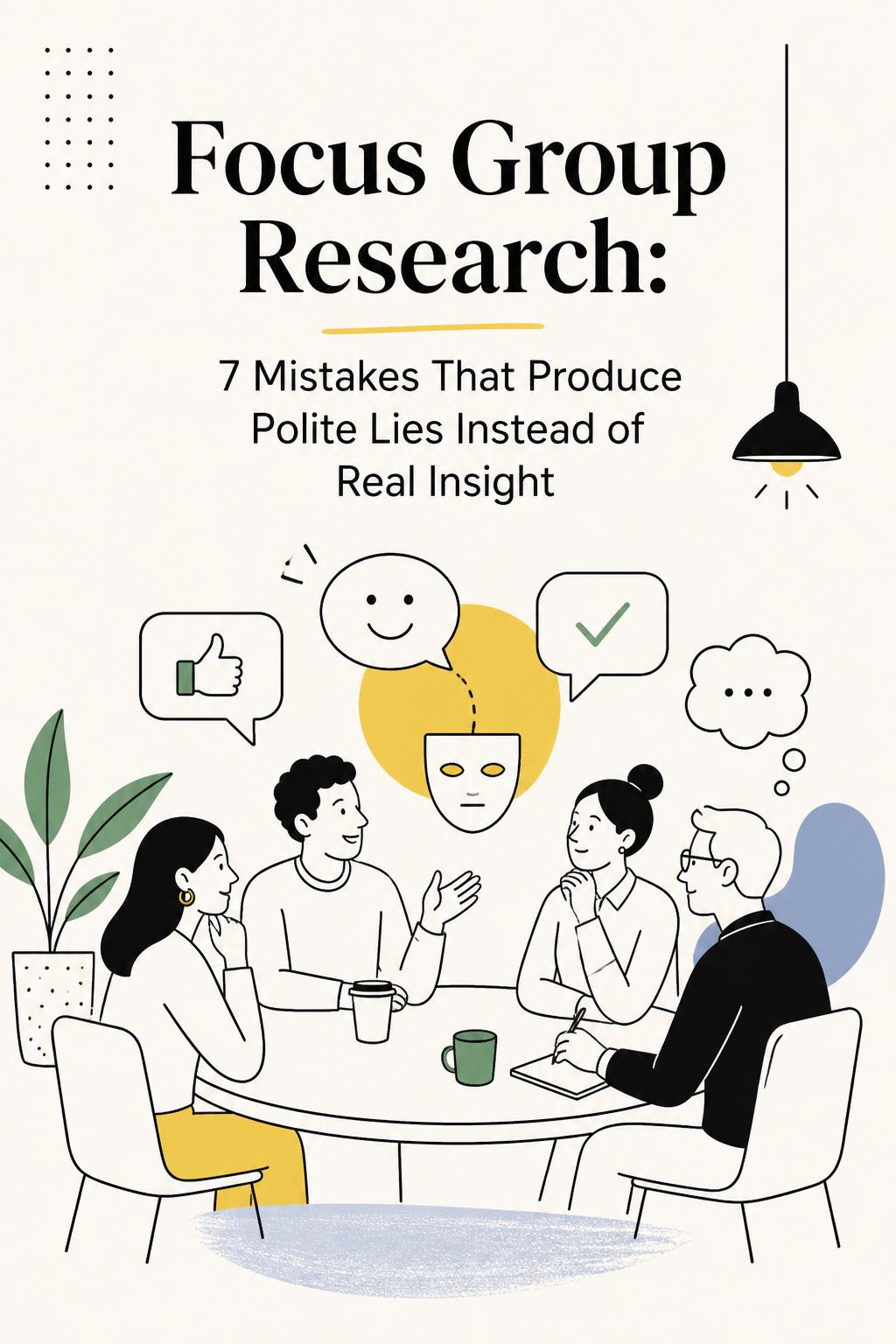
The most dangerous sentence in focus group research is not “I do not know.” It is “I would definitely use that.” I have heard that sentence from participants who, ten minutes later, could not name a realistic moment when they would open the product, abandon their current workaround, or convince a colleague to change with them.
Teams still mistake enthusiastic reactions for evidence because focus groups feel immediate. Eight people nod. A concept gets called “helpful.” Someone asks whether the launch can move forward. But a room full of polite approval is often the beginning of an expensive product mistake, not the end of a research question.
Focus group research can be exceptionally valuable. It can expose hidden social norms, show how customers describe a problem in their own language, and reveal where a product promise breaks under real-world constraints. But it only works when researchers stop using groups as a fast vote on ideas and start using them to examine decisions, tradeoffs, and disagreement.
What Focus Group Research Should Reveal
Focus group research brings a small, carefully recruited group together for a moderated discussion. That is the format. The strategic value is different: it helps researchers see how people react to one another’s experiences, how social expectations shape behavior, and which beliefs hold up when participants compare notes.
This makes focus groups especially useful when the product or service is shaped by shared norms. Consider workplace software, personal finance, health services, education, parenting, beauty, food, travel, or collaborative consumer products. In these categories, people do not make decisions alone. They borrow language from peers, hide certain behaviors, justify tradeoffs, and sometimes follow the most socially acceptable answer rather than their private preference.
A strong focus group does not answer, “Do customers like our concept?” That is a weak question with a predictable outcome: vague praise, feature requests, and a slide full of adjectives. A strong group answers questions such as:
- What event makes this problem urgent enough to change behavior?
- What is the customer doing today, even if that workaround is inefficient?
- Which tradeoff feels unacceptable: time, money, effort, risk, privacy, or loss of control?
- What language do customers use that the product team is currently missing?
- Where do different customer segments disagree, and why?
That is why focus group research belongs early in strategic exploration and later in message, concept, and category testing. It is far less useful as a substitute for usability testing, market sizing, or conversion measurement.
Why Most Focus Groups Produce Polite Lies
Most poor focus groups follow the same script. Recruit broadly. Show the polished concept. Ask participants what they think. Let the conversation flow. Summarize the themes. The process looks efficient, but it creates four serious distortions.
First, the group creates artificial consensus. People rapidly infer what kind of answer is safe. If the first participant calls a feature “great,” the next participant may soften their objection rather than challenge the room. This is especially common when the topic involves competence, career status, money, health, or family decisions.
Second, polished stimuli push participants into reviewer mode. The earlier you show a prototype, the more likely participants are to critique button placement, colors, and feature details. You lose access to the more valuable question: what were they trying to accomplish before your solution entered the conversation?
Third, stated preference is mistaken for future behavior. People can sincerely like an idea and still never adopt it. Habit is powerful. Switching costs are real. New workflows can require a manager’s approval, a partner’s cooperation, data migration, training time, or trust that has not yet been earned.
Fourth, teams turn qualitative discussion into fake statistics. “Six out of eight participants preferred option A” is not a market result. It may mean six people were influenced by the first two speakers. Focus groups are designed to explain patterns, not estimate percentages.
The better approach is not to eliminate group discussion. It is to structure it so participants first reveal independent experiences, then encounter disagreement, then pressure-test the product implication.
The Decision Reconstruction Framework
My preferred focus group research framework is decision reconstruction. Instead of asking participants what they generally think about a category, ask them to walk through one specific recent event. The last time they tried to solve the problem is more valuable than their broad opinion of the problem.
For example, do not ask a group of project managers, “Would you use an AI assistant to keep projects on track?” Ask them to reconstruct the last project that slipped. Who noticed first? What information was missing? Which messages were sent? What did the manager do instead of escalating? What made them hesitate? What happened next?
That reconstruction surfaces the operational reality your product must fit into. It also prevents the team from building for an idealized workflow that does not exist.
- Start with the trigger: Ask what happened immediately before the problem became important.
- Map the context: Identify location, time pressure, people involved, tools available, and constraints.
- Document the existing behavior: Learn what participants actually did first, not what they wish they had done.
- Expose the workaround: Find the spreadsheet, text message, manual check, call, or personal rule keeping the current system alive.
- Identify the tradeoff: Ask what they sacrificed to make the workaround work.
- Find the adoption threshold: Determine what a new solution must prove before it is worth changing behavior.
Several years ago, I moderated a group for a B2B operations platform. The product team wanted validation for automated approval routing. Every participant initially endorsed it. When I asked them to reconstruct the most recent delayed approval, the pattern changed. Their biggest frustration was not routing; it was uncertainty about who owned the next action once an approval stalled. Automation could move work faster, but it could also hide accountability. The team shifted the roadmap from automatic routing alone to visible ownership, aging alerts, and clear escalation paths. That was not a feature preference. It was a requirement for trust.
Recruit for Behavior, Not Demographics
Recruitment is where focus group research often becomes generic. “Adults aged 25 to 44 who shop online” is not a meaningful research segment for most product decisions. It describes a market, not a decision context.
Recruit around recent behavior and meaningful contrast. For a subscription product, separate recent cancellers from people who considered cancelling but stayed. For a collaboration tool, separate teams that adopted it quickly from teams that abandoned it after setup. For a financial product, separate people who actively track spending from those who avoid looking at it.
These contrasts are more valuable than broad demographic variety because they reveal competing explanations. One segment may reject a product because it lacks value. Another may reject it because the product creates anxiety, exposes them to judgment, or requires too much change at the wrong moment.
- Use a recent behavioral screener window, typically 30 to 90 days, so participants can describe real events in detail.
- Recruit six to eight people per group, but do not treat one group as sufficient evidence for a major decision.
- Keep major power differences out of the same room, including managers and direct reports or clinicians and patients.
- Build groups with shared context and differing strategies, not participants who are identical in every relevant way.
One important tradeoff: more homogeneous groups create faster, clearer discussion, while more varied groups create richer disagreement. For early exploratory research, I usually favor shared context with one deliberate point of contrast. For example, recruit experienced managers who all own the same workflow, but mix those who rely on formal processes with those who rely on informal relationships.
Design a Discussion Guide That Does Not Lead the Witness
A discussion guide should be built backward from the business decision. If the team cannot state what it will do differently based on the findings, the research question is not ready.
Start with behavior before introducing your product, brand, or concept. This sequencing is non-negotiable. Once participants know what you want to build, they start helping you build it. That is generous, but it contaminates discovery.
I use a three-stage structure: past behavior, current workflow, then future stimulus. The first stage establishes what happened. The second identifies the systems, people, and workarounds involved. Only then should the moderator show a concept, prototype, advertisement, or message.
When the stimulus appears, do not ask, “Do you like it?” Ask questions that force the idea into real life: “Where would this appear in your current process?” “What would you stop doing if this worked?” “Who else would need to agree?” “What could make this feel risky?” “What would make you ignore it on a busy day?”
During a consumer health study, a participant told me an appointment-booking flow was “fine.” Rather than move on, I asked her to narrate each step of the last booking attempt. She stopped at insurance verification and admitted she nearly abandoned the process because she did not know whether she would be charged. The problem was not the length of the flow. It was financial uncertainty at a high-anxiety moment. That finding changed both the interface priority and the messaging strategy.
Moderate for Dissent, Not Harmony
Moderators are often praised for making people comfortable. Comfort matters, but harmony is not the goal. A useful focus group makes disagreement safe enough that the team can see where assumptions break.
Start key questions with private written reflection. Give participants one or two minutes to write before anyone speaks. This prevents the first confident voice from setting the answer. Then invite each participant to share briefly before opening the conversation.
When someone says they agree, ask what specifically matches their experience. When someone disagrees, ask what happened that taught them a different lesson. When a participant gives a broad opinion, ask for the last concrete example. The moderator should treat vague approval as a prompt for detail, not a conclusion.
Pay close attention when participants revise an opinion after hearing another person. That moment can reveal a social norm, a missing piece of information, or an assumption the product must address. It is often more meaningful than the final consensus.
Turn Focus Group Data Into Decisions, Not Quote Collections
Do not analyze focus group research by highlighting every repeated word. Repetition can be caused by the moderator’s language, one influential participant, or a phrase that simply sounds agreeable. Instead, examine evidence at three levels: individual stories, group dynamics, and segment differences.
For each participant, capture the situation, behavior, unmet need, barrier, and consequence. At the group level, document where people converged, resisted, or changed their minds. Across groups, look for conditional patterns rather than universal claims.
A decision-ready finding has a structure: For this segment, in this situation, the current experience fails because of this constraint; therefore, the product should change this behavior, message, or workflow. That is far more useful than “Participants want simplicity.”
Research-grade AI can make this analysis faster without stripping away context. Usercall supports AI-native qualitative analysis and AI-moderated interviews with deep researcher controls, helping teams trace themes back to exact evidence, compare segments, identify contradictions, and ask follow-up questions of the data. It can also support targeted user intercepts at key product analytics moments, allowing researchers to understand why users abandon a flow, hesitate at pricing, or fail to activate after sign-up instead of merely reporting the metric.
When Focus Group Research Is the Wrong Method
Focus groups are not the right answer when you need statistical confidence, market sizing, precise preference measurement, or direct observation of complex task behavior. Use surveys to estimate prevalence. Use usability testing to diagnose interaction problems. Use individual interviews for highly sensitive topics. Use product analytics and contextual research when actual behavior matters more than social discussion.
Use focus group research when the question is fundamentally about meaning, language, shared norms, competing mental models, or reactions to tradeoffs. The method is powerful precisely because participants influence one another. Treat that influence as data to investigate, not noise to ignore.
The best focus groups do not give product teams a comforting answer. They give them a sharper problem, a clearer adoption threshold, and a more honest view of what customers will have to change. That is the kind of insight worth putting on a roadmap.
These seven mistakes are just the starting point — for a complete breakdown of why focus group research keeps letting teams down, and what actually replaces it, see the pillar guide: Focus Group Research: Why It Keeps Failing Teams. If you're ready to move past polite lies toward decision-grade insight, Usercall can help you run interviews that actually hold up under scrutiny.
Related: why moderators are often the real problem · recruitment mistakes that ruin your results · how to run a session that produces real insight