
Focus Group Moderator: The Difference Between Real Insight and a Room Full of Polite Nods
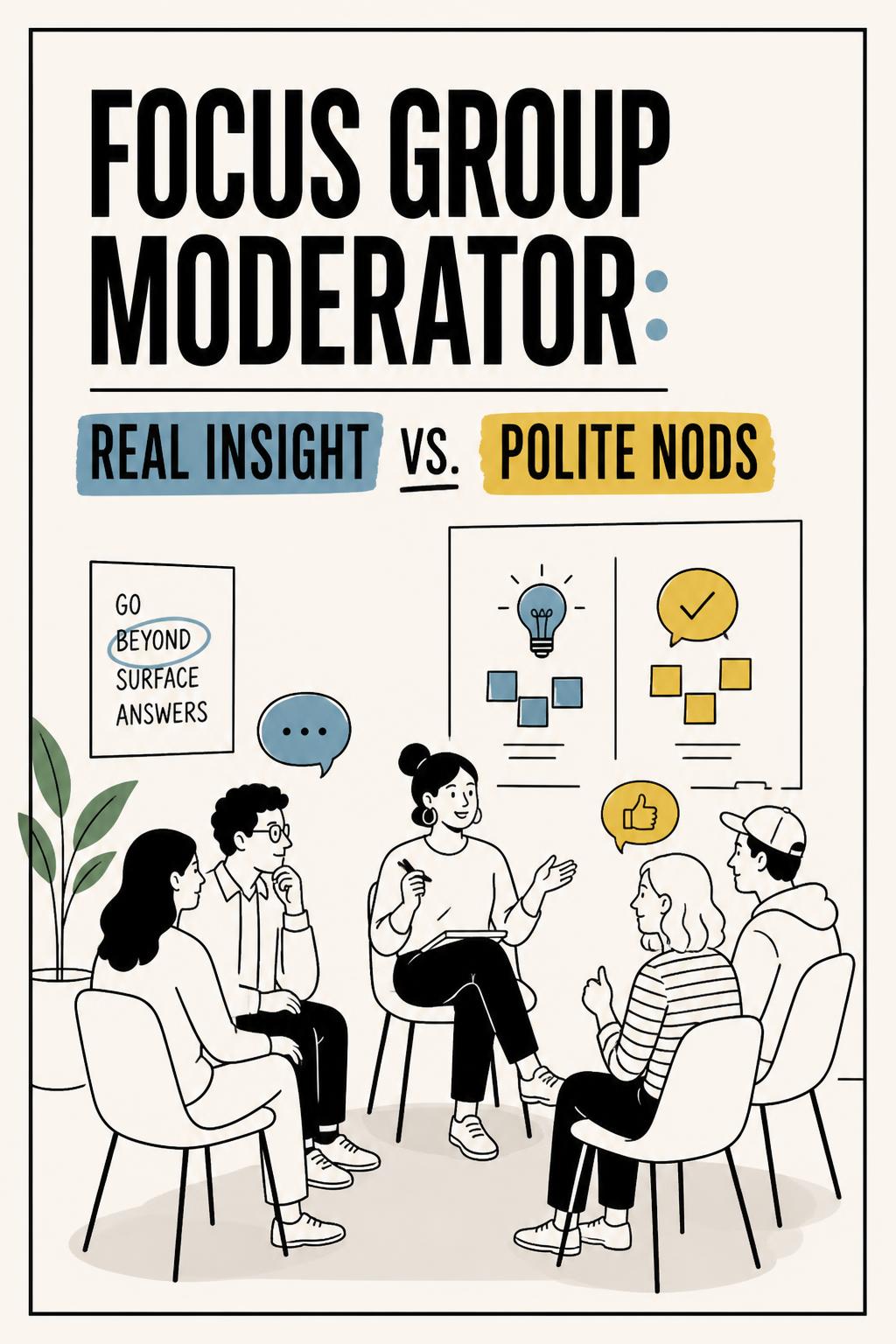
The most expensive sentence in focus group research is everyone liked it. I have heard it in observer rooms after a team spends $40,000 on recruitment, incentives, facility fees, prototypes, and analysis. Then, six weeks later, the same concept underperforms because participants were not describing what they would do. They were being agreeable in a room full of strangers, responding to a polished stimulus, and trying to sound reasonable. A focus group moderator who treats that reaction as validation has not found insight. They have staged a polite consensus.
That is the uncomfortable truth about focus groups: the format naturally produces social pressure, hindsight, and broad opinions. The job of a focus group moderator is to work against those forces. Not by making participants defensive or interrogating them, but by turning vague reactions into evidence about real situations, real tradeoffs, and real behavior.
I take a strong position here: a moderator is not a host with a discussion guide. A host makes the conversation pleasant. An expert moderator makes the evidence trustworthy enough to influence a product, pricing, positioning, or customer-experience decision.
What a Focus Group Moderator Actually Does
A focus group moderator designs and leads group discussions to understand how people interpret a product, problem, message, experience, or category. But that job description misses the difficult part. The moderator is managing a small, temporary social system in which one confident participant can shape every answer, a brand fan can make criticism feel impolite, and a visible stakeholder can turn customers into unpaid consultants.
Strong moderation requires three distinct forms of control. First, control of the conversation: who speaks, what gets explored, and when the group moves on. Second, control of the evidence: whether a claim is an actual experience, a prediction, a preference, or a post-rationalized explanation. Third, control of researcher bias: whether the moderator is accidentally rewarding answers that support the team’s favorite theory.
The goal is not consensus. In fact, rapid consensus is often a warning sign. When eight people immediately agree that a feature is useful, the moderator should be asking what problem it solves, when that problem last occurred, what participants do today, and what they would sacrifice to get the proposed benefit. If the answer disappears under those questions, the apparent agreement was never decision-grade evidence.
Why Common Focus Group Moderation Approaches Fail
The standard discussion guide usually looks disciplined: introductions, warm-up, category perceptions, concept reactions, rankings, and closing thoughts. It is also built to collect opinions at speed. That is why so many focus group reports contain polished but weak findings such as participants value convenience or users want a simpler experience.
These findings fail because they are too far from the decision context. Nearly everyone values convenience. The useful research question is whether a specific customer will trade control, privacy, money, or time to receive it at a particular moment.
Another common mistake is showing concepts too early. Once participants see an advertisement, prototype, or message, they become critics. They start evaluating typography, colors, wording, and imagined features. Yet real customers do not encounter a product as critics sitting in a research facility. They encounter it while rushing through a workflow, comparing alternatives, trying to avoid risk, or explaining a decision to someone else.
In one study I moderated for a payroll software company, the internal team wanted to test three new dashboard directions. We had 90 minutes, two prototypes, and a stakeholder room determined to choose a visual winner. I refused to begin with the screens. Instead, we spent the first 25 minutes reconstructing the last payroll error each participant had dealt with. The dominant problem was not dashboard comprehension. It was the fear of submitting incorrect payroll with no easy way to verify exceptions. The winning direction was the one that made errors visible before approval, not the one participants initially described as the most modern.
The Evidence Ladder: How to Move Beyond Stated Preference
When participants say I would use that, inexperienced moderators often record a positive reaction and move on. A better moderator hears a hypothesis that needs testing. The most practical way to test it is to move answers through an evidence ladder.
Start with preference: what do they say they like, dislike, or want? Then ask for their stated reason. Next, move to context: when did they last face the relevant problem, what triggered it, and who else was involved? Finally, get to behavior: what did they do, what workaround did they choose, what did it cost, and what stopped them from choosing a better option?
This sequence matters because people are excellent at explaining their self-image and far less reliable at reporting routine decisions from memory. A participant may say they want an all-in-one travel-planning app because it saves time. Ask about their most recent trip, however, and you may find they used five tools because they wanted separate control over price alerts, restaurant research, and itinerary sharing. The insight is not that they want simplicity. It is that they will tolerate fragmented tools when consolidation removes control they care about.
That is a product tradeoff a team can design for. The broad claim that users value simplicity is not.
A Better Focus Group Moderator Workflow
Good moderation begins before recruitment and continues after the session. The following workflow prevents a focus group from becoming an expensive collection of quotes.
- Start with one decision, not a broad learning goal. Define what the team must decide after the research. For example: Should the new onboarding lead with faster setup, better reporting, or lower operational risk?
- Map the competing explanations. If activation is low, do not assume users are confused. List credible alternatives: unclear value, poor timing, missing data, lack of trust, pricing anxiety, or a mismatch between the acquisition promise and product reality.
- Build questions that could disprove each explanation. This stops the discussion guide from becoming a vehicle for internal confirmation bias.
- Collect independent reactions before group discussion. Use private written responses, individual rankings, or silent reflection before inviting conversation. This preserves each participant’s initial view before the loudest person supplies language for the room.
- Analyze contradictions, not just recurring themes. The strongest insight may be the gap between what people claim to value and what their specific stories reveal they do under pressure.
That fourth step is especially important for concept testing. If participants immediately discuss a concept as a group, the first articulate speaker can define what the idea means. Silent reflection for even two minutes gives the moderator a cleaner baseline. The group discussion can then reveal why people differ rather than merely documenting how quickly they aligned.
Questions a Great Focus Group Moderator Uses
The quality of moderation is visible in the follow-up, not the opening question. Broad prompts have a role, but they should create a path toward concrete evidence. When someone says a feature is useful, ask: What would you use it instead of? When someone says a message is clear, ask: What did you think it would let you do? When they say a price feels high, ask: Compared with what are you making that judgment?
My most productive question is often: Tell me about the last time. It cuts through abstract identity claims. Instead of asking a manager how they normally choose analytics software, ask them to reconstruct the most recent purchase: what triggered it, who initiated the search, what nearly killed the deal, what evidence the buyer needed, and what happened after implementation.
A second high-value technique is forced tradeoff. People routinely ask for more control, more personalization, more support, lower prices, and less effort. The moderator’s job is to surface where those desires collide. Ask whether they would accept a longer setup process for more customization, whether they would trade detailed insights for stronger privacy, or whether they would pay more for live support during critical moments. Preferences become useful when participants must choose what they are willing to give up.
How to Manage Group Dynamics Without Flattening the Group
A focus group moderator should not pursue equal speaking time for its own sake. The purpose is not fairness as a performance; it is preventing one participant from corrupting the evidence. The confident expert, habitual complainer, early adopter, and brand loyalist can all be useful participants. They become a problem only when their view becomes the group’s default.
When someone dominates, interrupt calmly and redirect: I want to pause there and see whether that experience was common or different for others. Do not let the participant finish a five-minute speech merely because it feels rude to intervene. Every extra minute they speak reduces the chance that quieter participants will introduce a competing experience.
For quieter participants, avoid saying they have been quiet. That publicly labels them as disengaged and raises the social cost of speaking. Give them a specific entry point instead: Did your experience look more like that, or did it go another way? Contrast questions are easier to answer than an open demand for a polished opinion.
I learned this during a set of groups with small-business owners evaluating a lending experience. One outspoken owner described the application as straightforward, and the room began nodding. When I asked a quieter participant to compare her experience with his, she explained that she had abandoned the application because she could not tell what financial documents were required until halfway through. Three others then reported the same issue. The problem was not that the process was difficult for everyone; it was that uncertainty punished time-poor owners more than experienced operators. That segmentation insight would have disappeared if I had accepted the early consensus.
How AI Changes Moderation and Analysis
AI does not replace the need for an excellent focus group moderator. It can summarize a transcript full of shallow claims, but it cannot recover the questions that were never asked. Poor moderation produces tidy but unreliable synthesis at greater speed.
The valuable role for AI is to make rigorous qualitative work scalable. Research-grade AI-native qualitative analysis can compare themes across sessions, identify contradictions between segments, preserve the original participant language behind a finding, and help researchers trace patterns back to the moments that support them. This is far more useful than producing a generic list of themes with no decision context.
The Real Standard for Focus Group Moderation
A well-moderated focus group should leave stakeholders with fewer convenient assumptions, not more quotes that support them. The moderator’s work is successful when the team can name the customer situation that matters, the tradeoff driving behavior, the segment for whom it is true, and the decision the evidence should change.
Do not judge a focus group moderator by whether the room felt lively or whether every guide question was completed. Judge them by whether they challenged easy agreement, separated aspiration from behavior, and uncovered the detail that makes the next decision harder to get wrong. That is the difference between a room full of polite nods and research that actually moves a business forward.
A skilled moderator is the single biggest lever in focus group quality—but even the best moderator can't fully offset a flawed format. For the bigger picture on where focus groups break down and what to do instead, check out our focus group research guide. Usercall gives every session AI-moderated consistency, so insight quality doesn't depend on who's in the room.
Related: what a focus group facilitator actually fixes · what moderators really cost · how to run a session that produces real insight