
Paid Focus Groups: What They Cost, How to Recruit, and Why Most Waste the Budget
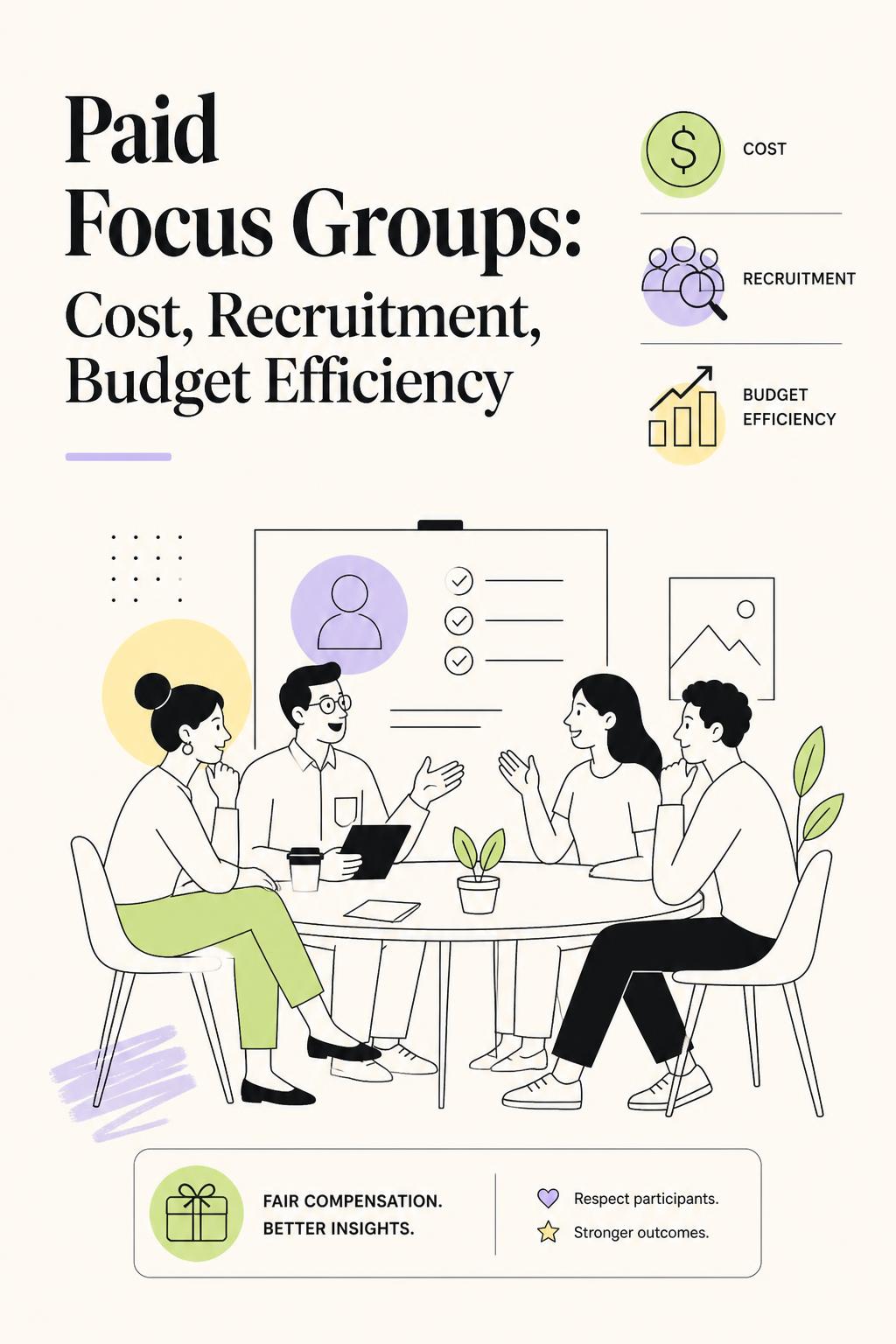
A paid focus group can burn through $8,000 to $25,000 in a day and still leave a team with nothing more useful than: “Customers seem interested.” That is not a participant problem. It is a research design failure. Companies routinely pay to put the wrong people in a room, ask them to predict behavior they cannot predict, and mistake a lively conversation for valid evidence. Then the loudest participant becomes the unofficial voice of the market.
As a qualitative researcher, I have a blunt view: paid focus groups are not a cheap way to validate a product idea. They are a high-leverage method for uncovering the tensions, language, and objections that shape decisions before customers ever reach your funnel. Used for the wrong job, they create polished nonsense. Used with discipline, they expose exactly where a product, message, or workflow will break in the real world.
What Paid Focus Groups Are Actually For
Paid focus groups are moderated discussions with carefully screened participants who receive compensation for their time. The compensation matters because it makes research possible with people who have scarce time, specialized expertise, or demanding jobs. It should never be treated as payment for a favorable opinion.
But the defining feature of a focus group is not the incentive. It is the group dynamic. Participants hear each other, challenge each other, borrow language from each other, and reveal which beliefs are socially reinforced. That makes paid focus groups excellent for questions that individual interviews cannot answer alone.
- How do buyers describe a frustrating problem when they hear peers describe a different workaround?
- Which objections become stronger after participants understand the product concept?
- What language sounds credible to customers versus overly polished, vague, or untrustworthy?
- Where do customer segments fundamentally disagree about what “simple,” “secure,” or “valuable” means?
- Which tradeoffs will customers accept, and which ones trigger immediate resistance?
They are poor tools for estimating demand, selecting a winning feature by vote, proving willingness to pay, or calculating the percentage of customers who hold an opinion. If you need a market-size estimate or a statistically reliable preference, use a properly designed quantitative study. A focus group can tell you why a price feels risky; it cannot tell you with confidence how many people will pay it.
Why Most Paid Focus Groups Produce Weak Insight
The conventional approach fails because it asks groups to do work that groups are structurally bad at. Put eight people together, show them a prototype, run through 25 questions, and end with a ranking exercise: this is the standard agency-friendly format. It also creates predictable distortions.
First, social influence arrives early. One articulate participant frames the discussion, and everyone else responds to that frame. If the first person says, “I would never let AI touch customer data,” the rest of the room often discusses whether that concern is reasonable rather than describing their actual data practices.
Second, people report intentions, not behavior. Participants want to appear thoughtful, price-conscious, security-aware, and rational. Ask how they choose software, and many will describe an ideal evaluation process. Ask them to reconstruct their last purchase decision step by step, and you will hear about rushed deadlines, executive mandates, personal recommendations, and the spreadsheet that nobody updated.
Third, teams overload the guide. They attempt to cover positioning, onboarding, pricing, feature concepts, brand perception, and competitive messaging in 90 minutes. The result is a transcript with many reactions but no depth. A participant cannot meaningfully evaluate a new pricing model when they have not explained how budget approval works in their organization.
I moderated a paid focus group for a B2B analytics company that wanted customers to rank 14 dashboard widgets. The team had already invested months in design. In the first 20 minutes, it became clear that ranking widgets was a distraction: customers did not trust the dashboard because they could not trace a headline number back to its source. We stopped treating the screen as the research object and asked participants to describe the last time they had to defend a metric in front of leadership. The insight was uncomfortable but decisive. The problem was not dashboard customization; it was auditability. The product team removed six planned widgets and prioritized drill-down evidence instead.
Start With a Decision You Are Willing to Change
Before you recruit participants, write the business decision the research must inform. Not a topic. Not a vague goal such as “understand customer needs.” A decision.
For example: “Should we position our new workflow around speed, control, or reduced operational risk for mid-market finance teams?” This forces the research team to distinguish interesting comments from evidence that changes the product or go-to-market direction.
Use the Decision–Tension–Behavior framework to shape the study:
- Decision: State the choice the company must make after the research.
- Tension: Identify the customer tradeoff beneath that choice, such as speed versus confidence, flexibility versus governance, or low cost versus support.
- Behavior: Ask for recent, specific examples of how participants managed that tension in reality.
This framework is a defense against the most common bad question in qualitative research: “Would you use this?” The better question is: “Tell me about the last time this problem happened. What triggered it, what did you try first, who else became involved, and what made the situation difficult?” Specific past behavior is not perfect truth, but it is dramatically more reliable than hypothetical enthusiasm.
How Much Do Paid Focus Groups Cost?
Costs vary sharply based on audience, location, recruiting difficulty, format, and whether participants need to prepare beforehand. A consumer group with broadly available participants may require modest incentives. A group of enterprise software buyers, clinicians, senior IT leaders, or regulated-industry professionals can cost several times more before moderation or analysis is included.
For planning purposes, a 60- to 90-minute consumer focus group often uses incentives in the range of $75 to $200 per person. Specialized B2B participants may require $250 to $600 or more, particularly when they have purchasing authority or must join during working hours. Add recruiting fees, no-show overrecruiting, moderator fees, incentives, technology or facility costs, and synthesis. A realistic remote study with two to four groups commonly lands between $8,000 and $25,000. Highly specialized audiences can exceed that quickly.
The costly mistake is trying to save money through loose screening. When the incentive attracts people who only vaguely match the audience, the research becomes cheaper per participant and vastly more expensive per decision. Pay qualified people fairly, then verify eligibility through real behavior: recent purchase timing, tools used, decision role, workflow complexity, or a specific scenario they can describe without coaching.
Recruit for Meaningful Contrast, Not a Generic Persona
“Small business owners” and “active users” are not recruiting strategies. They are labels broad enough to hide the differences that matter. Strong paid focus groups recruit participants around contrasts that could change your decision.
For example, do not put recent churners and loyal customers in the same discussion. Loyal customers often defend the product; churners often feel pressure to justify leaving. Run separate groups, then compare the underlying logic. Likewise, avoid mixing junior staff with executives when status differences make disagreement risky.
In one subscription-service study, stakeholders wanted to mix customers who renewed with customers who canceled. They believed a mixed group would create “healthy debate.” It created social theater. Renewers defended the value they received, while churners repeatedly explained that they were not simply looking for a discount. Once we separated the groups, the pattern became clear: customers who canceled had experienced a confusing account-setup step in the first week. The issue was not price sensitivity. It was an early trust failure that made every later charge feel unjustified.
Recruit for similarity within each group when psychological safety matters, and recruit for contrast across groups when you need to compare segments. That is how you avoid collecting a blended average opinion that represents nobody.
Build a Discussion Guide That Defeats Groupthink
A useful guide does not begin with your product. Once participants see a concept, they start responding to your framing instead of explaining their own mental model. Start with the real-world context, then introduce only the stimulus needed to test the decision.
- Reconstruct recent behavior: Ask participants to walk through a specific event from trigger to outcome.
- Identify the current workaround: Explore the tools, people, delays, and risks involved in solving the problem today.
- Surface decision criteria: Ask what makes a solution feel safe, worthwhile, and realistic in their environment.
- Show one focused concept: Test a message, workflow, prototype, or pricing structure only after establishing context.
- Probe the failure case: Ask what would stop adoption next week, who would object, and what would have to be true for the idea to fail.
Use private written reactions before open debate for sensitive or polarizing concepts. A two-minute silent exercise can reveal reactions that disappear once participants hear the room’s dominant view. Moderators should also actively invite dissent: “Who thinks this would create more work rather than less?” Fast agreement is rarely a finding. It is usually a signal to probe harder.
Pair Paid Focus Groups With the Evidence They Lack
Focus groups should not carry the full burden of product research. Individual interviews are better for sensitive decisions, complex professional workflows, and organizational politics. Product analytics reveals what users do at scale but cannot explain the fear, misunderstanding, or internal constraint behind a drop-off.
That is where an AI-native qualitative research platform such as Usercall is especially useful. Teams can run AI-moderated interviews with deep researcher controls and place user intercepts at key product analytics moments: after a failed activation step, immediately following a pricing-page exit, or when a customer abandons a workflow. Rather than waiting weeks to convene a group, researchers can capture the “why” while the experience is still fresh, then use focus groups to test whether that tension resonates across a carefully selected segment.
The strongest sequence is simple: use behavioral data to identify the moment, interviews or intercepts to uncover the mechanism, and paid focus groups to examine how customers collectively interpret the problem and the proposed response.
Turn the Discussion Into a Decision
Do not report findings in the order questions were asked. Stakeholders do not need a polished transcript summary. They need a view of what changed, for whom, and what the company should do next.
Evaluate each insight using three filters: prevalence across the relevant segment, intensity of the reaction, and consequence for the business decision. A concern raised by two enterprise buyers may matter more than a preference mentioned by six casual users if it blocks high-value adoption.
Write findings as decision statements, not observations. “New managers respond to control language, not efficiency language, because they fear being blamed for an automated mistake” is actionable. “Participants liked control” is not.
Paid focus groups earn their cost when they break an internal assumption before it becomes a product launch, campaign, or roadmap commitment. Recruit with precision, make disagreement useful, anchor every discussion in real behavior, and never confuse a room full of opinions with proof. That is how paid focus groups become decision-grade research instead of expensive groupthink.
Budgeting correctly for a focus group is worthless if the research design itself produces unreliable insights. Read our pillar post on focus group research to see the underlying reasons teams overspend and still walk away with mush. If you're rethinking how that budget gets spent, Usercall offers a lower-cost, higher-signal alternative built around 1:1 AI-moderated interviews instead of group sessions.
Related: how to get selected for legit paid research studies · what it really costs to hire a moderator · recruitment mistakes that ruin results