
 Table of Contents
The focus group did not fail your product. Your focus group probably did.
I have seen teams leave a session with a wall of enthusiastic quotes, a unanimous preference for Concept B, and complete confidence in their next move—only to watch the launch underperform weeks later. The issue was not that participants lied. They were asked to perform a task humans are famously bad at: predict what they will do in a future situation, in front of strangers, after being shown a polished idea by the people who made it.
That is the central tension behind the focus group. It can be one of the fastest ways to uncover the social beliefs, language, and hidden anxieties shaping a market. Or it can become an expensive room full of polite opinions that validate whatever the team already wanted to build. The difference comes down to one decision: whether you treat the group as a vote on your idea or as a way to study how people make meaning together.
My view as a qualitative researcher is blunt: focus groups are not for proving demand, choosing a winner by applause, or collecting feature requests. They are for exposing the forces that individual interviews and product analytics often miss: social pressure, category myths, status concerns, shared vocabulary, and the objections people only articulate after hearing another person say something uncomfortable.
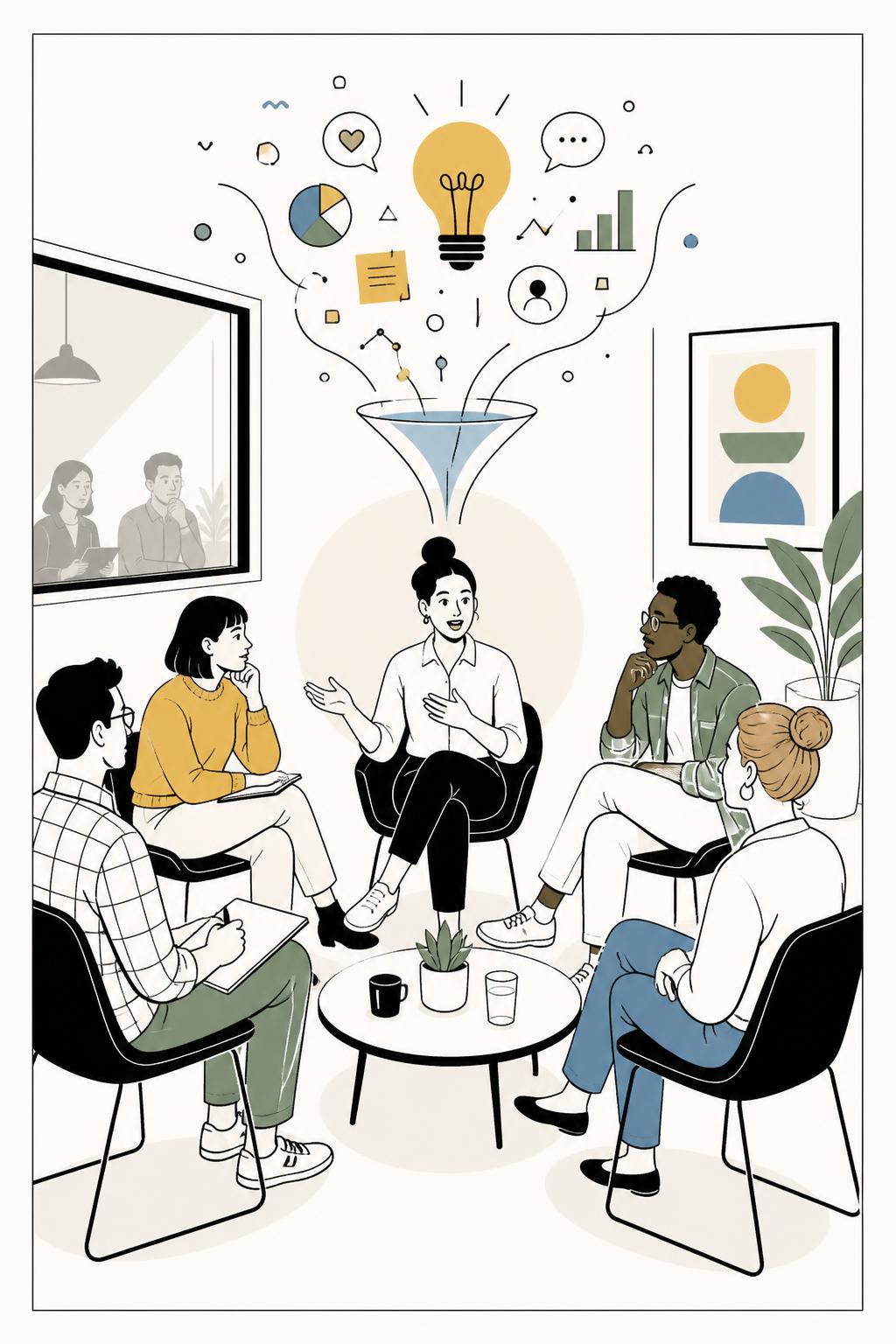
A focus group is a moderated discussion with a small, deliberately recruited set of participants—typically five to eight people—who share relevant experience with a product category, behavior, or decision. The group interaction is not a flaw in the method. It is the source of its value.
People do not make every decision privately. They borrow language from colleagues, compare themselves with peers, avoid choices that make them look uninformed, and follow unwritten norms about what is acceptable. A focus group can reveal those dynamics in real time.
Consider a team developing an AI assistant for managers. In one-to-one interviews, managers may say they want automated meeting summaries. In a group discussion, a different truth can emerge. One participant says the tool would make their team feel monitored. Another argues that the real problem is not note-taking but missed accountability. A third says they would use it only if employees could correct the record. Suddenly, “AI meeting summaries” is no longer the insight. The insight is a three-way tension between efficiency, trust, and authority.
Use the focus group when your research question involves shared interpretation:
The focus group is at its best when you need to understand why an idea means something different to different people, not merely whether they say they like it.
The standard approach fails because it turns a social research method into a presentation review. A team opens with a long explanation of its concept, asks whether participants like it, then collects reactions that sound useful but have almost no predictive power.
There are four reasons this breaks down.
I once moderated research for a B2B software company that wanted to choose between two dashboard directions. The product team had invested heavily in one of them and spent the first 20 minutes explaining why its new navigation model was more flexible. Participants praised the design, then struggled to describe the last time they had needed the dashboard at all. When we moved away from the prototype and reconstructed their actual workflow, the problem became obvious: users did not trust the underlying data enough to make decisions from it. The team was debating navigation while customers were questioning credibility.
That is why reactions are weak evidence. Context is stronger evidence. A researcher should earn the right to show a concept by first understanding the real situation the concept is supposed to improve.
Do not ask participants to act like a product committee. Ask them to help you observe how a category works in their lives and in their social world.
I use a three-layer model to keep focus group discussions grounded:
Take grocery delivery as an example. A superficial focus group finding is, “Customers want lower fees.” A better discussion may reveal that participants perceive delivery fees as a punishment for poor planning, while accepting a slightly more expensive basket because that cost is less visible. That distinction creates entirely different options: change fee framing, make subscriptions feel like planning tools, or surface cost certainty earlier. Cutting prices may be the least strategic response.
The most valuable moments in a focus group are often disagreements. If one participant says a feature feels empowering and another says it feels intrusive, do not rush to identify the majority view. Ask what is different about their work, level of experience, incentives, or risk exposure. You may have found the boundary between two meaningful customer segments.
A focus group is the wrong method when the answer depends on individual behavior rather than social meaning. Do not use it to estimate demand, measure willingness to pay, predict conversion, test detailed usability, or determine whether people can complete a task in a product.
For usability research, group settings are particularly misleading. Participants assist one another, follow the most confident person’s lead, and explain away confusion after they have seen somebody else succeed. If you need to know whether users can find a setting, understand a workflow, or recover from an error, test people individually.
Focus groups also require caution for highly sensitive subjects such as debt, health conditions, job insecurity, harassment, intimate relationships, or personal performance issues. A one-to-one interview gives participants more privacy and creates more room for detail.
The practical rule is simple: if your question is “Can people do this?” observe individuals. If your question is “What does this mean to people, and how do they talk about it with others?” consider the focus group.
Before recruiting anyone, write the decision your research must inform. “Understand customer attitudes” is not useful. “Decide whether to position our platform as a speed tool or a risk-reduction tool for operations leaders” is useful.
Then define what you need to learn to make that decision. You may need evidence about credibility, current alternatives, objections, and how those vary between experienced and first-time buyers. This prevents the session from becoming a broad conversation that produces interesting but unusable material.
Demographic similarity alone does not create a useful group. “Product managers aged 30 to 45” is not a research segment. Recruit around a relevant event, such as product managers who evaluated a customer feedback tool in the past six months, activated a trial, and either adopted it or abandoned it after the first week.
Build common ground within each group, then introduce purposeful contrast. For adoption research, I often separate successful adopters from recent abandoners rather than mixing them together. Each group has a different reference point, and separating them makes it easier to identify what changed the outcome.
Never lead with your concept. Start by reconstructing a recent real-world event. Ask participants to walk through the sequence, including the trigger, alternatives considered, people involved, workarounds used, and outcome.
In a benefits enrollment study I ran with six employees across two mid-sized companies, participants initially asked for “more choice.” But their stories told a different story. They felt overwhelmed by options, worried about making an expensive mistake, and wanted a recommendation they could defend to a partner. The product recommendation was not a broader catalog. It was guided narrowing, plain-language comparison, and reassurance at the commitment point.
When testing a concept, message, or stimulus, give each participant quiet time to write down their reaction before the group speaks. Then ask them to share differences, not just preferences. Questions such as “What assumption is behind that reaction?” and “Who sees the risk differently?” produce much richer evidence than “Do you like it?”
Use activities that force tradeoffs: rank only three benefits, rewrite a message for a colleague, identify what they would remove, or explain what would make them distrust the offer. These activities produce language and priorities; generic discussion produces polished opinions.
The biggest analysis mistake is turning sessions into a generic theme list: customers want simplicity, users value trust, participants need more education. These statements sound reasonable because they are broad enough to be true almost everywhere. They are also too vague to drive action.
Instead, write findings as conditional relationships: For this type of person, in this situation, this belief or friction leads to this behavior.
For example: “For first-time managers preparing for a visible performance conversation, AI-generated summaries feel useful only when they can inspect and correct the source evidence; otherwise, automation increases fear of being wrong.” This finding tells product, design, and marketing teams what must be true for adoption to happen.
AI can speed up this work, but it cannot replace researcher judgment. Usercall is particularly useful for research-grade AI-native qualitative analysis and AI-moderated interviews because it gives researchers deep control over prompts, probes, evidence, and synthesis. After a focus group reveals a critical hypothesis, teams can use AI-moderated follow-ups to test where it holds across a larger set of customers. Usercall can also intercept users at key product-analytics moments—after trial abandonment, repeated feature errors, activation drop-off, or feature non-use—to capture the why behind a metric rather than inventing a story from a dashboard.
The focus group is not dead. The lazy version of it should be.
Run groups when social context affects behavior. Ground every opinion in a recent event. Treat disagreement as data. Recruit around the decision moment, not a vague persona. And do not leave with a vote on your concept; leave with a sharper hypothesis about what people need to believe, fear, or trade off before behavior changes.
That is the real value of the focus group. It does not hand you certainty. It reveals the human logic your product strategy has been ignoring.
This is just one piece of a bigger problem with how teams approach group research. Check out our focus group research guide for the full picture, or try Usercall to get decision-changing insight from real conversations instead of consensus-driven sessions.
Related: the brutal truth about why groups mislead teams · how to actually conduct a focus group that produces insight · comparing interviews vs. focus groups
