
 Table of Contents
A Six Sigma team can cut process time by 30%, hit every SLA, and still lose customers. I have seen it happen: a contact-center team proudly reduced average call handling time from 11 minutes to 8. The dashboard turned green. Yet customers began saying they had to call back because agents ended conversations before the issue was truly resolved. The team had eliminated time from its process, not effort from the customer’s life.
That is the central failure of most Voice of the Customer Six Sigma programs. Teams treat VOC as a preliminary survey, translate a few customer comments into generic requirements, then spend months optimizing internal measures. The math may be flawless. The project logic is not.
Voice of the Customer in Six Sigma should be the mechanism that defines quality from the customer’s point of view. It determines which defects matter, where they occur in the journey, and what improvement customers will actually notice. If VOC is weak, DMAIC does not save the project. It simply makes the wrong solution more efficient.
The usual approach is painfully familiar: send a satisfaction survey, group comments into broad themes, build a CTQ tree, and move into measurement. The problem is that surveys usually capture evaluation after the fact, while process improvement requires an understanding of what happened during a specific task.
A customer who selects “communication” as the reason for dissatisfaction may mean any of the following: they did not receive an update, they received too many contradictory updates, nobody owned the next step, the message used language they could not understand, or the company told them bad news too late. Treating all of those as a single communication defect creates a CTQ so broad that no improvement team can act on it intelligently.
More survey responses do not solve this. A sample of 10,000 shallow answers can be less useful than 15 well-conducted interviews about recent, high-stakes experiences. Quantitative VOC tells you where sentiment or behavior changed. Qualitative VOC reveals why, under what conditions, and what a customer considers an acceptable recovery.
The other common mistake is asking customers to design the solution. “Would you prefer a chatbot or a callback?” is not VOC; it is a constrained internal design question. Customers are better sources of evidence about their goals, anxieties, workarounds, and consequences than they are about the operational fix. Ask them to describe the job they were trying to complete. Your team must do the work of turning that evidence into a measurable requirement.
Customers speak in outcomes. Six Sigma teams need specifications. The gap between those two is where most VOC programs lose the plot.
Take the statement, “I need faster delivery.” A weak team converts it directly into “reduce delivery time.” A stronger team asks what made speed important. Perhaps a contractor cannot schedule installers until materials arrive. Perhaps a buyer has a deadline but would accept a later delivery if the date were trustworthy. Perhaps the item arrived quickly but incomplete, creating more delay than a later complete order would have caused.
Those are different customer needs and demand different CTQs. The real requirement may be delivery certainty, order completeness, proactive exception alerts, or the ability to reschedule without calling support. Cycle time is only one possible driver of quality.
I use a simple rule in VOC research: never convert a customer quote into a metric until you understand the consequence of failure. The consequence exposes the real quality requirement. If a late update causes inconvenience, the solution may be different from a late update that causes a customer to miss payroll, delay treatment, lose a sale, or spend an hour chasing an answer.
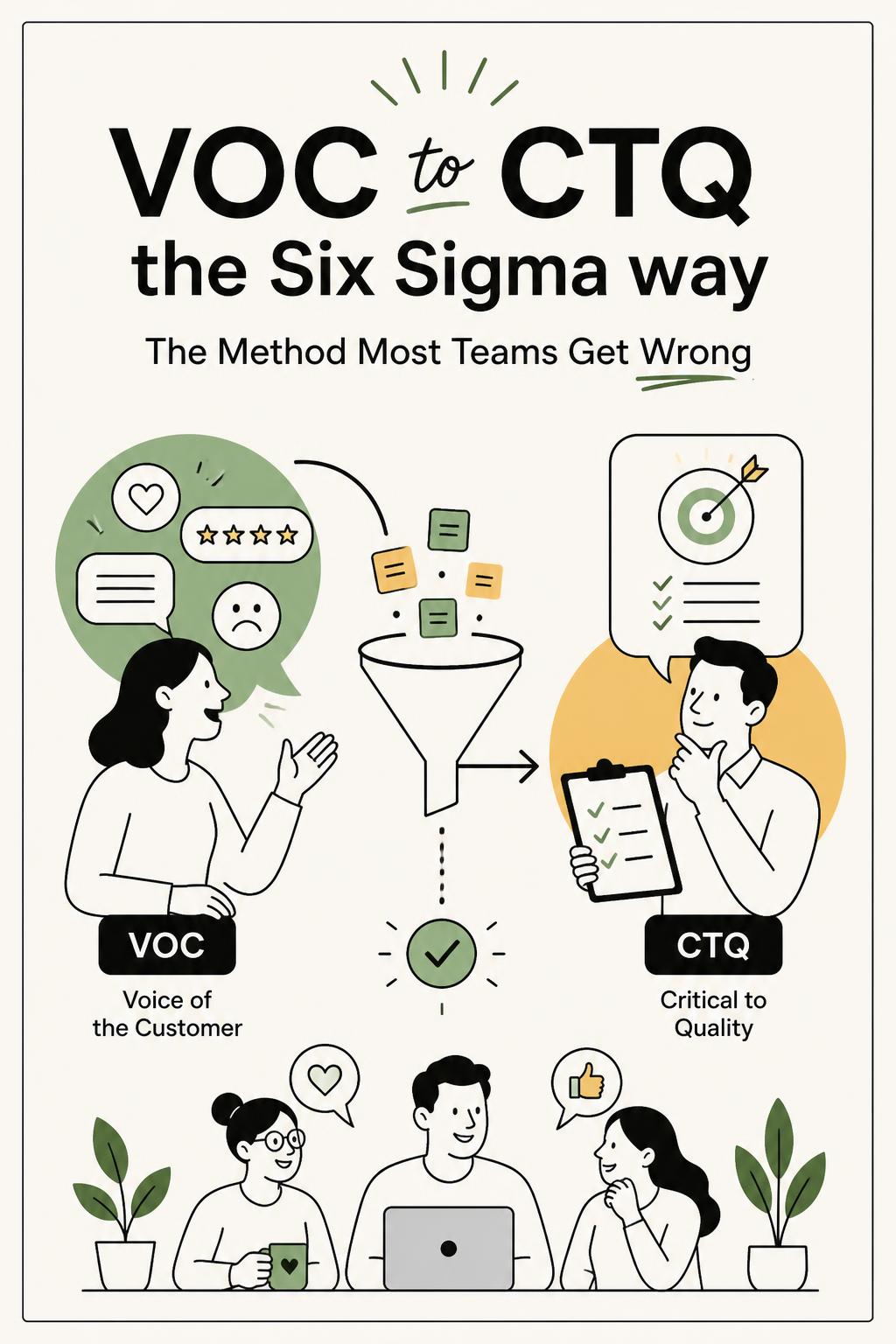
A useful Voice of the Customer Six Sigma process should move from lived customer experience to a testable operational requirement without stripping away context. This workflow is more rigorous than copying survey language into a CTQ tree.
The distinction between a need, a driver, and a specification matters. “Keep me informed” is a need. “Show the request owner and required next action” is a driver. “Update owner and next action within four business hours” is a specification. Skipping the middle layer is how teams create arbitrary CTQs that sound scientific but fail in the real customer journey.
Surveys have a role, but they should not be the only voice in the room. The best VOC programs triangulate what customers say, what they do, and what the operational process records.
Do not organize initial findings by your company’s silos. Coding feedback into “product,” “support,” “shipping,” and “billing” feels tidy but conceals cross-functional failure. Code it around customer outcomes instead: confirm eligibility, avoid a surprise charge, recover from an error, complete a task independently, or get a reliable answer.
In a B2B implementation study I led, leaders assumed poor satisfaction with setup speed was a staffing problem. We had only 12 interview slots and a two-week fieldwork window, so every conversation focused tightly on a recent implementation. Operations managers consistently told us they could tolerate a three-week process; what they could not tolerate was not knowing whether a delay was technical, contractual, or waiting for internal approval. The decisive CTQ was not “implementation completed within 15 days.” It was “customers can see their current implementation stage, owner, blocker, and next action without contacting an account manager.” The organization stopped debating headcount and fixed ownership visibility first.
Frequency is an incomplete prioritization method. It favors high-volume irritations and can bury failures that destroy trust at critical moments. A better Voice of the Customer Six Sigma prioritization model evaluates three factors: consequence, frequency, and recoverability.
I saw this clearly while researching a claims workflow. Only 6% of customers encountered a document-upload failure, so the issue initially ranked below routine call-volume reduction. But customers encountered the error immediately after an accident, often had limited documents available, and could not tell whether the failure put their claim at risk. Recovery required a call and sometimes a full resubmission. The defect was low frequency but high consequence and difficult to recover from. Fixing it reduced repeat contacts more than the broader call-time initiative.
This is why a VOC-backed CTQ should include the situation in which it matters. A four-hour response expectation may be acceptable for a routine account update and unacceptable for a fraud alert. One global target can hide a serious quality failure in the moments customers remember most.
VOC should not vanish once the project charter is approved. Every DMAIC phase needs a customer check.
The most dangerous improvement is one that makes a process look cleaner while moving invisible work onto customers. A self-service flow that lowers support volume is not a win if customers spend 20 minutes searching for an answer and leave without completing the task. Lower contact rate can mean better self-service—or silent abandonment. VOC tells you which one.
Modern teams rarely suffer from too little customer data. They suffer from fragmented evidence: calls in one system, survey comments in another, product events in a third, and customer interviews locked in slide decks. The practical value of AI is not automatic theme generation. It is accelerating the path from messy evidence to a traceable, research-backed decision.
Usercall is designed for research-grade AI-native qualitative analysis and AI-moderated interviews with deep researcher controls. It can help teams investigate patterns across customer conversations while retaining the underlying context that generic summaries often erase. For Six Sigma teams, that means an analyst can move from “customers report communication problems” to the more useful finding: “new enterprise administrators are uncertain about approval ownership after a configuration change, which drives repeat contacts within 24 hours.”
AI is especially powerful when paired with product analytics. Intercept customers after a failed workflow, repeated attempt, abandoned setup, sudden activation decline, or support escalation. Analytics identifies where behavior changed; an interview at that moment reveals why. This creates the evidence needed to build CTQs around actual customer failure modes rather than assumptions.
A VOC program is strong when the team can answer this question without hiding behind vague metrics: what outcome will improve, for which customers, in what situation, and how will we know they noticed?
If the answer is merely “reduce defects,” “increase satisfaction,” or “lower cycle time,” the work is not ready for DMAIC. Those are internal ambitions. The point of Voice of the Customer Six Sigma is to translate real customer consequences into operational discipline—without confusing efficiency with quality. That is how process improvement stops being a dashboard exercise and starts becoming something customers can feel.
