
Research and Focus Groups: The Brutal Truth About Why Most Groups Mislead Teams
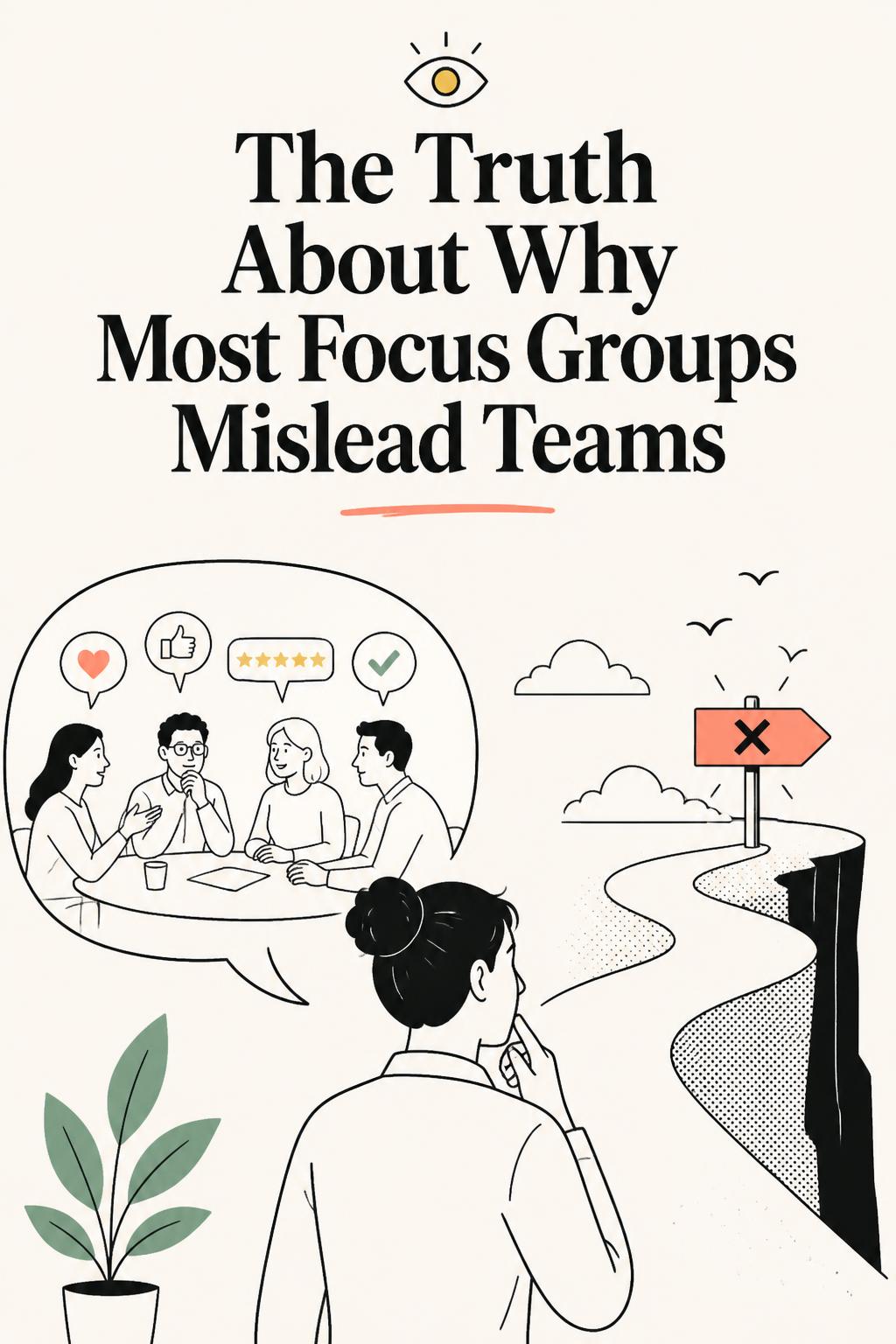
The most dangerous sentence in research and focus groups is: “Everyone liked it.” I have watched product teams treat that line as permission to ship, only to discover six weeks later that nobody changed behavior. Participants were not being deceptive. They were responding to a polished concept, in a room full of strangers, with no budget, no deadline, and no consequence for saying yes. The team had measured social politeness and called it product-market evidence.
My position is simple: focus groups are not a shortcut to truth. They are an amplifier. Used badly, they amplify groupthink, dominant personalities, and shallow opinions. Used well, they amplify the moments that individual interviews can miss: where people challenge each other, reveal unspoken norms, negotiate what sounds credible, and expose the real tradeoffs behind a decision.
That distinction matters for market researchers, UX teams, product managers, and business leaders. A focus group should never answer, “Will people buy this?” It can answer the much more valuable question: “What would need to be true for this to feel worth choosing, defending, and adopting?”
What research and focus groups can—and cannot—tell you
A focus group is a moderated discussion with a small set of participants, typically five to eight people who share a relevant experience, role, or behavior. But defining it that way misses the strategic point. The value is not in collecting eight separate opinions. It is in observing what happens when people hear an idea, react publicly, and respond to someone else’s interpretation.
That makes research and focus groups particularly strong for testing language, positioning, category expectations, packaging logic, and social buying dynamics. If you are deciding whether a product promise sounds like a meaningful advantage or empty marketing, a group can show you how participants interpret the claim in relation to alternatives they already know.
They are much weaker for evaluating task usability, private or sensitive behavior, technical workflows, and demand forecasting. If you need to know whether a participant can find a critical setting in your product, run a usability test. If you need to know whether a healthcare patient feels comfortable disclosing a personal experience, use an individual interview. If you need to predict revenue, use behavioral data, pricing research, and market evidence—not a room of people saying they might buy.
The mistake is treating every research question as if it needs the same format. Focus groups are a specialized method, not a default meeting with customers.
Why most focus group research produces polite fiction
The conventional approach fails because it asks people to do something humans are poor at: accurately predict their future behavior in a hypothetical setting. A moderator presents a concept, asks what participants think, and hears phrases like “I can see myself using that” or “That seems useful.” Those phrases feel encouraging, but they contain almost no decision-grade evidence.
Three common practices create this false confidence.
- Starting with the concept instead of the lived problem. When participants see your idea too early, every later response is contaminated by it. They begin evaluating your framing instead of describing their actual context, workarounds, and constraints.
- Confusing agreement with validation. Fast consensus can mean the group genuinely shares a view. More often, it means one confident participant has supplied an acceptable answer that others can safely adopt.
- Reporting memorable quotes as findings. A vivid quote can be useful evidence, but it is not a conclusion. A conclusion requires a pattern, the conditions under which it appears, the segment it applies to, and the evidence that complicates it.
I once worked on research for a B2B analytics platform where every group told the client they wanted “one dashboard for everything.” The product team interpreted this as a demand for a larger, more comprehensive interface. But when we pressed on the last time participants had struggled with reporting, the real issue surfaced: they were assembling executive updates from five separate systems and feared being challenged on the numbers. They did not want one dashboard to operate their work. They wanted a defensible summary they could take into a leadership meeting. The right response was not more dashboard complexity; it was traceable, executive-ready reporting.
The phrase sounded like a feature request. The underlying tension was a credibility problem.
The better approach: study the decision behind the opinion
Before recruiting a single participant, write down the business decision the research must improve. Not “understand customers better.” That is too vague to design against. Write something operational: “Should we lead our new offer with faster insight generation or stronger research confidence?” Or: “Which onboarding barrier causes experienced users to abandon setup in the first session?”
Then investigate the decision chain, not a preference score. I use a five-part model called Trigger, Tension, Tradeoff, Threshold, and Talk.
- Trigger: What happened recently that made the problem urgent enough to address?
- Tension: What outcome do they want, and what risk are they trying to avoid?
- Tradeoff: What do they have to give up, change, learn, or defend if they choose a new solution?
- Threshold: What proof, capability, price, or internal approval would make the switch feel justified?
- Talk: How would they explain the choice to a manager, colleague, customer, or procurement team?
Consider an AI research analysis feature. “Would you use AI to summarize interviews?” is almost a useless question. A stronger sequence is: “Tell me about the last synthesis project that took longer than expected. Where did the work slow down? What did stakeholders challenge? What would make a summary unsafe to share? What would you need to inspect before trusting it?”
Now you can distinguish between surface enthusiasm and a real adoption threshold. One participant may need speed because they have 20 interviews to analyze before Monday. Another may reject a black-box summary because their credibility depends on showing the raw evidence behind a recommendation. Both may say they want AI, but they need fundamentally different things.
Recruit for behavior, not broad demographics
Recruitment quality determines whether a focus group becomes a meaningful conversation or a collection of generic reactions. Job title, age, geography, and company size are useful filters, but they rarely explain the decision you are studying. Recent behavior does.
Recruit participants based on what they have done: purchased a competing product within the last six months, changed a workflow, abandoned a process, managed a specific problem at least twice recently, or influenced a relevant buying decision. The closer the screening criteria are to observable behavior, the less likely your group is to drift into abstract commentary.
I learned this the hard way during a study of operations leaders for a workflow product. Our first screener asked whether people were responsible for process improvement. It attracted articulate senior leaders who had plenty of opinions but had not personally changed a process in years. We revised the screener to ask for the most recent process change, who resisted it, and what failed in the first two weeks. Nearly one-third of recruits could not answer with specifics. Removing them gave us a far sharper group and uncovered a recurring adoption issue: teams were not rejecting the product; they were failing to assign ownership after initial setup.
Build groups with enough shared context to speak the same language, but enough variation to create useful disagreement. A group of ecommerce leaders may all own conversion, for example, while differing in whether they run experimentation in-house or rely on an agency. That difference can reveal whether your product is solving a software problem, a capability problem, or a coordination problem.
How to moderate without manufacturing consensus
A good moderator does not make the room comfortable at all costs. A good moderator makes disagreement safe. The goal is not a smooth conversation; it is an honest one.
Start with private reflection before public discussion. Ask participants to write their initial reaction to a message, concept, or tradeoff before anybody speaks. Then invite them to share. This simple step reduces anchoring from the first loud voice and gives quieter participants an independent position.
When someone says, “I like it,” do not accept the answer. Ask what they would stop doing, what could make them reject it, and whether they would spend their own budget on it. When the group agrees too quickly, introduce a productive challenge: “Imagine this solution has failed after three months. What most likely caused the failure?”
Strong focus group research does not seek consensus. It maps the conditions under which different people reach different conclusions.
In an enterprise messaging study, I asked participants who in their organization would disagree with their view. That question changed the entire session. Individual contributors loved the promise of automation. Managers worried about quality control. Procurement leaders, mentioned by several participants, would question data handling before they ever discussed features. The client had been preparing one message for “the buyer.” The group revealed three different audiences with three different objections.
Turn discussion into evidence that changes a decision
Do not end focus group research with a transcript, highlight reel, or a slide full of adjectives. Analyze the discussion against the decision chain: triggers, tensions, tradeoffs, thresholds, and the language participants use to justify a choice.
For each apparent theme, ask four questions: Who said this? In what context? What evidence contradicts it? What product, UX, or go-to-market decision should change because of it? This prevents the familiar failure mode where “simplicity” becomes a vague finding. Simplicity might mean fewer clicks for one segment, fewer approval steps for another, or better evidence for a third.
AI can accelerate this work, but generic summaries often flatten the contradictions that matter most. Usercall supports research-grade AI-native qualitative analysis and AI-moderated interviews with deep researcher controls, helping teams trace findings back to source evidence rather than accepting a polished but shallow theme. It can also help teams intercept users at key product analytics moments—after repeated feature abandonment, activation drop-off, or unexpected conversion—and investigate the why behind the metric while the experience is still fresh.
The final output should be a decision statement, not an observation. For example: “Lead with confidence, not speed, for experienced research teams. They value automation only when they can inspect source evidence, challenge interpretations, and defend the findings to stakeholders.” That is specific enough to shape positioning, product requirements, and follow-up research.
The standard your next focus group should meet
Research and focus groups are worth the investment when they expose the social logic behind a decision: what people fear, what they need to justify, whose approval matters, and which tradeoffs they will actually accept. They fail when teams use them to collect compliments for an idea they already want to launch.
Go into the room looking for friction, not approval. Recruit for recent behavior. Start with real experiences before showing concepts. Protect independent views. Analyze contradictions as carefully as consensus. If your research produces less certainty about a weak assumption, that is not a failed focus group. It is exactly what good research is supposed to do.
Groupthink and false demand signals aren't edge cases—they're the default outcome of most focus group setups. For the full breakdown of what actually works instead, check out our focus group research guide. If you want to test alternatives without overhauling your whole research process, Usercall makes it easy to run scalable, one-on-one interviews that avoid the social pressure of a room.
Related: why nods don't equal demand in qualitative research · getting honest insights instead of polite agreement · mistakes that turn insight into groupthink