
Research Participant Recruitment: Why Most Studies Fail Before the First Question Is Asked
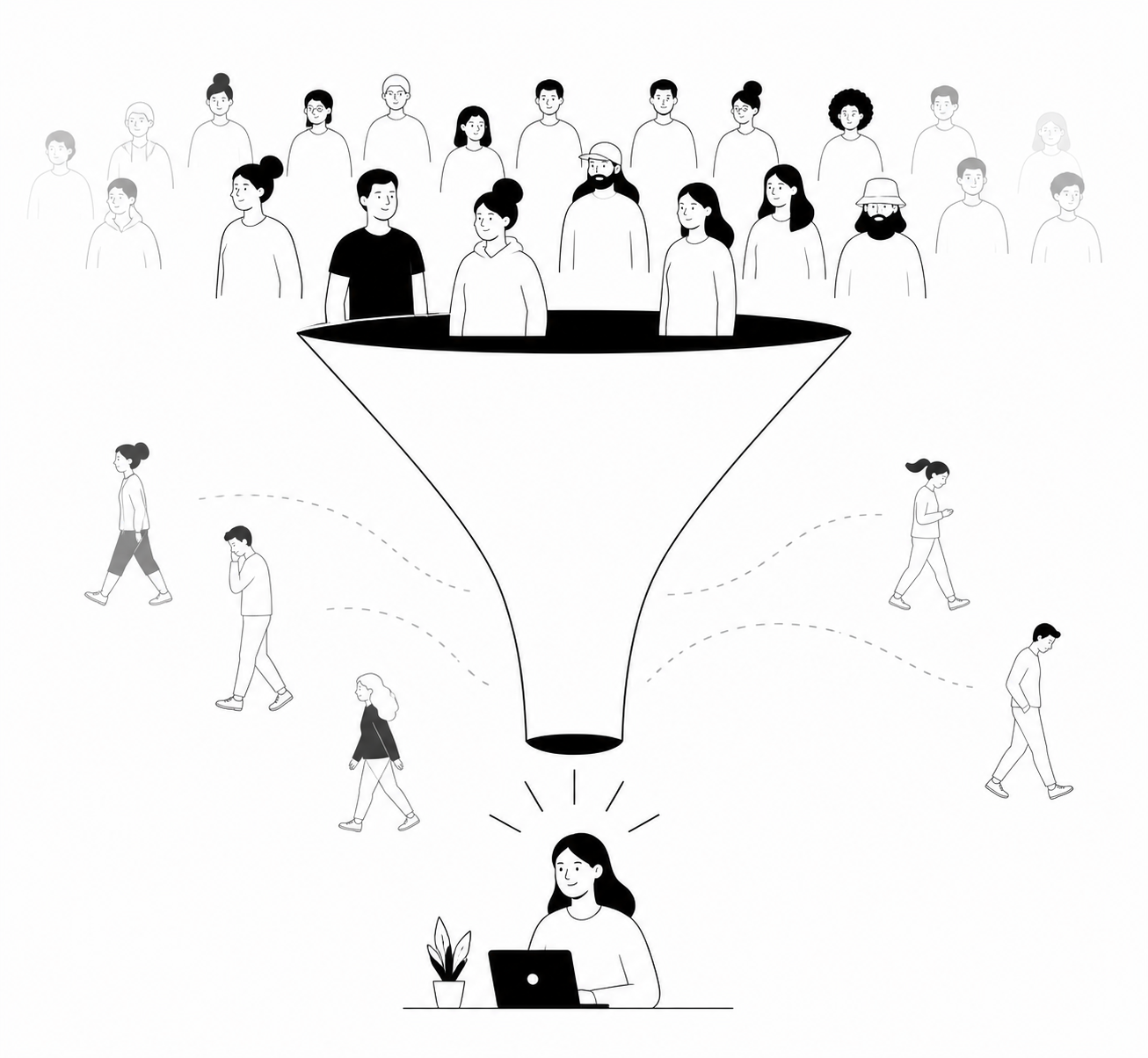
I've run studies where the discussion guide was perfect, the incentive was generous, and the findings were still garbage. Every single time, the problem traced back to the same place: who showed up. You can write the sharpest questions in the world, but if you're talking to the wrong people, or worse, professional survey-takers pretending to be your customers, you're just generating expensive noise.
Participant recruitment is the least glamorous part of research and the part that determines everything else. I've spent a decade watching teams obsess over interview scripts and analysis frameworks while treating recruitment as an afterthought, something you hand off to a panel vendor and forget about. That's backwards. Recruitment is the foundation. Get it wrong and no amount of clever moderation saves you.
The Real Cost of Bad Participant Recruitment
Early in my career I ran a study for a fintech client trying to understand why new users abandoned onboarding. We recruited through a generic panel, screened on basic demographics, and got twelve interviews scheduled in two days. Fast, cheap, easy. Except four of the twelve participants gave answers that felt scripted, oddly polished, contradictory when I pushed on details. Turns out they'd done six other "user interviews" that same week for unrelated products. They weren't lying about being customers, they just weren't representative of anyone real. Their feedback made it into a stakeholder deck before anyone caught it.
That's the quiet failure mode of bad recruitment. It doesn't look broken. The Zoom calls happen, the transcripts get generated, the report gets written. But the insights are built on sand, and you don't find out until a product decision based on that research falls flat in the market.
Professional Respondents and the Fake Panel Problem
The market research industry has a well-documented fraud problem, and it's gotten worse as recruitment has moved online and incentive payouts have gone up. There's an entire underground economy of people who complete surveys and interviews solely for cash, often using fake identities, VPNs, or coached answers to get past screeners repeatedly.
I get asked constantly about specific platforms and whether they're safe to recruit from. I actually wrote a full breakdown on this after digging into one of the more commonly searched names, whether Apex Focus Group is legit, because the volume of confused questions about it told me people don't know how to vet a recruitment source before committing time and budget to it. The short version applies broadly: check for verifiable company information, look at how screeners are structured, and never trust a panel that promises impossibly high response rates. If recruitment feels too easy, it usually is.
The fix isn't paranoia, it's process. Build verification steps into your screener (open-ended questions that are hard to fake), cross-reference participant history if your platform allows it, and treat unusually fast or unusually smooth interviews as a signal to double-check, not celebrate.
Where Everyone Recruits From (and Why It's Not Enough)
Most teams default to one or two well-known panels and call it a day. That works fine for broad consumer studies but falls apart fast when you need niche professionals, B2B decision-makers, or people with specific technical experience. I've had studies where a client needed to talk to healthcare IT administrators, and a general panel simply couldn't produce qualified people, no matter how the screener was worded.
This is why I put together a comparison of Prolific alternatives for teams that need more targeted recruitment than the big general-purpose panels offer. Different platforms specialize in different populations, and knowing which one to reach for saves weeks of frustration.
Recruitment Source TypeBest ForWatch Out ForGeneral consumer panelsBroad demographic studies, quick turnaroundProfessional respondents, shallow answersNiche/professional panelsB2B roles, specific job titles or industriesHigher cost per participant, longer lead timeYour own customer baseProduct feedback, churn research, feature validationRequires internal recruitment ops or automationSocial/community recruitmentHard-to-reach niches, superusers, communitiesSampling bias toward the most engaged users
The mistake I see most often is treating recruitment source as an afterthought rather than a research design decision. Where you recruit from shapes who you talk to just as much as your screener does.
The Recruitment Process, Step by Step
Recruitment isn't just "post a screener and wait." A proper process has distinct stages, and skipping any of them is where quality erodes. I laid out the entire workflow in detail in my complete guide to recruiting participants for research, but the core stages are worth repeating here because so many teams skip straight from "write screener" to "schedule calls" without the steps in between.
That backup channel step matters more than people think. I once had a study where 40% of scheduled participants no-showed because the panel had oversold availability. Without a secondary recruitment path, we'd have missed the deadline entirely.
Find qualified participants for your research
Describe participants to recruit for your research study. You'll get a recruiting plan, screener, and cost/feasibility estimate instantly—then we'll contact you with details on sourcingthe right participants for you.
Recruiting for User Interviews Without Skewing Your Sample
User interviews have a specific recruitment failure mode that's different from surveys: sampling bias baked in by convenience. If you recruit exclusively from your power users, your existing customer list, or people who respond fastest to outreach, you get a skewed picture of your actual user base. I wrote about this in depth in how to recruit user interview participants without skewing your data, because it's one of the most common ways teams unknowingly poison their own findings.
A pattern I see constantly: a PM wants to understand churn, so they pull a list of "customers who churned in the last 90 days" and email everyone. The people who respond are disproportionately the ones who left on relatively good terms and are willing to spend 30 minutes being nice about it. The genuinely angry churned customers, the ones with the most useful feedback, almost never respond to a cold email from the company that failed them. You have to actively design around this, sometimes using third-party recruitment or anonymized incentives to reach the people who wouldn't otherwise talk to you.
Screening for Quality, Not Just Availability
A screener's job is to filter for relevance, not just to confirm someone exists and is free on Tuesday. I've reviewed hundreds of screeners over the years and the same weakness shows up repeatedly: multiple choice questions that are trivially easy to answer correctly by guessing what the "right" answer sounds like.
My approach, detailed in recruiting the right user research participants, is to mix behavioral specificity with open-ended validation. Instead of asking "Do you use project management software?" I ask "Walk me through the last time you assigned a task to a teammate. What tool did you use and what happened after?" A real user answers this in seconds with specific detail. Someone gaming the screener hesitates, gives vague answers, or contradicts themselves two questions later.
I also recommend rotating your screener questions periodically. Professional respondents share notes on paid research communities, and a screener that's been live unchanged for six months has almost certainly been reverse-engineered by frequent flyers looking to qualify for the incentive.
What to Pay Participants (and What They Actually Earn)
Incentive design is where recruitment quality and recruitment speed pull in opposite directions. Pay too little and you only attract people with a lot of free time and low opportunity cost, which skews your sample. Pay too much relative to the market rate and you attract professional respondents chasing the highest-paying gigs, not people who genuinely fit your target profile.
I get a lot of questions from both sides of this: researchers trying to figure out fair pay, and people trying to figure out if paid research is worth their time. On the researcher side, I've broken down actual market rates in my review of Respondent's payouts and pricing structure, which gives a useful benchmark even if you're not using that specific platform. I also built a user interview incentive calculator because "what should I pay" is one of the most common questions I get, and the honest answer depends on session length, participant rarity, and study complexity, not a flat industry number.
On the participant side, if you're curious what the earning potential actually looks like, I wrote a guide on how to participate in paid market research and actually earn $100+ per study. Understanding the participant's incentive is useful for researchers too. If a study is genuinely paying $100+ for 45 minutes, you should expect competition from professional respondents and need a sharper screener to compensate.
Session TypeTypical Fair RangeNotes15-20 min survey/screener follow-up$15 to $25Keep short to protect quality on low pay30-45 min user interview$50 to $100Scale up for hard-to-reach professionals60+ min in-depth or B2B decision-maker$150 to $300+Niche executive roles command premium rates
Building Your Own Research Panel
The single best long-term fix for recruitment headaches is stopping the reliance on rented panels entirely and building your own. A proprietary customer research panel means you're not paying a middleman for access to strangers, you're maintaining a relationship with people who already know and use your product.
I go deep on this in how to build a customer research panel without ending up with bad data, but the short version is this: recruit continuously in small batches rather than in a panic before each study, keep a lightweight CRM of participant history and past engagement, and rotate who you invite so you're not exhausting your most enthusiastic ten customers every quarter. A panel is an asset. Treat it like one and it pays back every time you need to run a study on short notice.
How AI-Moderated Interviews Change the Recruitment Equation
One thing that's shifted recruitment strategy for me over the last couple of years is the ability to run interviews asynchronously and at scale using AI moderation. When you're not bottlenecked by a human moderator's calendar, you can recruit larger, more diverse samples and let people participate whenever it suits them, which itself improves who's willing to show up. It also means you can screen and interview in the same motion, catching quality issues in real time instead of after a wasted 45-minute call.
This is exactly the gap Usercall was built to close. It runs AI-moderated voice interviews that scale past what a human moderator can realistically schedule, while still producing the kind of nuanced, probing conversation you'd expect from a skilled researcher, not a rigid survey. If your recruitment strategy is solid but your bottleneck is actually running enough interviews to get statistically meaningful qualitative signal, that's the problem worth solving next.
If you're tired of chasing panel vendors, second-guessing whether your "customers" are real, and watching good screeners get reverse-engineered by professional respondents, it might be time to rethink the whole pipeline. Usercall lets you recruit smarter, interview at scale with AI moderation, and turn raw conversations into themes linked directly to real quotes, so you're never left wondering whether the insight in front of you is actually true. Give it a look at usercall.co and see what your next study could sound like.