
5 Best Pendo Alternatives in 2026 (Honestly Compared)
product analytics and in-app guidance platform
Pendo is genuinely excellent at showing you which features users click, how far they get through onboarding, and where they drop off, it's one of the best product analytics and in-app guidance tools on the market. The ceiling hits when you're staring at a feature with 12% adoption and Pendo can tell you the number but not the story: not why users skip it, not what they expected instead, not whether the ones who do use it actually find it valuable. This page compares five alternatives, including tools that give you the qualitative layer Pendo was never built to provide.
Usercall at a glance
Usercall is a self-serve AI-moderated interview platform. An AI moderator runs one-to-one voice interviews with real people, and every theme links back to the quotes behind it.
- Real people, AI moderator. Every participant is a real person. Only the interviewer is AI.
- Recruit or bring your own. We can recruit participants for you from a 4M+ panel, or you can bring your own.
- 50+ languages. Every plan includes every language.
- Concept tests. 15-30+ interviews, back in 48 to 72 hours.
Does it tell you WHY, not just WHAT?
Pendo excels at behavioral telemetry, clicks, sessions, funnel drop-offs. What it can't do is explain the intent or reasoning behind those behaviors. The most valuable tools in this list either run qualitative research at scale or synthesize feedback into themes. If an alternative just gives you more dashboards, you're still guessing.
Can it connect behavioral events to open-ended insight?
The real power move is triggering a research study the moment Pendo's data surfaces something interesting, a user who churned, completed onboarding, or ignored a key feature. Look for tools that can act on behavioral signals to ask users follow-up questions automatically, closing the loop between the metric and the meaning.
Does qualitative analysis scale without a research team?
Traditional user interviews and manual thematic coding don't scale. If a tool requires you to schedule sessions, moderate conversations, or spend hours in a spreadsheet tagging quotes, it's not solving Pendo's limitation, it's just adding a different kind of overhead. Look for automation that gets you from raw feedback to actionable themes in minutes, not weeks.
Can it synthesize feedback you already have, not just new data it collects?
You likely have NPS verbatims, app store reviews, support tickets, and sales call notes sitting unused. A genuinely useful Pendo complement should be able to ingest that existing signal and surface patterns across it, not just collect new data. Tools that only analyze what they collect leave half your insight on the table.
Quick verdict
- ⭐ Best overall: Usercall: Find out why your Pendo numbers look the way they do, without scheduling a single interview.
- Best for data-savvy product teams who outgrow…: Mixpanel: Deeper behavioral analytics without the in-app guidance layer.
- Best for ux and product teams who need to…: FullStory: Session replay and behavioral intelligence that shows you exactly what users experience.
- Best for product teams who want fast: Sprig: In-product micro-surveys that capture user sentiment in the moment.
- Best for smaller product teams and growth…: Hotjar: Heatmaps, session recordings, and on-site surveys for understanding user behavior visually.

1. Usercall
⭐ TOP PICKFind out why your Pendo numbers look the way they do, without scheduling a single interview. Self-serve from $89 a month. Your first interview is free. No sales call.
Usercall is an AI-powered user research platform that runs fully autonomous moderated interviews and automatically synthesizes unstructured feedback, interviews, NPS comments, app store reviews, support tickets, into themes, sub-themes, and patterns in minutes. Where Pendo tells you a feature has 12% adoption, Usercall triggers an AI interview the moment a user skips it and gives you the verbatim reasoning at scale, across hundreds of users simultaneously. It's built for product teams, PMs, and UX researchers who need qualitative depth without the manual overhead of traditional research.
- ✓ Pendo shows you who dropped off onboarding. Usercall triggers an AI interview the moment it happens and returns in-depth, open-ended responses from every affected user, no scheduling or researcher required. You go from 'X% completed step 3' to knowing exactly what confused them.
- ✓ Pendo can't synthesize your NPS verbatims, app store reviews, or support tickets into themes. Usercall ingests all of it and auto-codes it into structured patterns with confidence scores, AI summaries, and representative quotes, turning months of unread feedback into a 10-minute read.
2. Mixpanel
Deeper behavioral analytics without the in-app guidance layer.
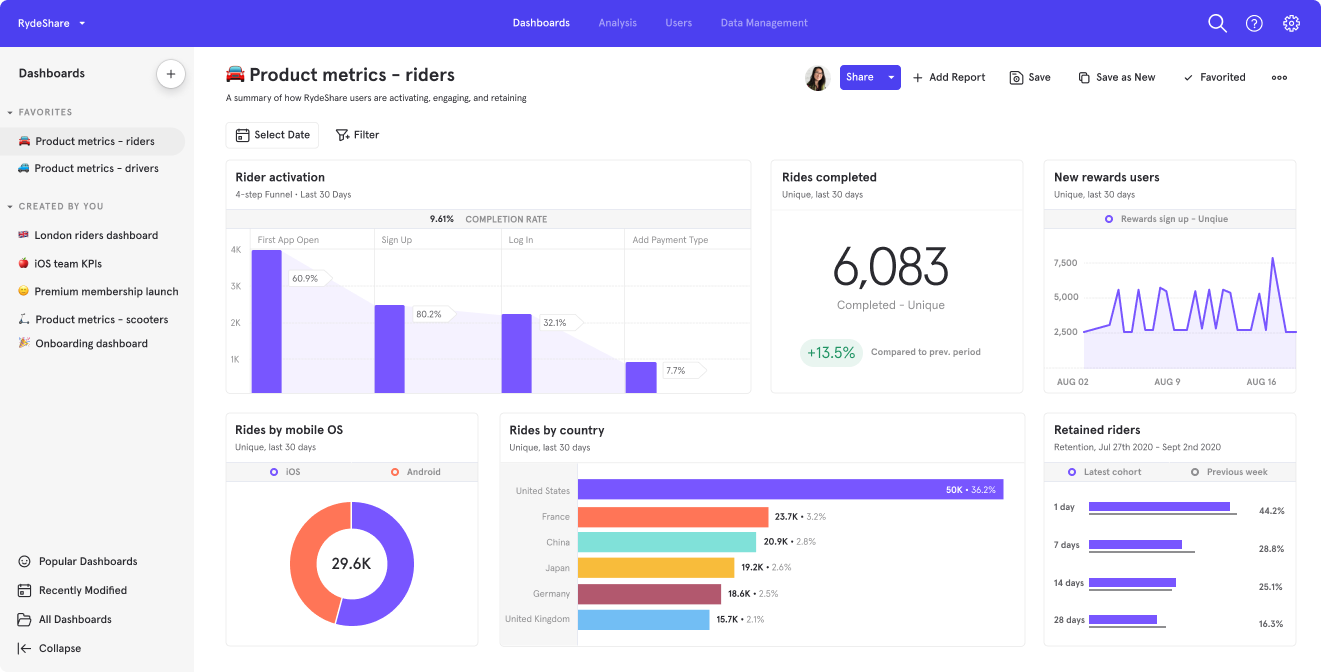
Mixpanel is a product analytics platform focused on event-based user tracking, funnel analysis, and retention reporting. Compared to Pendo, Mixpanel offers significantly more flexible querying, cohort analysis, and data exploration for teams who are more analytics-heavy and less focused on in-app guidance. It's best for teams who feel Pendo's analytics are too rigid and want to ask more freeform questions of their behavioral data.
- ✓ Pendo's analytics feel constrained for complex cohort queries. Mixpanel's event-based model lets you build highly specific user segments and funnels without limitations on how you slice behavioral data.
- ✓ Pendo's reporting is built around its own feature taxonomy. Mixpanel gives you full control over your event schema, making it easier to track custom behaviors that matter to your specific product.
3. FullStory
Session replay and behavioral intelligence that shows you exactly what users experience.
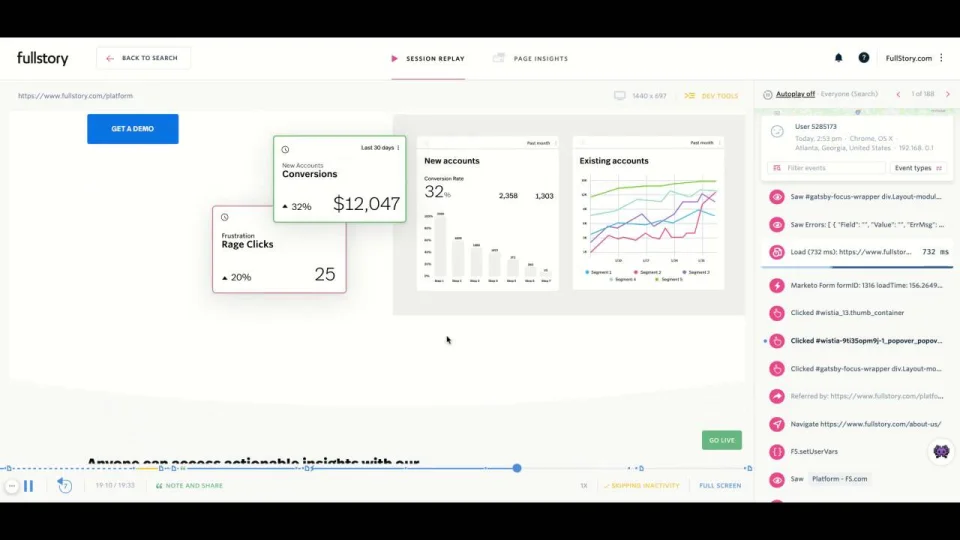
FullStory captures every user interaction, clicks, scrolls, rage clicks, dead clicks, form abandonment, and lets you replay sessions to see the product through your users' eyes. Where Pendo gives you aggregate feature adoption rates, FullStory shows you the granular moment-by-moment experience that explains why those rates look the way they do. It's best for product and UX teams who need to diagnose friction at the interaction level.
- ✓ Pendo shows you a drop-off in a funnel step but not what happened on screen. FullStory's session replay lets you watch exactly what a user did, clicked, and struggled with before abandoning.
- ✓ Pendo doesn't surface frustration signals automatically. FullStory detects rage clicks, dead clicks, and error clicks across your entire user base and alerts you to UX issues before they show up in your retention numbers.
4. Sprig
In-product micro-surveys that capture user sentiment in the moment.
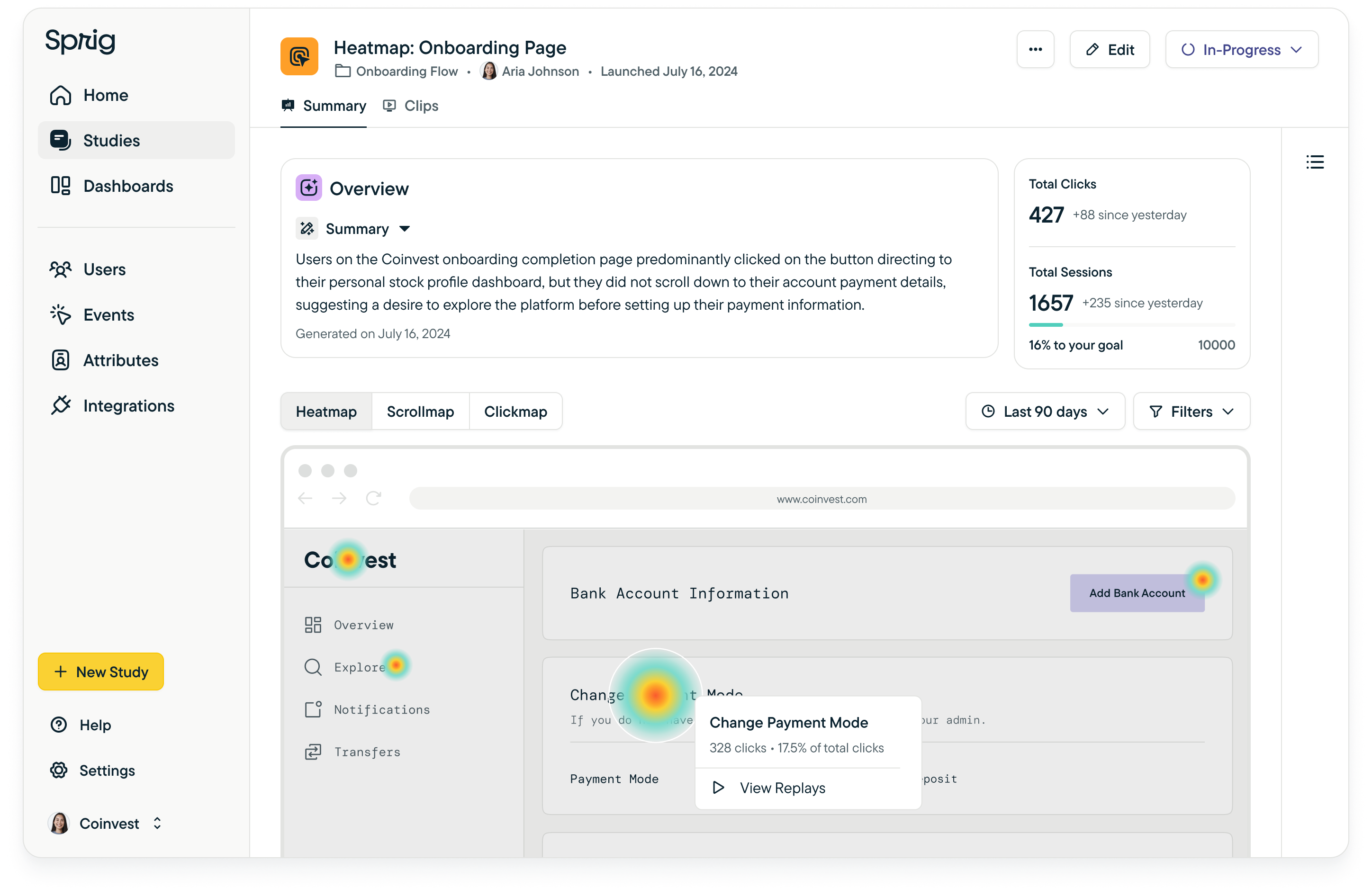
Sprig embeds lightweight surveys and concept tests directly into your product, triggered by user behavior and targeted at specific segments. It's designed to capture in-the-moment feedback, satisfaction, confusion, intent, right inside the product experience rather than via external email surveys. It's best for product teams who want lightweight qualitative signal tied to specific product moments without leaving the product context.
- ✓ Pendo's in-app guides push information out to users. Sprig's in-product surveys pull sentiment and reasoning back in, letting you capture why users feel a certain way about a feature at the exact moment they're using it.
- ✓ Pendo doesn't natively surface qualitative sentiment data per feature. Sprig lets you target surveys to specific user segments and behavioral cohorts, giving you structured feedback attached directly to the product moments that matter.

5. Hotjar
Heatmaps, session recordings, and on-site surveys for understanding user behavior visually.
Hotjar combines heatmaps, scroll maps, session recordings, and lightweight feedback surveys into a single platform focused on understanding how users interact with your web product visually. It's a strong entry-level alternative for teams who find Pendo's price point steep and primarily need to understand UI engagement patterns and collect basic user feedback. It's best for smaller product teams or growth teams doing conversion and UX optimization.
- ✓ Pendo requires significant setup and carries enterprise-level pricing. Hotjar's heatmaps and session recordings are operational within hours and accessible to teams without a dedicated analytics engineer or large budget.
- ✓ Pendo doesn't show you where users' attention lands visually on a page. Hotjar's click and scroll heatmaps give product and design teams an immediate, visual read on engagement patterns without any event instrumentation.
Want a direct comparison? Read our Usercall vs Pendo breakdown, feature-by-feature analysis with pricing and a clear verdict on which tool fits your workflow.
| Feature | Usercall AI | Pendo |
|---|---|---|
| Research Rigor & Methodology | ||
| AI Automated Coding & Themes | ✅ Yes | ❌ No |
| Editable codes for iterative refinement | ✅ Yes | ❌ No |
| Multi-source analysis: interviews, tickets & reviews | ✅ Yes | ❌ No |
| Adaptive, AI-decided follow-up depth (not a fixed follow-up count) | ✅ Yes | ❌ No |
| Evidence-backed analysis, themes traceable to exact quotes | ✅ Yes | ❌ No |
| Detailed AI summaries per theme | ✅ Yes | ❌ No |
| AI Chat with Your Data | ✅ Yes | ❌ No |
| Voice of Customer (VoC) analysis | ✅ Yes | ❌ No |
| Research | ||
| In-product AI-moderated Interviews | ✅ Yes | ❌ No |
| In-product research triggers (e.g. post-purchase insights) | ✅ Yes | ✅ Yes |
| Visual stimulus / concept testing (show images or prototypes during interview) | ✅ Yes | ❌ No |
| Self-Serve & Pricing | ||
| Self-serve, no sales call required | ✅ Yes | ❌ No |
| Free to try / transparent pricing | ✅ Yes | ✅ Yes |
| Pay-as-you-go | Pay-as-you-go | Free tier available; paid plans start around $7,000/year (enterprise pricing, typically requires sales engagement) |
| Platform | ||
| Ideal For | Product Teams, PMs, UX Managers, Startups, Market Researchers | Product managers tracking feature adoption and in-app user behavior |
Does Pendo have user interview or qualitative research features?
No. Pendo is built for product analytics and in-app guidance, not qualitative research. If you want to understand why users behave the way Pendo's data shows, you need a separate tool like Usercall that runs AI-moderated interviews or synthesizes open-ended feedback.
What's the best tool to use alongside Pendo for qualitative insights?
Usercall is purpose-built for this gap, it can trigger AI interviews based on in-product events (like the ones Pendo tracks) and automatically synthesize NPS verbatims, support tickets, and feedback into themes. It gives you the 'why' layer that Pendo's behavioral data alone can't provide.
Is Pendo worth the price for small product teams?
Pendo's paid plans start around $7,000/year, which is a significant commitment for teams that primarily need analytics rather than in-app guidance. Smaller teams often find that a combination of a lighter analytics tool and a qualitative research platform like Usercall covers their needs at a fraction of the cost.
Can I replace Pendo's in-app guides with another tool?
Yes, tools like Appcues, Chameleon, or Intercom's product tours can replicate in-app onboarding guidance. If your core reason for using Pendo is understanding user behavior rather than delivering guides, switching to a dedicated analytics or user research tool may serve you better.