
5 Best UserVoice Alternatives in 2026 (Honestly Compared)
customer feedback and product management platform
UserVoice is genuinely good at collecting structured customer feedback and routing it into a manageable product backlog. The ceiling hits when you realize all that collected feedback still needs a human to read, tag, and synthesize before it tells you anything — and at $699/month, you're paying enterprise prices for a inbox that doesn't interpret itself. This page compares five real alternatives, ranked by how much closer they get you to actual insight without the manual overhead.
Analysis that happens automatically, not eventually
UserVoice collects feedback well, but turning that collection into themes and patterns is still a manual job. Look for a tool that automatically codes unstructured feedback — NPS comments, reviews, tickets, transcripts — into themes with no tagging, no spreadsheets, and results in minutes, not sprint cycles.
Depth of insight, not just volume of responses
Feedback forms tell you what users clicked. They rarely tell you why. If the decision you're trying to make requires understanding motivation, context, or nuance, you need a tool that can ask follow-up questions — not just capture a star rating or a text box response.
Feedback from every source, unified in one place
Your customers aren't leaving feedback in just one channel. They're writing app store reviews, responding to NPS surveys, emailing support, and talking to sales. A real alternative to UserVoice should ingest all of it continuously — not require you to manually export and re-upload from each source.
Scales without scaling your research team
The reason teams hit the UserVoice ceiling isn't price alone — it's that getting more insight still requires more human hours to moderate interviews, synthesize responses, and write up findings. The right alternative makes qualitative research something a team of two can run at the scale of a team of twenty.
Quick verdict
- ⭐ Best overall — Usercall: UserVoice collects feedback. Usercall already understands it.
- Best for saas product teams that want a… — Canny: A cleaner, more affordable feedback board built for modern product teams
- Best for mid-market to enterprise product… — Productboard: Feedback-to-roadmap prioritization with deeper product strategy tooling
- Best for product teams that want behavioral… — Pendo: Behavioral analytics plus in-app feedback — the 'what' and a slice of the 'why'
- Best for teams that primarily need high-convert… — Typeform: Beautiful, conversational surveys for teams that want more responses, less friction

1. Usercall
⭐ TOP PICKUserVoice collects feedback. Usercall already understands it. Self-serve from $89 a month. Your first interview is free. No sales call.
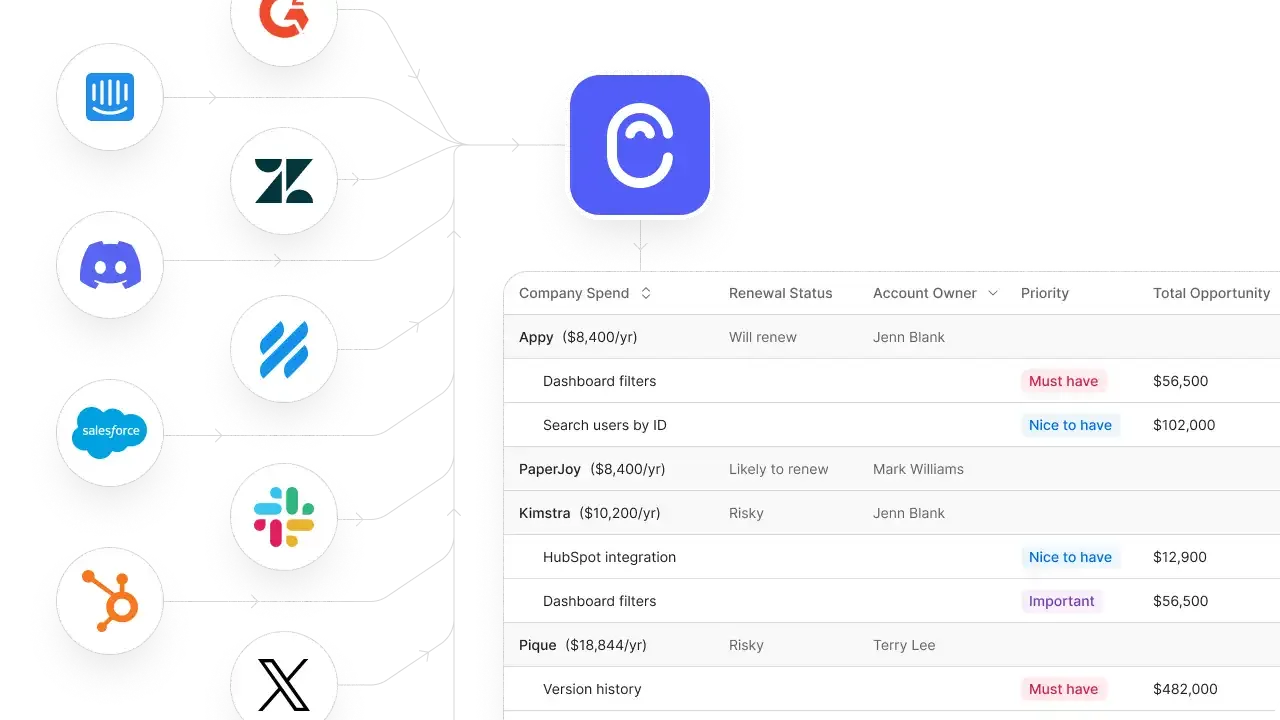
Usercall is an AI-powered user research platform that runs fully autonomous interviews with your users and automatically analyzes any unstructured feedback — transcripts, NPS comments, reviews, support tickets — into themes, patterns, and summaries without any manual coding. Where UserVoice stops at collection, Usercall delivers synthesis: upload your feedback or connect a live stream, and the analysis is done for you in minutes, not weeks. It's built for product managers, UX researchers, and CS teams who need to understand the why behind user behavior at scale, without hiring a research ops team to make it happen.
- ✓ UserVoice leaves you with a backlog of raw feedback that someone still has to read and tag — Usercall's AI qualitative analysis automatically codes any unstructured text into themes, sub-themes, and patterns with confidence scores, cutting synthesis time from days to minutes.
- ✓ UserVoice feedback forms capture what users submit but can't ask a follow-up — Usercall's AI moderated interviews hold real async conversations with 100 users simultaneously, probing deeper on each answer so you get interview-quality insight without scheduling a single session.
2. Canny
A cleaner, more affordable feedback board built for modern product teams
Canny is a dedicated customer feedback and feature request platform that lets users submit, vote on, and comment on product ideas, with a built-in changelog to close the feedback loop. It covers the core UserVoice use case — structured feedback collection and prioritization — at a considerably lower price point and with a significantly more modern interface. It's a strong fit for SaaS teams that want organized, voteable feedback boards without the enterprise overhead.
- ✓ UserVoice's pricing starts at $699/month for similar functionality — Canny offers public and private feedback boards, voting, and roadmap views starting at a fraction of that cost.
- ✓ UserVoice's interface and setup can feel heavy for smaller teams — Canny is notably faster to deploy and easier for both customers and PMs to navigate day-to-day.
3. Productboard
Feedback-to-roadmap prioritization with deeper product strategy tooling
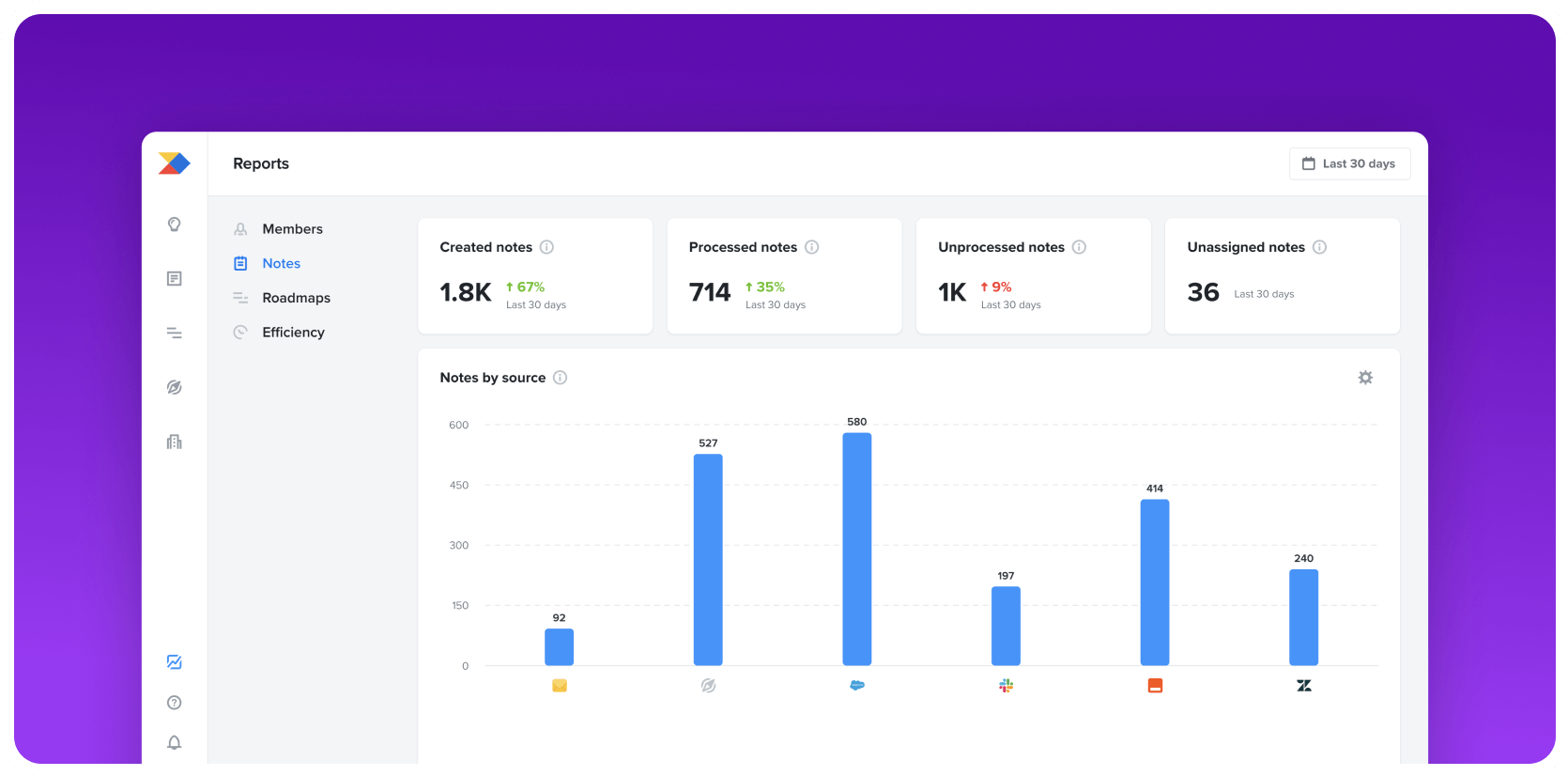
Productboard is a product management platform that centralizes customer feedback, links it to features, and helps teams prioritize roadmap decisions based on user impact scores and business goals. It goes further than UserVoice on the roadmap and strategy side, with stronger integrations across Jira, Zendesk, Intercom, and Salesforce to pull feedback from existing workflows. It's best suited for mid-to-large product organizations that need both feedback management and structured roadmap tooling in one place.
- ✓ UserVoice's roadmap features are relatively basic — Productboard offers more sophisticated prioritization frameworks that tie customer feedback directly to strategic objectives and effort scores.
- ✓ UserVoice requires manual feedback imports from most channels — Productboard has native integrations with Zendesk, Intercom, Salesforce, and Slack to automatically pull feedback where your team already works.

4. Pendo
Behavioral analytics plus in-app feedback — the 'what' and a slice of the 'why'
Pendo combines product analytics, in-app guides, and NPS/survey collection into a single platform, making it one of the few tools that can connect user behavior data to structured feedback without switching tools. It's considerably more expensive than UserVoice but serves a different and broader use case — teams that want to see what users do in-product and collect feedback in the same platform. The best fit is mid-to-enterprise SaaS companies that have outgrown standalone feedback tools and want analytics and research under one roof.
- ✓ UserVoice has no product analytics layer — Pendo shows you exactly where users drop off, which features they adopt, and which segments are most active, giving feedback requests important behavioral context.
- ✓ UserVoice relies on users proactively submitting feedback — Pendo's in-app guides and NPS triggers reach users at the right moment in their workflow, improving response rates on targeted segments.
5. Typeform
Beautiful, conversational surveys for teams that want more responses, less friction
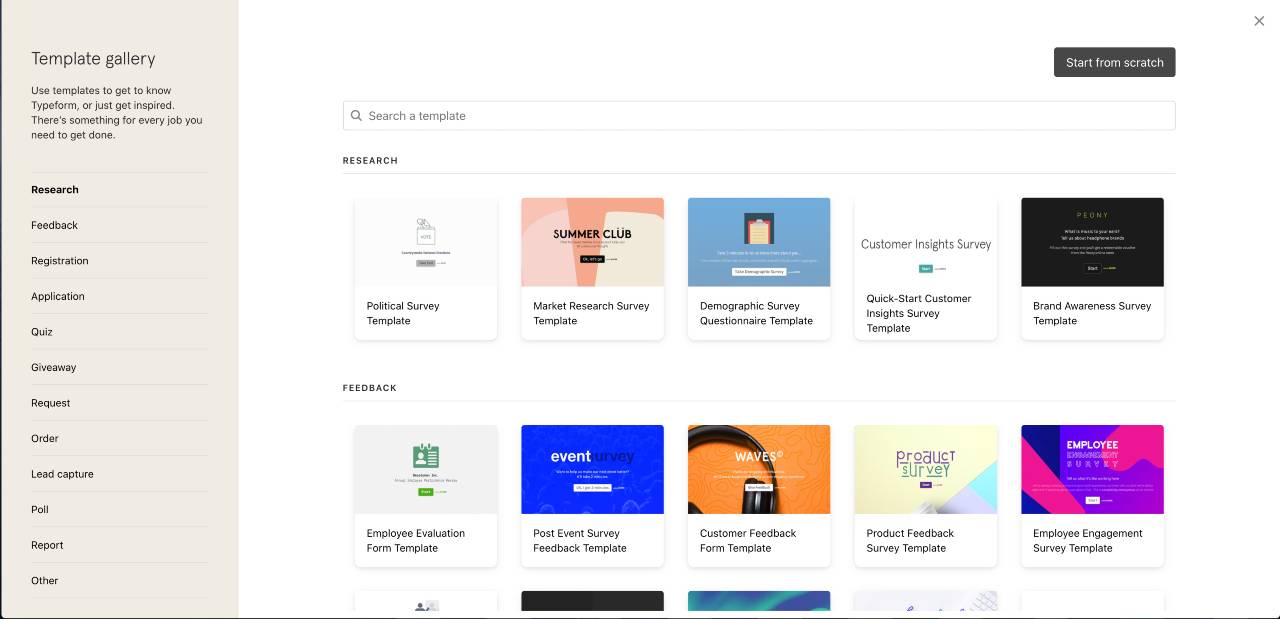
Typeform is a form and survey builder known for its conversational, one-question-at-a-time interface that consistently drives higher completion rates than traditional survey formats. It doesn't do feedback management or roadmap prioritization, but for teams whose primary need is collecting structured and semi-structured customer input — CSAT, NPS, onboarding surveys — it does that job with better UX and far lower cost than UserVoice. It's best for teams that need flexible, on-brand survey collection without the overhead of a full feedback management platform.
- ✓ UserVoice's feedback forms feel dated and rigid — Typeform's conversational format consistently outperforms traditional forms on completion rate, which means more feedback from the same audience size.
- ✓ UserVoice locks core functionality behind high-tier pricing — Typeform gives small teams access to polished, embeddable surveys with logic branching and integrations at a price that doesn't require budget approval.
Want a direct comparison? Read our Usercall vs UserVoice breakdown — feature-by-feature analysis with pricing and a clear verdict on which tool fits your workflow.
| Feature | Usercall AI | UserVoice |
|---|---|---|
| Research Rigor & Methodology | ||
| AI Automated Coding & Themes | ✅ Yes | ✅ Yes |
| Editable codes for iterative refinement | ✅ Yes | ❌ No |
| Multi-source analysis: interviews, tickets & reviews | ✅ Yes | ❌ No |
| Adaptive, AI-decided follow-up depth (not a fixed follow-up count) | ✅ Yes | ❌ No |
| Evidence-backed analysis — themes traceable to exact quotes | ✅ Yes | ❌ No |
| Detailed AI summaries per theme | ✅ Yes | ❌ No |
| AI Chat with Your Data | ✅ Yes | ❌ No |
| Voice of Customer (VoC) analysis | ✅ Yes | ✅ Yes |
| Research | ||
| In-product AI Moderated Interviews | ✅ Yes | ❌ No |
| In-product research triggers (e.g. post-purchase insights) | ✅ Yes | ❌ No |
| Visual stimulus / concept testing (show images or prototypes during interview) | ✅ Yes | ❌ No |
| Self-Serve & Pricing | ||
| Self-serve — no sales call required | ✅ Yes | ❌ No |
| Free to try / transparent pricing | ✅ Yes | ❌ No |
| Pay-as-you-go | Pay-as-you-go | Starts around $799/month (Growth tier); enterprise pricing requires contacting sales |
| Platform | ||
| Ideal For | Product Teams, PMs, UX Managers, Startups, Market Researchers | Product managers at B2B SaaS companies managing feature request pipelines and roadmap prioritization |
Is there a cheaper alternative to UserVoice that still handles customer feedback well?
Yes — Canny starts at $79/month and covers the core feedback board and voting use case that most teams actually use UserVoice for. If you also need automated analysis of that feedback, Usercall adds AI-powered synthesis at a fraction of UserVoice's $699/month starting price.
What's the best UserVoice alternative for qualitative user research at scale?
Usercall is purpose-built for this — it runs AI-moderated interviews autonomously and automatically analyzes unstructured feedback into themes, so you get qualitative depth without scheduling, moderating, or manually coding anything. UserVoice doesn't offer qualitative research capabilities at all.
Can I replace UserVoice if I want to analyze NPS comments and support tickets automatically?
Usercall's VoC analysis feature continuously ingests feedback from multiple sources — NPS verbatims, support tickets, app store reviews, transcripts — and surfaces themes and patterns automatically without any manual tagging. That's a capability UserVoice doesn't provide at any price tier.
How do UserVoice alternatives compare for product roadmap prioritization?
Productboard is the strongest alternative if roadmap prioritization and feature scoring are your primary need, with more sophisticated frameworks than UserVoice and better integrations with tools like Jira and Salesforce. Canny is the better choice if you want simpler, voteable feedback boards at a much lower cost without the full product strategy layer.