
Evidence, not vibes
Cross-market themes with quote trails the team could defend in the client room.
Case study · research agency · anonymized
A research agency had to concept-test campaign ideas for a kitchen-appliance brand across seven markets-and deliver usable qualitative evidence in one week. With Usercall they ran 90 AI-moderated voice interviews (recruiting included), then returned source-linked themes the agency could put in front of the client. Real participants. Agency owned the guide and the codebook.
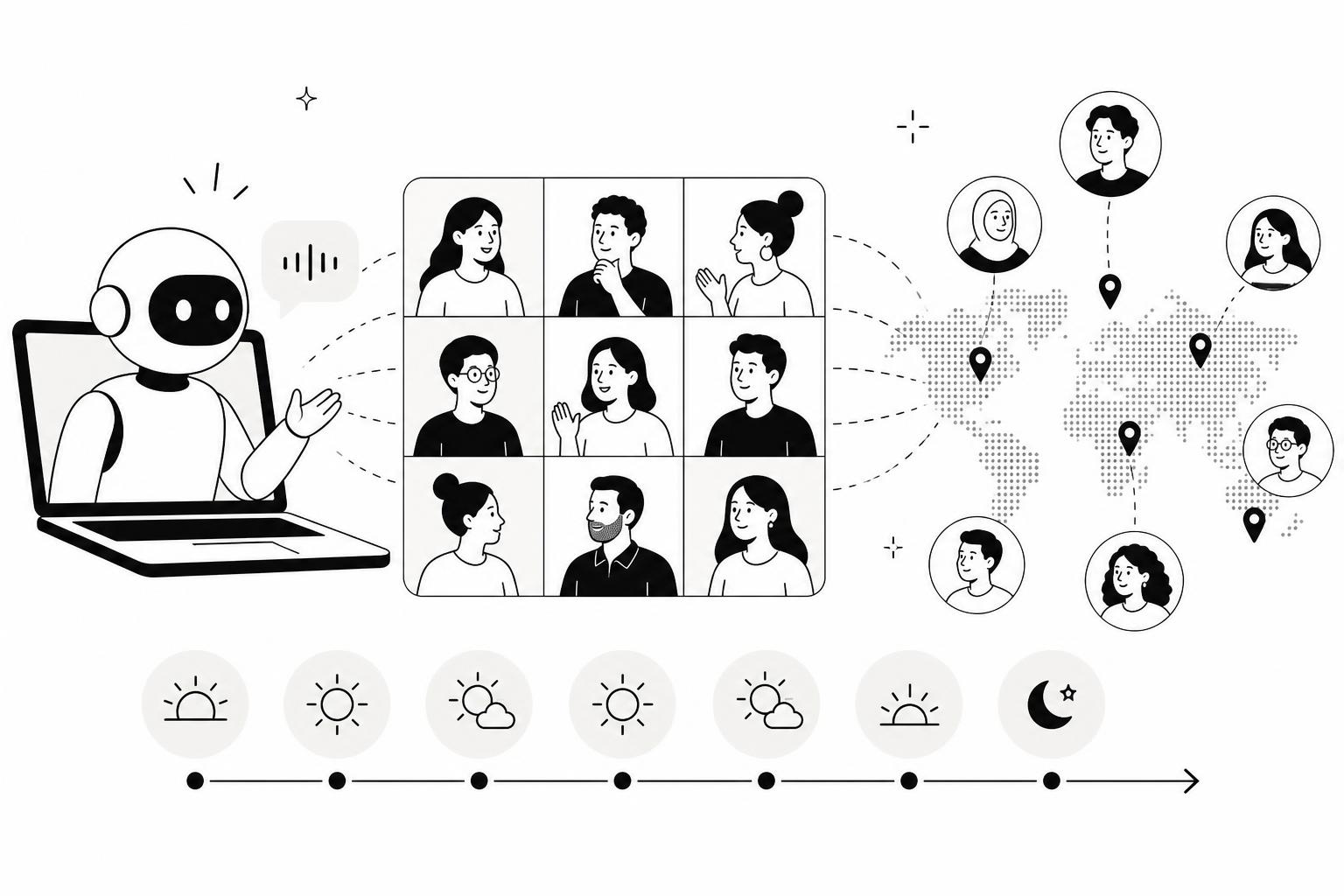
The agency was not looking for another platform bake-off. Their client needed campaign concept testing: reactions to competing creative routes, pairwise preference, uniqueness and persuasion ratings with reasons, and a read on which brand initiatives were dead on arrival.
The constraint was the calendar. Covering seven markets with classic moderated IDIs at this n would have blown the week. They needed depth that still scaled - voice, not a long form - and analysis they could audit back to quotes.
Usercall hosted the fieldwork layer. The agency wrote the discussion guide for campaign concept testing (exposure to concept write-ups, open reaction, "what stood out," uniqueness scales with why, brand-perception change, pairwise preference between routes, then initiative ratings). Participants opened a link and spoke 1:1 with an AI interviewer that probed when answers were thin.
AI-moderated voice interviews
markets
end-to-end, including recruiting
Across sessions, long brand-essay concepts were rejected early - "too much text," "no one's gonna read it," uniqueness scores around 3/10, little brand-perception lift. Shorter, product-led lines scored higher on attention and persuasion. Several proposed brand initiatives (education-style content, price stunts) were rated 1/10 with blunt reasons.
That is the point of concept testing with voice: the agency could show the client not only which route won on preference, but the spoken why - including the kills.
In their words
Excerpt from one campaign concept-testing session. Agency and brand names removed.
Hi there. Greetings from an independent market research company. Today we will share two sets of campaign ideas and hope to get your inputs. Please share your thoughts freely - there are no right or wrong answers. Before we begin: your responses are for research only, not to sell you anything. Results are reported in aggregate. By participating, you agree to keep study content confidential. If you agree and can spare about 35 minutes, please proceed. Are you still there?
Yes. I am.
Great. Let's start with the first campaign idea.
What do you want me to do?
Please read the entire write-up for the first campaign idea. After you've read it, I'd like to hear your detailed thoughts. What do you think about it?
Well, for starters, I don't understand what the campaign is about. It doesn't say anything about the product they are trying to sell. So if I didn't already know they make kitchen appliances, I wouldn't know what to buy or where to go.
What in this idea stood out to you most? Why?
Nothing. Too much text. No one's gonna read it.
On a scale of one to ten, how unique is this campaign idea? Why?
3.
Has this campaign idea changed how you see the brand? Why or why not?
No. Not really. Didn't affect me in any way.
Now, let's forget that idea. What do you think of the second campaign idea?
Same problem - I don't understand what they're trying to sell.
Please read the full write-up, then share detailed thoughts on the concept, its message, and how it makes you feel.
Actually, the message doesn't matter if it's that long. No one is gonna read it.
Between the two ideas, which better captures your idea of "better living"? Why?
The second one, I guess - but mostly because of how the message is framed, not because I love the idea itself.
For a shorter brand line about living more simply - what are your immediate thoughts? How relevant and believable is it?
This message is a bit smarter than the previous ones, and it's also shorter. So I guess it's more interesting.
On a scale of one to ten, how likely is this concept to catch your attention?
6.
Thinking about the product-specific concepts, how relevant do you find them?
The second one has a smart message. Some appliances are too complicated to operate, so that message lands. I like it.
On a scale of one to ten, how persuasive are these concepts for you?
8.
Please rate the appeal of a "digital coffee-break" style initiative from 1 to 10.
1. Because I don't know what that even is.
And chilled instruction videos?
I don't like it. I don't want a video to learn how to use the appliances. I want the appliances to be easy to use.
A price-led promotional initiative - 1 to 10?
1. This is very stupid. I hope it's not real.
Thank you for sharing. That wraps this session.
Outcome
Cross-market themes with quote trails the team could defend in the client room.
Fieldwork + analysis landed inside the one-week window, recruiting included.
Guide, probing goals, and codebook stayed with the agency - Usercall ran sessions at n = 90.
What this is not: a promise that every self-serve Sprint ships 90 interviews weekly, synthetic users, or a replacement for senior researchers on strategy. It is one documented agency delivery of campaign concept testing at scale.
See how to run interviews across markets and languages.
The same guide can run in 50+ languages.
Frequent questions
Campaign concept testing for a kitchen-appliance brand: compare creative routes, collect uniqueness and persuasion ratings with reasons, measure whether concepts shifted brand perception, and pressure-test supporting initiatives-qualitatively, across markets, on a one-week fuse.
90 AI-moderated voice interviews across 7 markets in one week, including recruiting. Documented agency project on Usercall-not the same as the smaller self-serve Consumer Interview Sprint SKU.
The research agency. They defined the concept-testing guide and kept the codebook. Usercall ran the AI-moderated sessions and produced transcripts plus source-linked themes the agency could edit and present.
Participants read concept write-ups, then were probed on overall reaction, what stood out, uniqueness (1-10 + why), brand-perception change, pairwise preference between routes, reactions to shorter brand lines, product-led concepts, and appeal ratings for initiatives. Thin answers got follow-ups instead of a skipped probe.
Yes. Live voice with an AI interviewer; participants were told it was AI. The transcript excerpt shows unscripted rejection of long copy and low initiative scores-not synthetic users.
We are waiting on written permission to name them. The method and the 90 / 7 / one-week facts are real; logos wait.
For agency-scale campaign concept testing on a short timeline, Contact us. For smaller self-serve sprints, see the Consumer Interview Sprint page.
Free to start for your own interviews. For agency-scale projects on a short timeline, Contact us. For smaller self-serve studies, see the consumer interview sprint.