
7 Methods of Qualitative Data Collection: Choose Evidence, Not Opinions
A team can run 20 customer interviews, fill a repository with compelling quotes, and still make the wrong product decision. I have watched it happen repeatedly. The team asks users what they want, users describe an idealized version of themselves, and leadership ships for that imaginary customer instead of the person who is distracted, time-poor, and trying to finish a job with imperfect information.
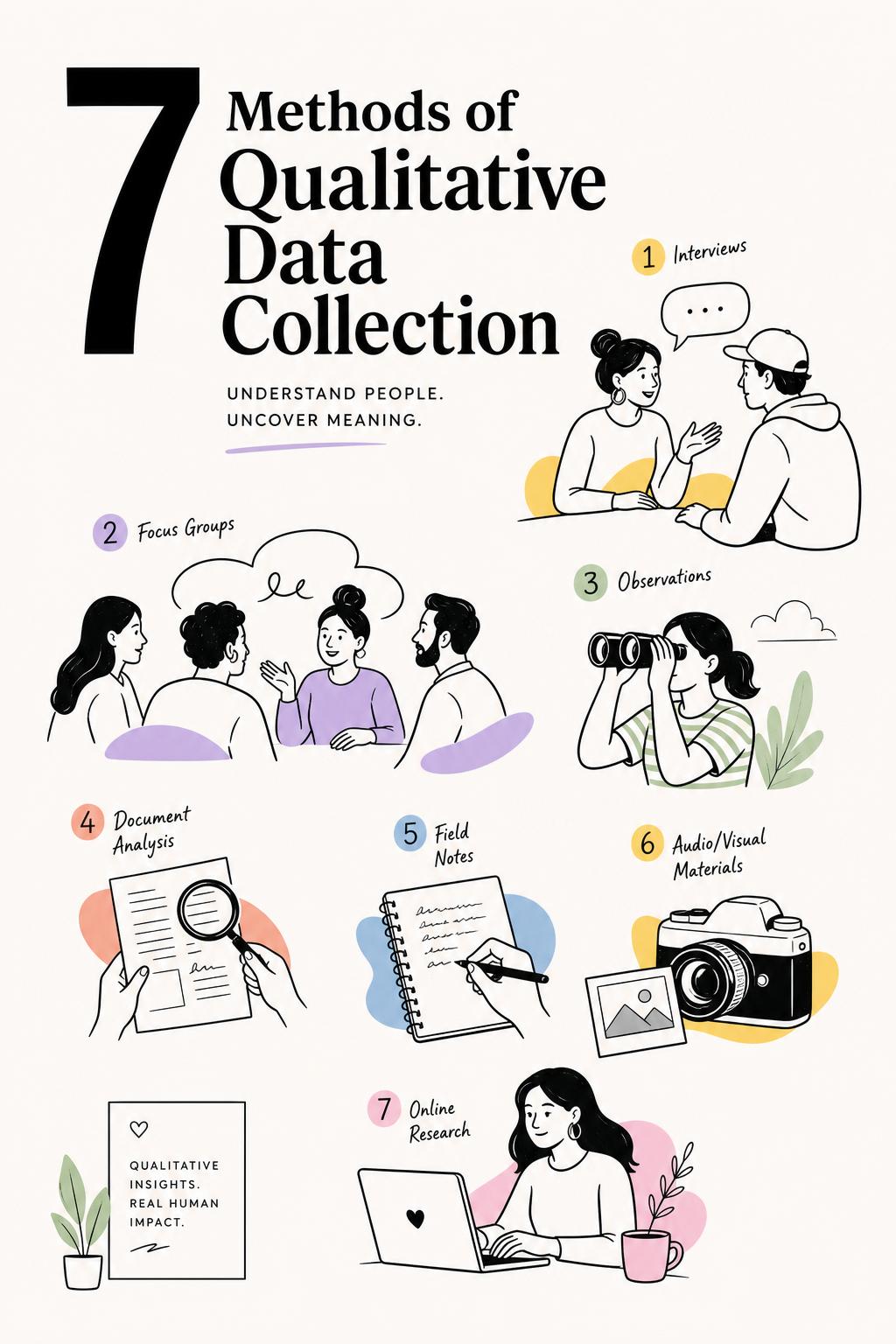
That is the uncomfortable truth behind choosing a method of qualitative data collection: most teams select a method because it is convenient, familiar, or easy to defend in a planning meeting. They should select it based on the kind of evidence their decision requires. Interviews, focus groups, observation, diary studies, usability tests, and open-text feedback are not interchangeable. Each captures a different version of reality. Use the wrong one, and your research may sound insightful while leading directly to false confidence.
My position is simple: the closer your research gets to the moment a customer makes a tradeoff, experiences friction, or abandons a task, the more useful it becomes for product and business decisions. Opinions matter, but observed behavior deserves more weight than polished explanations after the fact.
Why the Most Common Qualitative Research Approach Fails
The default playbook is to recruit target users, schedule 30- to 60-minute interviews, and ask broad questions about pain points, preferences, and feature ideas. Interviews are valuable, but this approach fails when teams use them as universal evidence.
People are not reliable forecasters of their own behavior. They can sincerely say they would use a feature, pay for an upgrade, or change a habit—and still do none of those things. Human memory is reconstructive. Customers often remember the beginning and end of a difficult experience while skipping the small interruptions, workarounds, and competing priorities that actually shaped their behavior.
- Stated preferences are not behavioral proof. “I would use that” is a hypothesis, not validation.
- Retrospective accounts erase context. Participants often omit the spreadsheet, Slack message, approval step, or deadline that made their real workflow difficult.
- Generic questions produce generic answers. “What could we improve?” invites vague feedback that cannot guide a specific decision.
- Volume can create false certainty. Twenty similar comments do not outweigh one observed failure in a high-value customer workflow.
The better approach starts with a decision, not a method. Before recruiting anyone, ask: What decision will this research change, and what behavior must we understand to make it well? That question forces rigor. It also prevents teams from running research that is interesting but operationally useless.
The Evidence Distance Framework: How to Choose the Right Method
I use a simple framework called evidence distance. It measures how far your data is from the behavior you need to influence. The farther away the data is, the more cautiously you should use it for product, pricing, or investment decisions.
Closest evidence: Direct observation, usability testing, contextual inquiry, in-product intercepts triggered by behavior.
Near evidence: Diary studies, task walkthroughs, follow-up interviews conducted soon after an event.
Further evidence: In-depth interviews, focus groups, open-ended surveys.
Furthest evidence: Hypothetical concept reactions, feature voting, and broad preference questions.
This does not mean every question requires observation. If you need to understand how procurement leaders justify buying a new category, an in-depth interview may be the best method because the important evidence is political, strategic, and difficult to see in a screen recording. But if you need to know why people abandon an onboarding step, asking them a week later is inferior to watching them attempt it or intercepting them immediately after they exit.
Match the method to both evidence distance and decision risk. The greater the commercial, customer, or technical consequence of being wrong, the closer to behavior your evidence should be.
1. In-Depth Interviews: Best for Motivation, Context, and Hidden Constraints
In-depth interviews are the strongest method of qualitative data collection for understanding motivations, decision criteria, internal politics, existing workarounds, and customer language. They are especially effective during discovery, segmentation, positioning, and jobs-to-be-done research.
They become weak when researchers ask participants to predict their future behavior. “Would you use AI-generated insights?” is a low-value question because it invites participants to perform optimism. A stronger question is: “Tell me about the last time you had to explain a drop in retention. What did you investigate first? What evidence did your stakeholders trust? What made the process slow?”
That line of questioning grounds the participant in a real event. It reveals actions, constraints, sequence, and consequence.
In a study I ran with 12 product leaders at a growth-stage SaaS company, participants initially said they needed “better customer insights.” If we had stopped there, the team would have built another dashboard. By reconstructing their last quarterly planning cycle, we found the real problem: they had evidence, but could not turn it into a credible narrative quickly enough to influence executives. Sales had revenue data. Analytics had charts. Product had scattered customer quotes. The unmet need was not more feedback; it was decision-ready evidence. That distinction changed the product strategy.
2. Contextual Inquiry: Best for Complex Workflows and Invisible Workarounds
Contextual inquiry means observing people in the environment where work actually happens while asking targeted questions about what they are doing. It is one of the most underused qualitative research methods because it is harder to schedule than interviews. It is also one of the most valuable.
Use it when workflows cross tools, departments, permissions, spreadsheets, or approval processes. The participant’s actual environment contains evidence they will rarely remember to mention: browser tabs, copied data, side conversations, personal templates, and manual checks.
In a B2B reporting study, finance managers told us a reporting feature was “very useful” but rarely used it. We observed four managers complete their monthly reporting process over remote screen share. All four hit the same hidden dependency: the feature required an admin permission setting that was buried in a separate workspace. The issue was not perceived value, education, or pricing. It was a setup failure. Three observed sessions gave the team a clearer diagnosis than eight prior interviews.
The tradeoff is real: contextual inquiry creates more complex data and often reveals ugly operational details. That is not a downside. Those details are where differentiation lives.
3. Usability Testing: Best for Finding Friction Before It Hits Metrics
Usability testing is a focused observation method. Give participants a realistic task, let them work through an interface, and capture where comprehension, navigation, or trust breaks down. It answers whether users can complete a task and whether they understand the outcome they reached.
The common mistake is asking participants whether they like a prototype. Product preference is not task success. A visually polished interface can still cause users to make costly interpretation errors.
Use scenario-based tasks with real stakes. Instead of saying, “Explore this analytics dashboard,” say, “Your weekly active users dropped by 12% after a release. Find the most likely cause and tell your manager what action you would take.” Watch for wrong turns, hesitation, backtracking, ignored information, and false confidence.
A customer who cannot finish a task is visible friction. A customer who finishes the task but reaches the wrong conclusion is hidden risk. Measure both.
4. Diary Studies: Best for Behaviors That Unfold Over Time
Diary studies collect participant reflections, screenshots, voice notes, or brief responses over days or weeks. They are the right method when behavior is intermittent, emotional, seasonal, or shaped by changing conditions. Financial planning, healthcare adherence, recruiting, travel, team collaboration, and recurring reporting cycles are common examples.
A single interview compresses time and creates a tidy story. Diary data captures the messy middle: the abandoned attempts, delayed decisions, changing priorities, and moments when a customer switches to a workaround.
Do not ask participants to write long daily journals. That produces fatigue and low-quality entries. Trigger short prompts after relevant events. Ask what they were trying to accomplish, what changed, what they did instead, and what they captured as proof. A two-minute response immediately after a failed workflow is worth more than a 20-minute retrospective interview at the end of the month.
5. Focus Groups: Best for Social Meaning, Not Individual Behavior
Focus groups are useful when group interaction is part of the research question. They can reveal how people discuss a category, which words feel credible, how status affects adoption, and where audiences disagree on messaging.
They are a poor choice for usability testing, sensitive subjects, private behaviors, or feature prioritization. A dominant participant can shape the conversation. Others may signal agreement to avoid appearing uninformed. The result is often social performance rather than candid evidence.
Use focus groups to test positioning, category language, or cultural attitudes. Do not use them as your only evidence for whether customers will adopt a workflow.
6. Open-Ended Surveys and Product Intercepts: Best for Capturing the “Why” at Scale
Open-ended feedback is dismissed too easily. The problem is not the method; it is the timing and question design. A generic survey question such as “How can we improve?” creates a pile of disconnected wishes. A targeted intercept delivered immediately after a meaningful behavior can uncover why a metric moved.
Trigger qualitative questions after users abandon onboarding, exit pricing, repeatedly encounter an error, export a report, downgrade a plan, or disable a feature. Ask one precise question: “What were you trying to do today?” or “What stopped you from completing this step?”
AI-native qualitative research tooling such as Usercall is particularly useful here because it supports research-grade AI analysis and AI-moderated interviews while giving researchers deep control over probes, participant criteria, and synthesis. Teams can place user intercepts at key product analytic moments, then investigate the reason behind a funnel drop rather than inventing explanations from click data alone.
Scale helps identify patterns. It does not eliminate the need for deeper follow-up with the people behind the pattern.
7. Artifact Analysis: Best for Finding Patterns in Existing Customer Evidence
Support tickets, sales call transcripts, customer success notes, churn feedback, community discussions, and prior research are qualitative data sources already created by real customer activity. Artifact analysis is efficient for identifying recurring problems across a broad customer base.
But frequency is not priority. A complaint mentioned 400 times may be a minor annoyance. A friction point mentioned by six enterprise customers may threaten renewals worth far more. Analyze artifacts through two lenses: how often the issue appears and what happens if it remains unresolved.
A Step-by-Step Workflow for Selecting a Qualitative Data Collection Method
- Name the decision. Specify the choice the research must inform: a workflow change, pricing decision, positioning claim, segment, or roadmap investment.
- Define the behavior. State what customers need to do, avoid, understand, or decide—not what they should say they prefer.
- Locate the moment of truth. Identify where the behavior occurs: during use, after an event, across time, or inside a group setting.
- Choose the closest feasible evidence. Observe behavior when possible; use interviews to explain context and meaning.
- Triangulate before acting. Pair one behavioral method with one explanatory method, especially for high-risk decisions.
- Prioritize by consequence. Focus on patterns that materially affect adoption, trust, revenue, task success, or customer retention.
The best method of qualitative data collection is not the most fashionable or the fastest to run. It is the method that makes it hardest for your team to fool itself. Ask customers about their beliefs when beliefs are the decision. Observe customers when behavior is the decision. And when your metrics change, capture the customer’s explanation at the moment it happens—not after memory has turned the truth into a neat story.
Choosing the right method is only half the job—you still need questions sharp enough to produce evidence, not opinions. See our guide on how to write qualitative research questions for 45+ examples across interviews, surveys, and user studies, and try Usercall to run these methods without the manual grunt work.
Related: types of qualitative research · qualitative data collection methods · techniques of qualitative research