
 Table of Contents
The dangerous moment in an interview-led AI readiness assessment is not when stakeholders refuse to participate. It is when 24 people agree, the calendar has five open days, and the audit was priced around six conversations.
Most teams respond by shrinking the sample, delegating loosely, or postponing synthesis. All three preserve the appearance of progress while quietly weakening the evidence the final recommendations will need.
A stakeholder interview is not a 45-minute calendar block. It includes outreach, scheduling, preparation, consent, facilitation, note cleanup, follow-up, coding, comparison, and the inevitable reschedule with the executive whose perspective supposedly cannot be missed.
In practice, one experienced researcher can usually conduct five or six useful interviews during a busy audit week. Push beyond that and the first casualty is probing: the interviewer starts collecting answers rather than investigating contradictions.
Delegating interviews without tight controls creates a different failure. Three facilitators may ask the same opening question, then follow completely different threads. One explores incentives, another stays at the tool level, and the third turns the session into AI coaching.
The transcripts look substantial, but they cannot support clean comparisons. This is why I treat an interview-led audit differently from security “AI audit” slideware; the distinction is explained further in what an interview-led AI readiness audit actually is.
Five or six interviews can consume most of week one. That is the ceiling for a typical one-person audit lead or small consulting team once coordination and session quality are counted honestly.
The arithmetic is unforgiving. Six 45-minute interviews require 4.5 live hours, but scheduling, preparation, notes, and debriefing can push the real workload above 15 hours. Add sales, leadership readouts, document review, and delivery management, and the week is gone before cross-interview analysis begins.
Synthesis then takes additional days or weeks. A researcher must distinguish repeated language from repeated meaning, separate observed behavior from aspiration, and test whether an apparent pattern is organization-wide or merely shared by three executives who attend the same meetings.
I use one Usercall program as my benchmark for what becomes possible after removing this ceiling. We ran AI-moderated interviews with a 100-person internal stakeholder cohort at a financial consulting firm, where the constraint was a normal audit timeframe rather than an open-ended research program.
The interviews examined how AI was actually being used, where education and training were needed, and where better adoption could improve performance and an AI-enabled culture. Running 100 conversations manually would have been impractical; preserving the interview method while expanding capacity made the coverage possible.
The lesson was not “automate research.” It was that interview capacity should no longer determine which parts of the organization are allowed to count as evidence.
A six-interview audit can identify hypotheses. It usually cannot defend statements such as “operations lacks confidence,” “middle managers are blocking adoption,” or “the organization needs prompt training” without substantial qualification.
With broader coverage, the audit can compare functions, levels, locations, tenure bands, and AI experience. A consultancy can over-deliver stakeholder inclusion without destroying a fixed fee, while an in-house owner can build credibility beyond the leadership team they already know.
More interviews do not automatically create truth, but they make weak claims easier to expose. If ten leaders describe enthusiastic adoption while 18 frontline employees report workarounds, policy confusion, and fear of disclosing use, the contradiction becomes a finding rather than an inconvenient anecdote.
This is where Usercall fits: AI-moderated interviews add overflow capacity while retaining deep researcher controls over questions, probes, participant routing, and evidence requirements. Research-grade qualitative analysis can then compare patterns at a scale that manual transcript review rarely reaches within a fixed audit schedule.
Teams often waste scarce interview capacity by asking stakeholders to rate “how mature” the organization is. Most participants lack the cross-functional visibility to answer, so the result is confident speculation wrapped in a five-point scale.
An AI readiness assessment should instead test whether the organization can adopt specific AI-enabled changes responsibly and repeatedly. That means examining actual workflows, data access, decision rights, incentives, risk boundaries, skills, and managerial behavior.
The sequencing differs from a broad maturity benchmark. I recommend using the sharper protocol in AI readiness assessment versus AI maturity assessment before writing the interview guide.
The calibration interviews matter. I would not launch 40 identical sessions from an untested guide; that only scales the mistakes made on Monday morning.
The usual stakeholder list overweights sponsors, functional heads, and visible AI enthusiasts. Those people explain official intent well, but they are often the least reliable witnesses of day-to-day adoption.
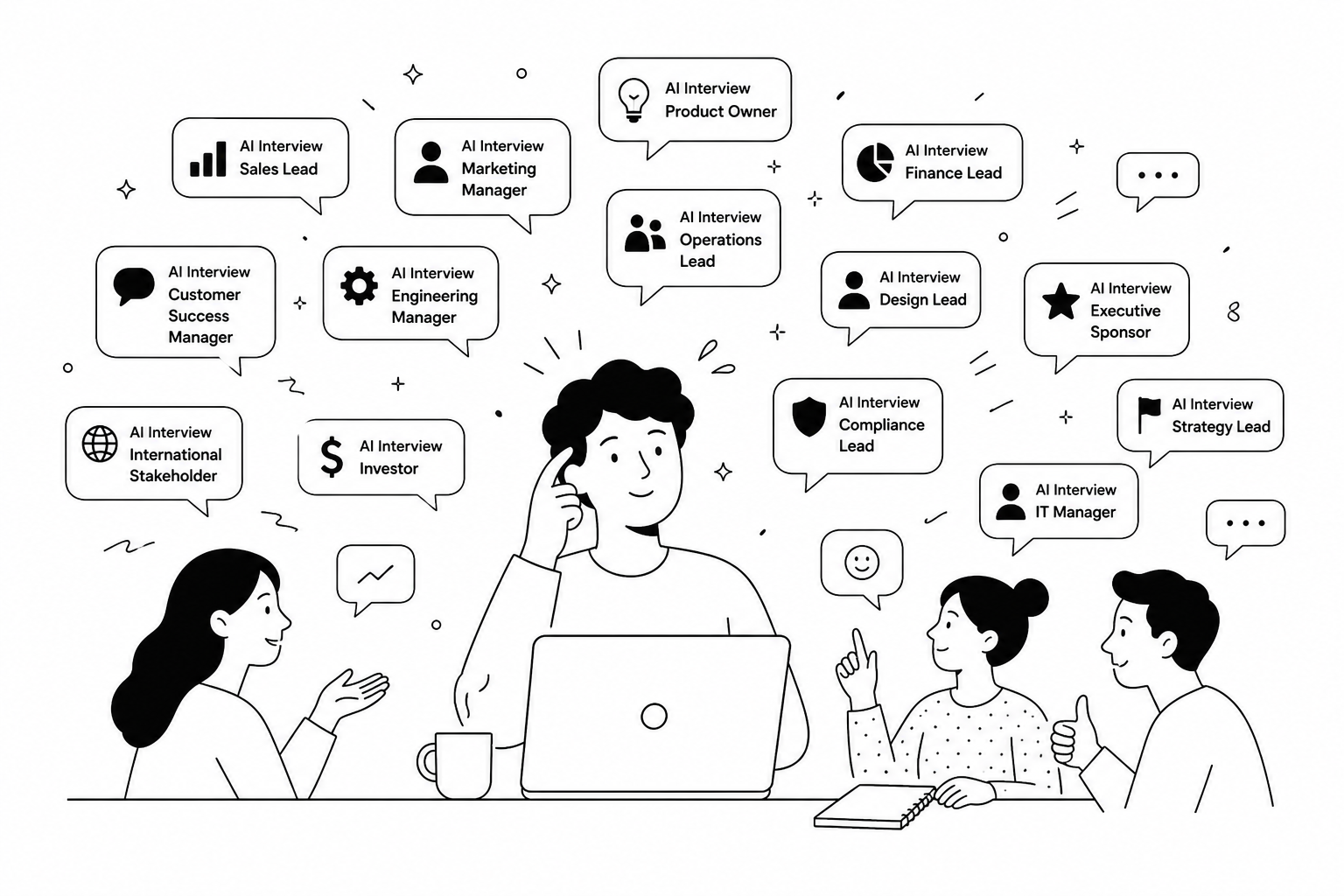
The best sample is designed around competing exposure to the proposed change. For an AI-assisted client-delivery workflow, that may mean interviewing partners who own risk, managers who review outputs, consultants who produce the work, operations staff who govern systems, and employees who have quietly built their own workarounds.
A fixed-fee discovery sprint still needs boundaries. The practical approach in the fixed-fee week-one stakeholder interview plan shows how to set coverage without turning the audit into indefinite organizational ethnography.
Overflow fails when teams upload a generic question list and accept polished summaries as analysis. AI moderation is useful only when the researcher controls what counts as a sufficient answer, when to probe, which branches different participants receive, and how claims trace back to source material.
I require behavioral specificity. “Our team uses AI frequently” should trigger probes about the last task, tool, input data, review process, output destination, and consequence of an error. Without those details, the audit measures enthusiasm rather than readiness.
Human-led and AI-moderated interviews should form one evidence system. The first conversations shape language and probes; scaled interviews test how widely those patterns hold; researchers inspect outliers and contradictions before making recommendations.
For digital-product organizations, Usercall intercepts can also invite stakeholders or internal users at key product-analytics moments. That connects a metric such as feature abandonment or low activation to an immediate explanation of why the workflow failed, rather than relying on retrospective guesses weeks later.
Readiness also overlaps with organizational change capacity, but it should not require standing up a permanent listening system. The narrower approach in running an organizational diagnostic without an EX platform is better suited to a time-bounded audit.
The second-order benefit of overflow capacity is political. People are more likely to accept difficult recommendations when they can see that the audit heard the organization beyond its usual decision-makers.
Findings based on five leadership interviews are easy to dismiss: “You only spoke to a handful of people.” Findings supported by dozens of voices across functions and levels are harder to wave away, especially when the report shows both dominant patterns and credible dissent.
That legitimacy matters differently for each audit owner. A boutique consultancy gains broader coverage without blowing the fixed fee; an internal leader running the assessment alone gains organization-wide evidence they could never build by interviewing only their direct network.
The practical rule is simple: use scarce human-moderated time for calibration, sensitive conversations, and high-value follow-up. Use controlled overflow capacity for breadth, then keep synthesis under a single research framework.
An AI readiness assessment should not recommend organization-wide change from a sample chosen by calendar scarcity. Once interview capacity stops being the bottleneck, the audit can cover the organization it claims to assess—and defend the actions it asks people to take.
Related: AI readiness assessment vs. AI maturity assessment · stakeholder interviews for AI discovery sprints · organizational diagnostic and change readiness assessment · interview-led AI readiness audits vs. security audit slideware
Usercall runs AI-moderated user and stakeholder interviews that collect qualitative insights at scale, with the depth of a real conversation and without the overhead of a research agency. It gives researchers deep controls over interview design and research-grade analysis, so overflow capacity expands the evidence without weakening the method.
