
5 Best Hotjar Alternatives in 2026 (Honestly Compared)
website heatmap and user behavior analytics tool
Hotjar is genuinely good at showing you where users click, scroll, and abandon, it's one of the fastest ways to spot friction in a UI. The problem is it stops there: you get a heatmap of a drop-off, a recording of someone rage-clicking, and no way to know what was actually going through their head. This page compares five tools that go further, and helps you find the right one based on what Hotjar can't tell you.
Usercall at a glance
Usercall is a self-serve AI-moderated interview platform. An AI moderator runs one-to-one voice interviews with real people, and every theme links back to the quotes behind it.
- Real people, AI moderator. Every participant is a real person. Only the interviewer is AI.
- Recruit or bring your own. We can recruit participants for you from a 4M+ panel, or you can bring your own.
- 50+ languages. Every plan includes every language.
- Concept tests. 15-30+ interviews, back in 48 to 72 hours.
Can it tell you WHY, not just WHERE?
Heatmaps and recordings show behavior, they don't explain intent. If your real question is 'why are users abandoning this flow?' or 'what's confusing about this page?', you need a tool that can actually ask users and synthesize their answers. Look for qualitative capabilities: interviews, open-ended feedback, or AI analysis that surfaces themes from what users say, not just where they click.
Does it connect behavioral triggers to research automatically?
The most valuable insight comes from catching users at the exact moment of a behavior, right after they churn, abandon checkout, or complete onboarding. A strong Hotjar alternative should let you trigger research or feedback collection based on in-product events, so you're not manually recruiting users after the fact and hoping they remember what happened.
Can it synthesize feedback at scale without manual work?
Watching 200 session recordings or reading through 500 NPS comments is not a scalable research process. Look for tools that can automatically identify patterns across large volumes of unstructured feedback, app store reviews, support tickets, survey verbatims, and surface themes without requiring a researcher to tag everything by hand.
Does it replace a process, or just add another dashboard?
The best alternatives reduce your research overhead, they don't add to it. Avoid tools that require significant setup, manual moderation, or a dedicated analyst to get value from. Prioritize tools where a PM or UX researcher can run a study, upload a dataset, or get a synthesized insight without needing to own a complex workflow.
Quick verdict
- ⭐ Best overall: Usercall: Hotjar shows you where users drop off. Usercall finds out why.
- Best for enterprise teams needing high-fidelity…: FullStory: Enterprise-grade session intelligence with deeper behavioral data than Hotjar
- Best for small teams and startups who need…: Microsoft Clarity: Free heatmaps and session recordings with no data limits
- Best for product teams running in-product…: Sprig: In-product surveys and concept testing triggered by user behavior
- Best for product designers and ux researchers…: Maze: Rapid usability testing and prototype research without a research team

1. Usercall
⭐ TOP PICKHotjar shows you where users drop off. Usercall finds out why. Self-serve from $89 a month. Your first interview is free. No sales call.
Usercall is an AI-powered user research platform that runs fully autonomous interviews with users and automatically analyzes qualitative feedback at scale, no scheduling, no manual coding, no synthesis overhead. Where Hotjar leaves you staring at a heatmap wondering what went wrong, Usercall lets you trigger an AI interview the moment a user drops off, churns, or completes a key action, then automatically surfaces themes across all your responses. It's built for product teams, PMs, and UX researchers who need the story behind their behavioral data without hiring a full-time researcher to get it.
- ✓ Hotjar can show you a rage-click but can't ask why it happened. Usercall's in-product research triggers fire an AI interview at the exact moment of a behavior (drop-off, churn, onboarding completion), so you get the user's real explanation while it's still fresh, connected directly to the event that prompted it.
- ✓ Instead of watching session recordings one by one, Usercall automatically ingests app store reviews, NPS verbatims, support tickets, and interview transcripts and codes them into themes with confidence scores, giving you a synthesized view of what users actually care about in minutes, not days of manual analysis.
2. FullStory
Enterprise-grade session intelligence with deeper behavioral data than Hotjar
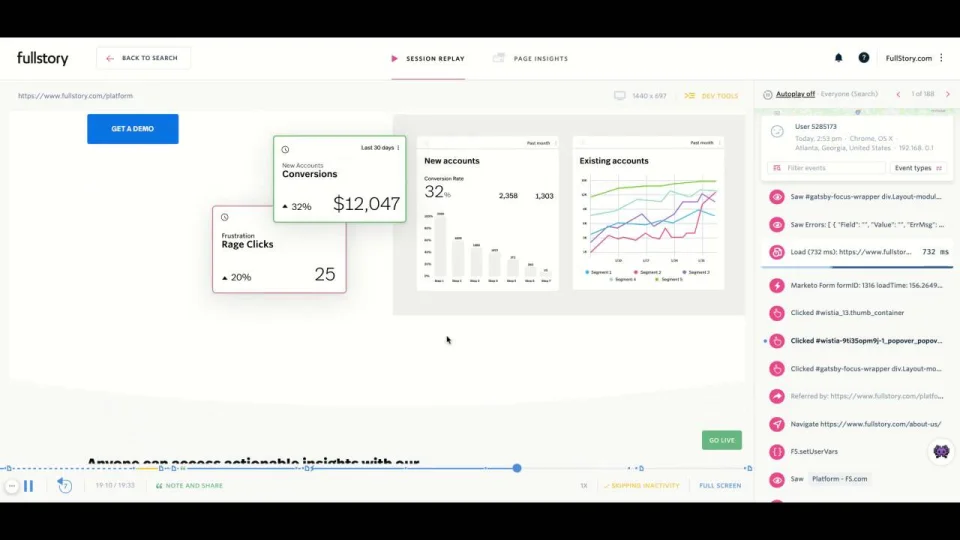
FullStory is a digital experience intelligence platform offering session replay, heatmaps, and funnel analysis, similar to Hotjar but built for larger teams with more complex data needs. It goes further than Hotjar with autocapture of every user interaction, advanced segmentation, and DX Data APIs that let engineering and data teams query behavioral data programmatically. It's best suited for enterprise product and engineering teams that need behavioral analytics deeply integrated into their data infrastructure.
- ✓ FullStory autocaptures every user interaction retroactively, unlike Hotjar, you don't need to have had tracking set up in advance to analyze a specific session or funnel you didn't anticipate needing.
- ✓ Its DX Data feature exposes behavioral data via API and data warehouse integrations, making it far more useful than Hotjar for data teams that want to combine session behavior with product and revenue data in their own BI tools.

3. Microsoft Clarity
Free heatmaps and session recordings with no data limits
Microsoft Clarity is a completely free behavior analytics tool offering heatmaps, session recordings, and basic funnel analysis, with no traffic caps or paywalled features. It covers the core Hotjar use case at zero cost, making it a compelling swap for teams that primarily need visual behavior data without the subscription overhead. It's a straightforward choice for smaller teams, agencies, or startups that find Hotjar's paid tiers hard to justify.
- ✓ Unlike Hotjar, Clarity is completely free with no session recording limits or feature paywalls, teams on Hotjar's paid plan purely for recordings and heatmaps can switch and eliminate that cost entirely.
- ✓ Clarity includes a built-in AI-generated session summary feature that automatically flags sessions with rage clicks, dead clicks, or excessive scrolling, giving you faster triage than manually scrubbing through recordings in Hotjar.
4. Sprig
In-product surveys and concept testing triggered by user behavior
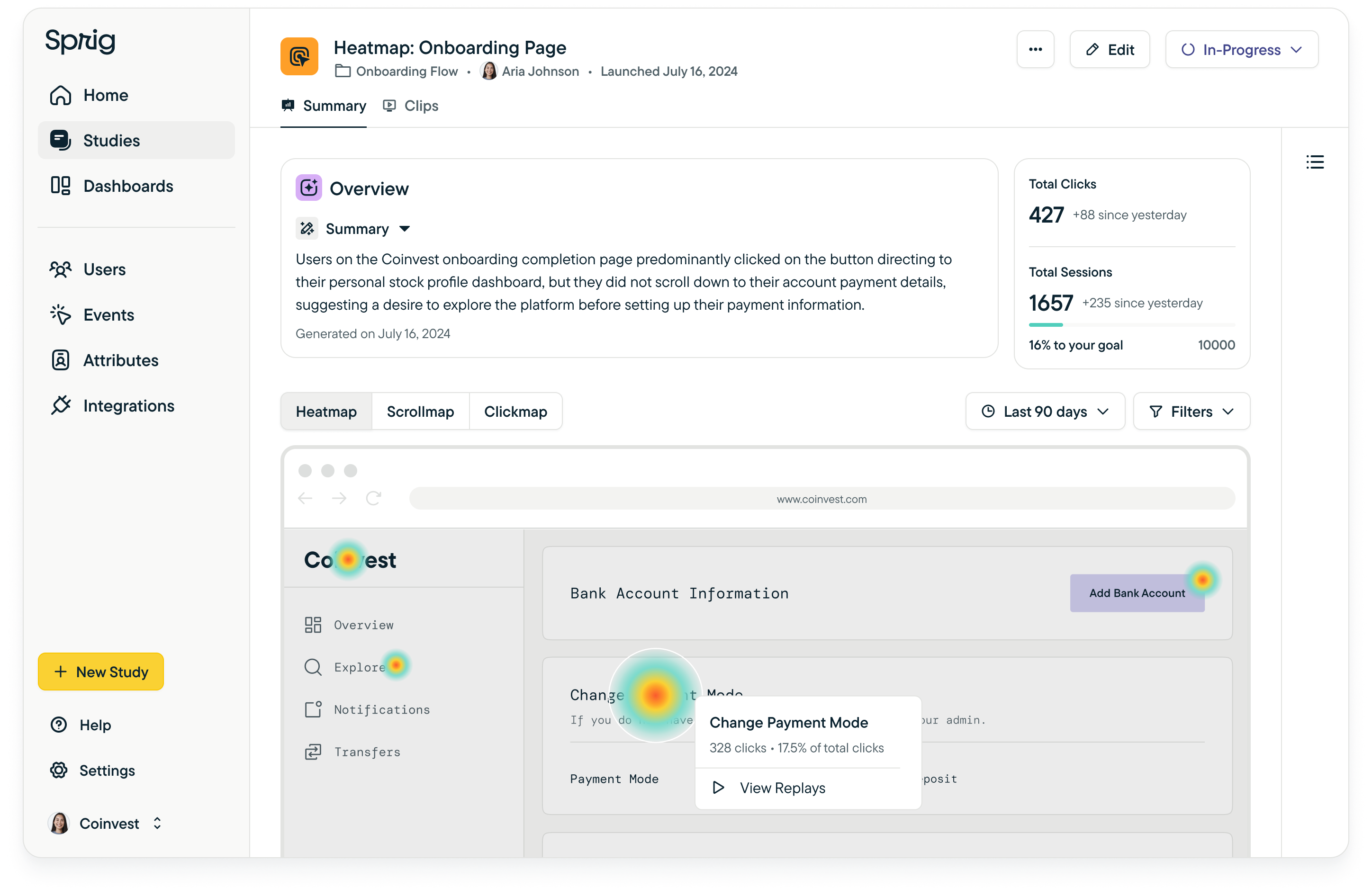
Sprig is an in-product research platform that lets teams deploy targeted micro-surveys, prototype tests, and AI-analyzed feedback prompts directly inside their product, triggered by user events. It closes some of the 'why' gap that Hotjar leaves by pairing behavioral triggers with structured survey responses and AI-generated insight summaries. It's particularly strong for product teams that want to validate specific hypotheses or measure satisfaction at key moments in the user journey.
- ✓ Unlike Hotjar's feedback widgets which are passive and form-based, Sprig lets you trigger targeted research, surveys, prototype tests, or satisfaction prompts, based on specific in-product events, so you're reaching users in context rather than hoping they opt in.
- ✓ Sprig uses AI to automatically summarize open-ended survey responses across respondents, giving you synthesized themes from qualitative answers without manual coding, something Hotjar's feedback tools don't do at all.
5. Maze
Rapid usability testing and prototype research without a research team
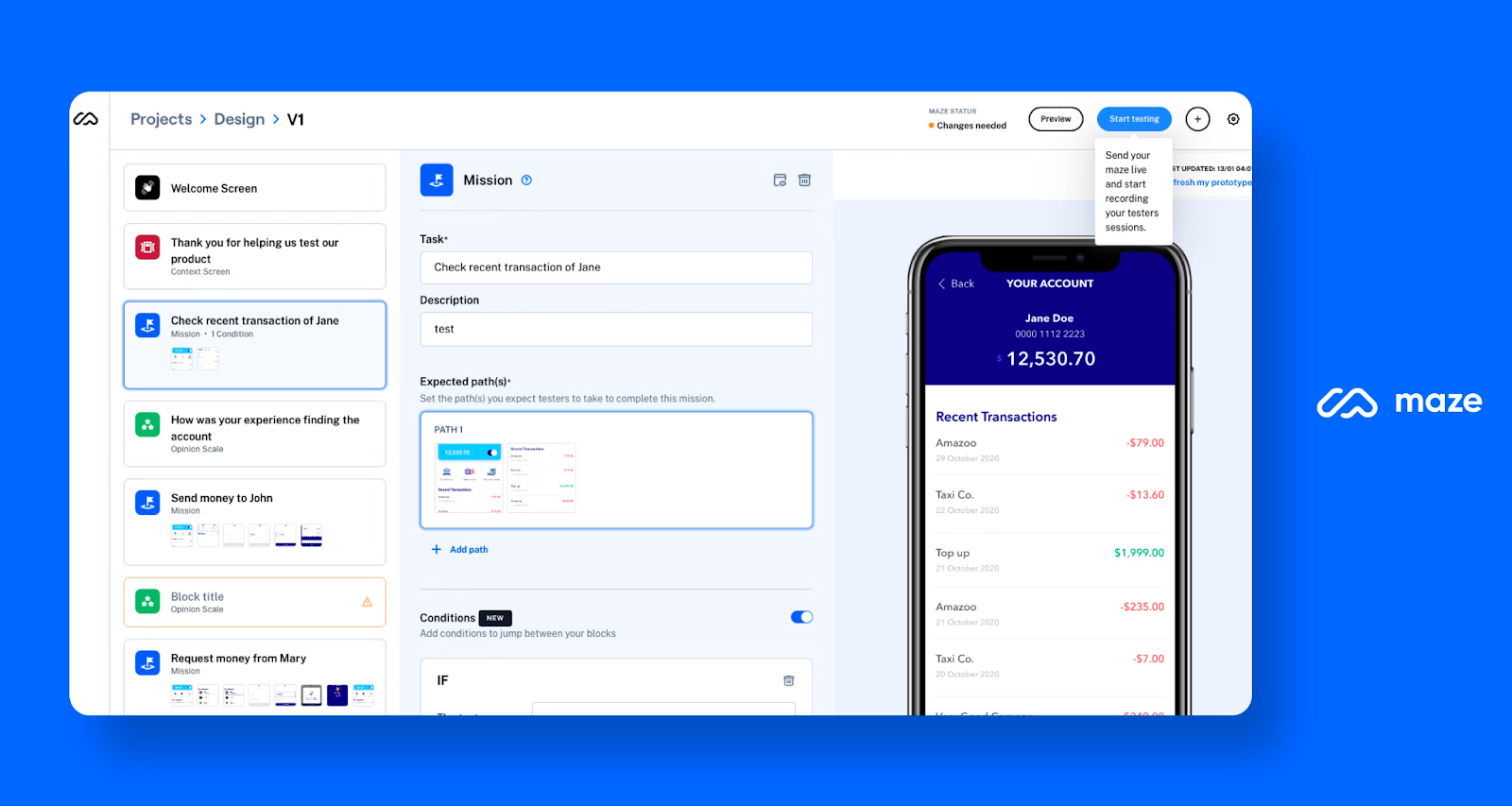
Maze is an unmoderated usability testing platform that lets teams test prototypes, flows, and designs with real users and get quantitative usability metrics, task success rates, misclick rates, time-on-task, alongside open-ended qualitative responses. Where Hotjar shows you what users do in your live product, Maze helps you validate designs before they ship by testing with a panel or your own users asynchronously. It's well-suited for product designers and UX researchers who need structured usability data earlier in the design process.
- ✓ Unlike Hotjar, which only captures behavior on your live product, Maze integrates directly with Figma and other prototyping tools so you can test a design before it's built, catching usability issues earlier when they're far cheaper to fix.
- ✓ Maze gives you quantitative usability metrics like task completion rate and misclick heatmaps alongside open-ended responses, so you get a structured, comparable picture of usability across designs rather than the raw, unanalyzed recordings Hotjar produces.
Want a direct comparison? Read our Usercall vs Hotjar breakdown, feature-by-feature analysis with pricing and a clear verdict on which tool fits your workflow.
| Feature | Usercall AI | Hotjar |
|---|---|---|
| Research Rigor & Methodology | ||
| AI Automated Coding & Themes | ✅ Yes | ❌ No |
| Editable codes for iterative refinement | ✅ Yes | ❌ No |
| Multi-source analysis: interviews, tickets & reviews | ✅ Yes | ❌ No |
| Adaptive, AI-decided follow-up depth (not a fixed follow-up count) | ✅ Yes | ❌ No |
| Evidence-backed analysis, themes traceable to exact quotes | ✅ Yes | ❌ No |
| Detailed AI summaries per theme | ✅ Yes | ❌ No |
| AI Chat with Your Data | ✅ Yes | ❌ No |
| Voice of Customer (VoC) analysis | ✅ Yes | ❌ No |
| Research | ||
| In-product AI-moderated Interviews | ✅ Yes | ❌ No |
| In-product research triggers (e.g. post-purchase insights) | ✅ Yes | ✅ Yes |
| Visual stimulus / concept testing (show images or prototypes during interview) | ✅ Yes | ❌ No |
| Self-Serve & Pricing | ||
| Self-serve, no sales call required | ✅ Yes | ✅ Yes |
| Free to try / transparent pricing | ✅ Yes | ✅ Yes |
| Pay-as-you-go | Pay-as-you-go | Free tier available; paid plans start around $32/month (Basic) up to $171/month (Business), billed annually |
| Platform | ||
| Ideal For | Product Teams, PMs, UX Managers, Startups, Market Researchers | UX designers and web teams analyzing on-page visitor behavior |
What is the best Hotjar alternative for understanding why users drop off?
Usercall is the strongest option if your goal is to understand the reason behind drop-offs, it lets you trigger AI-moderated interviews automatically when users abandon a flow, then synthesizes responses into themes without manual analysis. Tools like Sprig also help by letting you ask targeted in-product questions at key moments, but Usercall goes deeper by running full open-ended conversations rather than structured surveys.
Is there a free alternative to Hotjar?
Microsoft Clarity is the most direct free replacement, it offers unlimited session recordings and heatmaps with no traffic caps and no paid tier required. If you also need feedback collection or basic survey features, Sprig has a free tier. Usercall does not. The first interview is free, and plans start at $89 a month, with pay-as-you-go available. Both go beyond what Hotjar does.
Can any Hotjar alternative analyze open-ended feedback automatically?
Yes. Usercall is specifically built for this: upload interview transcripts, NPS comments, app store reviews, or support tickets and it automatically codes them into themes with confidence scores, generates AI summaries per theme, and lets you query your full dataset conversationally. Sprig also offers AI summaries of survey open-ends, but it only analyzes data collected within its own platform rather than external sources.
What's the difference between Hotjar and tools like Usercall or Sprig?
Hotjar is a behavioral analytics tool, it shows you what users do through heatmaps, scroll maps, and session recordings, but it doesn't capture or analyze what users think or say. Tools like Usercall and Sprig are research tools that collect and analyze qualitative feedback, giving you the motivations and reasoning behind the behaviors Hotjar surfaces, they're complementary layers, not direct replacements for each other.