
Employee Research Surveys: Why Most Companies Get Them Wrong (And How to Fix Yours)
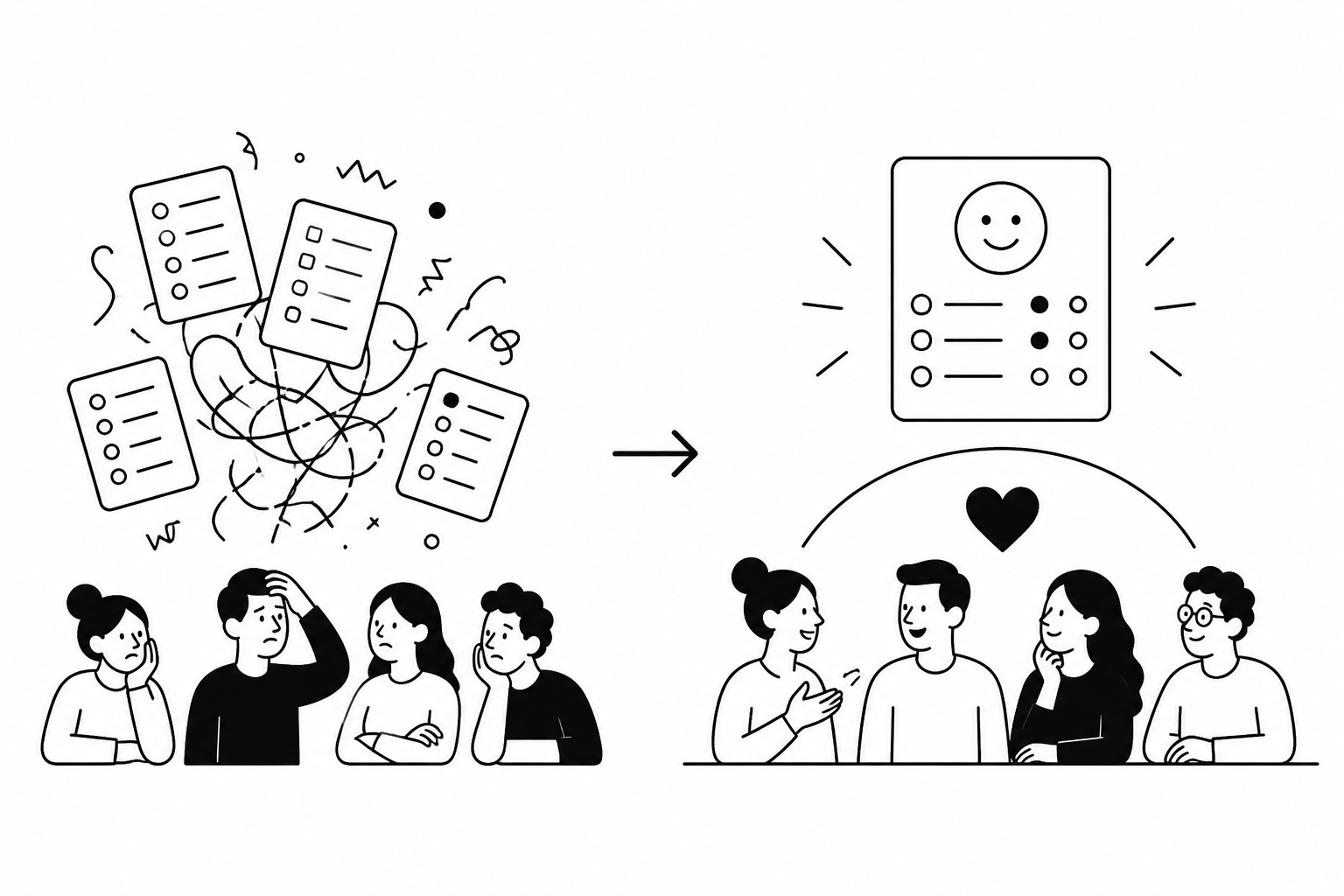
I've sat in the room after an employee survey results meeting more times than I can count. The energy is always the same: a slide with a 3.4 out of 5 engagement score, a shrug, and someone saying "well, at least it's not lower than last year." Nobody knows what to do next. Nobody even knows why the number moved. That's not a data problem. That's a research design problem, and it starts the moment someone builds a survey in an afternoon and calls it "listening to employees."
After a decade of running qualitative and quantitative research programs, I've come to believe most employee research surveys are performative. They exist so leadership can say they asked. The actual insight, the kind that changes a policy or fixes a broken manager relationship, rarely makes it out of the spreadsheet. This guide is about building employee research surveys that produce real answers, not just reassuring averages.
Why Most Employee Research Surveys Fail Before They Start
The failure usually happens at the design stage, long before anyone hits send. Three mistakes show up constantly:
- Vague questions. "How satisfied are you with your job?" tells you almost nothing actionable. Satisfaction with what, exactly? Pay, manager, workload, growth path?
- No theory of what you'll do with the answer. If a low score on a question wouldn't change any decision, the question shouldn't be there.
- Survey fatigue. Employees who've filled out five pulse surveys this year with zero visible follow-through stop giving honest answers. They start picking the middle option just to finish faster.
I worked with a mid-size logistics company a few years back that ran quarterly engagement surveys with 60 questions each. Response rates had dropped to 31 percent, and the open-text comments were basically empty. When we cut the survey to 12 sharp questions and added a short voice-based follow-up for a sample of employees, response rates jumped to 68 percent and we finally got comments with actual substance. The lesson was blunt: fewer, better questions beat comprehensive, boring ones every time.
The Focus Group Trap
When surveys don't give leadership enough color, the default move is to schedule a focus group. HR books a conference room, invites eight to ten employees, and hopes candor shows up. It almost never does, especially when someone's manager is sitting three feet away or the facilitator is clearly aligned with leadership's agenda.
I've run dozens of these sessions and watched the same dynamic play out: one or two people dominate, the quiet majority nods along to avoid conflict, and the "insights" that come out are really just the loudest opinion in the room repeated back as consensus. If you're going to run focus groups for employee research, you need to fix the structural issues that kill honesty, from who's in the room to how questions get sequenced. I broke down the specific mistakes and fixes in this piece on why employee focus groups don't work until you fix these critical mistakes. If you're currently relying on group sessions as your primary qualitative method, read that before your next one.
Asking Questions That Actually Reveal Something
Most employee satisfaction questions are written to be easy to analyze, not to be honest. "Rate your satisfaction from 1-5" is easy to chart and nearly useless for action. The better approach separates satisfaction into its actual components: manager relationship, growth opportunity, workload sustainability, compensation fairness perception, and psychological safety. Each of those needs its own question, phrased in a way that doesn't telegraph the "right" answer.
I once audited a survey for a fintech client where every question started with "Do you agree that..." followed by a positively framed statement. That phrasing alone was inflating their scores by half a point across the board, because agreement bias is real and people default to yes when a question is framed as agreement. Rewriting statements as neutral questions dropped the average score, but the new number was actually true, and leadership finally had a baseline they could trust.
If you're rebuilding your question bank from scratch, I put together a full breakdown of how to phrase satisfaction questions so they surface real signal instead of comfortable noise, in this guide to asking better employee satisfaction survey questions and getting actionable insights. It covers the specific wording traps that quietly wreck your data.
25 Questions Worth Stealing
Sometimes you just need a starting list you can trust, one that's been stress-tested against the common failure modes: leading language, double-barreled questions, and vague abstractions that mean something different to every respondent. I've built and rebuilt employee satisfaction question banks for enough companies that I know which questions consistently produce variance worth analyzing, and which ones just produce flat, uninformative averages.
Here's a sample of the difference between a weak question and a strong one:
| Weak Question | Stronger Alternative |
|---|---|
| Are you satisfied with your job? | In the last month, has your workload felt manageable, too light, or too heavy? |
| Do you feel valued at work? | When was the last time your manager acknowledged a specific piece of work you did well? |
| Is communication good at this company? | Do you usually hear about major company decisions before or after they've already taken effect? |
The full list, with 25 questions across categories like manager trust, growth, workload, and belonging, is laid out in this collection of employee satisfaction survey questions that actually reveal how your team feels. Use it as a starting template, then cut it down to the 10-15 that matter most for your current business problem. Nobody needs all 25 every quarter.
Building an Engagement Survey Program, Not a One-Off Event
A single survey is a snapshot. An engagement survey program is a system that tracks change over time, ties results to specific manager or team-level action plans, and closes the loop with employees about what happened after they gave feedback. The difference between the two is the difference between "we did a survey" and "we run a listening function."
The companies that get this right treat the survey cadence itself as a strategic decision. Annual surveys give you a big comprehensive picture but miss fast-moving issues, like a team blowing up after a reorg. Quarterly pulses catch problems early but risk fatigue if every pulse feels like the last one. The right model usually blends a deep annual survey with short, targeted pulses tied to specific events: a new manager starting, a product launch, a layoff round.
I laid out a full framework for structuring this cadence, picking the right questions for each survey type, and avoiding the fatigue trap in this guide covering engagement survey strategy, top questions, and real examples. If you're starting an engagement program from scratch or trying to fix one that's stalled out, that's the place to start.
Measuring What Actually Matters (Not Just What's Easy to Chart)
Here's an uncomfortable truth: a lot of the metrics companies track in employee surveys, like overall engagement score or eNPS, are easy to report up the chain but don't actually predict anything useful, like attrition risk or team performance. I've seen companies with a stable eNPS of 40 lose their entire senior engineering team in six months because the survey never asked the right question about growth stagnation or compensation competitiveness relative to the market.
What actually matters is picking two or three metrics that are genuinely predictive for your business and tracking them relentlessly, rather than chasing a composite score that sounds good in a board deck but doesn't tell you where the fire is. This usually means combining survey data with behavioral signals: internal mobility rates, time-to-promotion, manager 1:1 frequency, and exit interview themes. The survey alone is never the full picture.
I go deep on how to identify the metrics worth tracking, and how to structure your analysis so results actually drive changed behavior instead of just a report nobody reads, in this piece on measuring what really matters in employee satisfaction surveys and using it to drive change. It's the most practical resource I've written on connecting survey data to action.
Designing Surveys People Actually Want to Answer
Response rate is a design problem, not a motivation problem. If your response rate is low, the fix usually isn't a reminder email or a raffle prize, it's the survey itself. Long surveys, vague purpose statements, and no visible follow-through from the last round are the real culprits.
A client I worked with in retail had this exact issue. Their engagement survey had a 22 percent completion rate, and their instinct was to offer a gift card incentive. We tested a different fix instead: we cut the survey from 45 questions to 15, added a one-sentence explanation of why each section existed, and opened with a summary of what changed after the last survey based on employee feedback. Completion jumped to 61 percent with zero incentive spend. People will answer honestly when they believe it matters and it doesn't cost them ten minutes of their break.
I broke down the specific design choices, including communication timing, question sequencing, and how to signal to employees that their input actually shapes decisions, in this guide to creating engagement surveys that people actually want to fill out. It's worth reading before you send your next round, especially if fatigue is already a problem in your organization.
Where Surveys Stop Working and Interviews Take Over
Surveys are great at telling you the size of a problem. They're bad at telling you why it exists. A survey can tell you 40 percent of your team feels unsupported by management, but it can't tell you whether that's about communication style, unclear priorities, favoritism, or something structural like span of control being too wide. For that, you need a conversation, not a checkbox.
The traditional path here is expensive and slow: hire an agency, schedule 15-20 interviews, wait three weeks for a report. Most HR and people teams don't have that budget or that timeline for every question that comes up. That's the gap Usercall was built to close. It runs AI-moderated voice interviews at scale, so instead of choosing between a shallow survey and an expensive round of manual interviews, you can send employees a voice conversation that adapts follow-up questions in real time based on what they actually say, then automatically organizes the responses into themes linked directly back to the quotes that support them.
I've used this approach to follow up on survey findings that didn't have an obvious explanation. When a client saw a drop in a specific team's engagement score with no clear cause in the quantitative data, we ran a short voice interview round with that team the following week. The themes came back within a day, and it turned out the real issue was a reporting structure change that hadn't been communicated clearly, something that never would have shown up as a checkbox option in a standard survey.
Get Started
If your employee research program is stuck producing scores nobody trusts and comments nobody acts on, the fix isn't more surveys, it's better ones paired with real conversations where they matter most. Usercall lets you run AI-moderated voice interviews at scale, so you can go beyond the survey number and actually understand why your people feel the way they do, without waiting weeks or hiring an agency. Try it on your next employee research round and see what your team has actually been trying to tell you.