
Food Focus Group Guide: The Mistakes That Make Consumers Say “Yes” and Never Buy
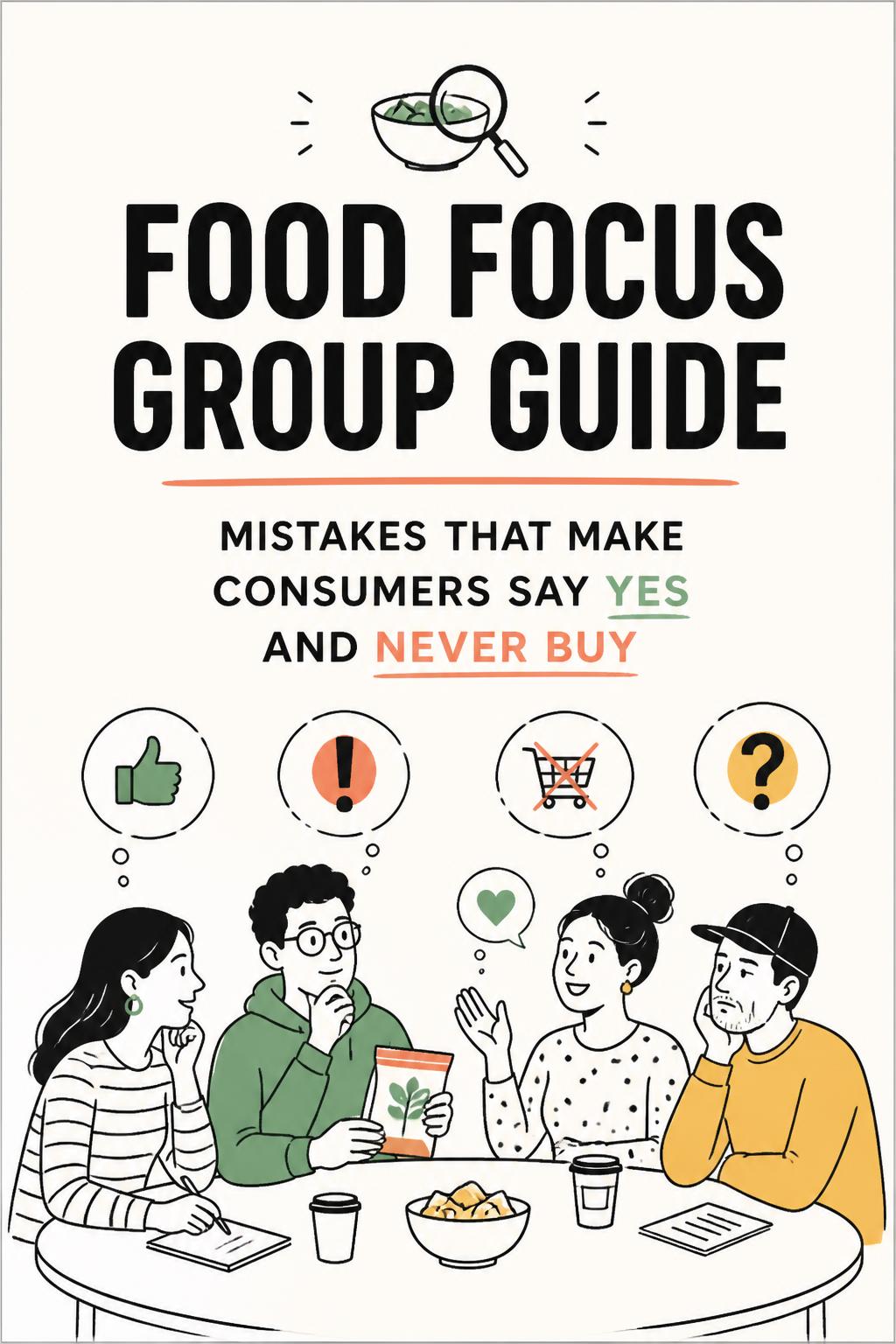
A food focus group can give a team the most dangerous sentence in product development: “Everyone liked it.” I have seen it happen with a high-protein pudding that scored warmly in a research facility, won praise for its low sugar claim, and looked ready for launch. Yet when we asked participants to choose between it and the product they had actually bought the previous week, most reached for the familiar full-sugar alternative. The issue was not that consumers had lied. They had answered an easy question—“Is this good?”—when the business needed an answer to a much harder one: “Will this replace something people already buy?”
That gap is why many food focus groups generate enthusiastic debriefs and disappointing sales. Food consumers are skilled at explaining what they should want: cleaner labels, more protein, less waste, more sustainable ingredients. But purchase behavior is shaped by the fridge, the budget, the children, the time of day, the texture of the first bite, and whether the product feels worth buying again. If your research does not expose those pressures, it is collecting compliments, not commercial evidence.
What a Food Focus Group Should Actually Decide
The purpose of a food focus group is not to collect a popularity score. Quantitative testing can tell you how broadly a reaction occurs. Qualitative food research should explain the mechanism behind that reaction: what consumers compare the product with, which compromise they will tolerate, which promise they distrust, and what needs to happen for trial to become repeat purchase.
I take a firm position here: “Would you buy this?” should never be treated as a finding. It is a prompt for follow-up. A participant may say yes because they enjoy being asked, approve of your mission, like a package, or want to present themselves as health-conscious. Ask instead: “What did you buy the last time this situation happened?” “What would this replace in your basket?” “When would you choose it over your usual option?” “What would make you stop buying after the first purchase?”
Those questions reveal whether the product has a real job. A spicy snack may be enjoyable but too messy for the car. A plant-based entrée may fit a consumer’s values but fail the household dinner test because their partner expects a larger portion. A functional beverage may taste excellent but lose to coffee because consumers do not understand when to drink it. These are not minor observations. They determine formulation, positioning, pack size, price architecture, and where the product belongs on shelf or menu.
Why Standard Food Focus Groups Fail
The usual research sequence is backwards. Teams often reveal the brand, polished packaging, product claims, and concept before participants have tasted the food. Then they ask for impressions. By that point, consumers are evaluating the story you supplied. A premium-looking pack can make a merely acceptable product feel premium in a room. A “high protein” badge can make participants work harder to find positive language. Neither effect tells you whether the product will earn a second purchase.
Another failure is recruiting broad category buyers. “Adults who buy snacks” is not a meaningful consumer group for most decisions. The parent packing school lunches, the runner buying post-workout fuel, and the desk worker trying to avoid an afternoon slump can all purchase snacks, but they are hiring products for different jobs. If their feedback conflicts, that may not be a research problem. It may be evidence that your product only fits one occasion well.
Group consensus is also routinely overvalued. When four participants call a sauce “comforting” and four call it “heavy,” do not average their feedback into a weakly positive conclusion. Find the dividing line. Perhaps regular premium sauce buyers associate richness with quality, while calorie-conscious shoppers see the same attribute as a reason not to repurchase. The useful output is not an average reaction; it is a choice about which consumer you are willing to serve.
The Better Approach: Study the Whole Food Decision
Food products do not compete in a tasting room. They compete inside a consumption system: an occasion, a mood, a location, a budget, a routine, and a set of imperfect alternatives. The product may be discovered in a store, purchased online, stored for days, prepared under time pressure, shared with others, and judged later when consumers decide whether it was worth the money.
That is why a food focus group should begin well before the product is introduced. Reconstruct a recent, specific purchase occasion in detail. Ask participants where they were, what else they considered, who the item was for, what was already at home, what they paid, and what happened when it was consumed. Recent behavior is not perfect evidence, but it is dramatically more useful than generalized claims such as “I try to eat healthy.”
In a study I moderated for a chilled meal brand, the client assumed its main competitor was another prepared-meal range. It was not. Participants described choosing among three options at 6:00 p.m.: ordering delivery, assembling something from the fridge, or accepting the effort of cooking. The product was judged less on flavor than on whether it made a stressful evening feel solved. That changed the brief from “improve taste appeal” to “prove dinner reliability.” The team revised portion cues, preparation instructions, and the imagery used at purchase.
The REAL Framework for Food Focus Group Research
To keep teams from slipping back into vague opinion gathering, I use the REAL framework. It is designed to uncover purchase reality before a group is asked to assess a product concept.
- Reconstruct the last occasion. Start with the latest relevant purchase, not a typical one. Explore the trigger, shopping channel, alternatives, price, household context, preparation, consumption, and post-consumption reaction.
- Examine the current substitute. Your competitor may be another brand, another category, a homemade solution, or doing nothing. A breakfast bar may compete with coffee and a banana more than it competes with other bars.
- Let sensory response come before the sales story. Where possible, capture blind or minimally cued tasting reactions before revealing brand, benefit claims, ingredients, pack design, and price. First sensory language is often the cleanest diagnostic signal.
- Locate the repeat-purchase barrier. Separate what creates curiosity from what creates habit. Trial can come from novelty; routine buying requires reliable value, clear usage, and a product that satisfies in the right moment.
The framework is especially important for products that ask consumers to accept a tradeoff. Lower sugar can mean less indulgence. Plant-based can signal unfamiliar texture. Clean label can raise concern about shelf life or taste. Premium ingredients can make the price feel difficult to justify. A good food focus group does not hide these tensions behind positive concepts. It makes consumers articulate which tradeoff is acceptable, for whom, and in which situation.
Use a Reveal Sequence That Separates Product Truth From Marketing Halo
When physical samples are available, control what participants learn and when. This is one of the simplest ways to make food research more credible. Do not let an attractive concept board do the product’s job.
- Explore the category and recent purchase behavior. Establish the language, routines, and decision criteria consumers already use.
- Conduct a blind taste or usage evaluation. Capture spontaneous responses before participants know what they are expected to value.
- Reveal the product description and benefits. Identify which claims strengthen appeal and which create skepticism or unrealistic expectations.
- Reveal packaging and price. Test whether the complete offer feels credible and worth choosing over the current alternative.
- Place the product in a realistic competitive context. Ask participants to make a choice from a shelf, menu, cart, or set of substitutes rather than discussing the product in isolation.
Each reveal should change the conversation. If consumers love a drink blind but cool off when they hear it costs $4.99, you do not have a taste problem. You have a value equation problem. If they find a product ordinary blind but become interested once they understand its gut-health benefit, you may have a viable proposition—but only if the benefit can overcome an unremarkable sensory experience on repeat.
I once worked on a premium frozen dessert where participants praised the package before tasting but described the texture as “powdery” and “strangely dry” when blind. The internal team initially wanted to emphasize the indulgent packaging cues harder. We argued against it. Better photography might improve first purchase, but it would amplify disappointment at the first spoonful. The right decision was to fix the formulation before spending more on the story.
Recruit by Occasion and Tradeoff, Not Demographics Alone
Demographics are useful descriptors; they are weak explanations of food behavior. The person who buys a product, prepares it, serves it, and decides whether it returns to the basket may not be the same person. Recruit the decision-maker for the occasion you need to win.
- Category frequency: Distinguish habitual buyers, lapsed buyers, and occasional users. They have different expectations and different tolerance for novelty.
- Occasion ownership: Include the shopper, preparer, or household gatekeeper rather than recruiting only people who consume the category.
- Existing workaround: Recruit consumers who already solve the need with an alternative, such as takeout, a homemade recipe, another category, or a routine they are reluctant to disrupt.
- Required compromise: Screen for consumers who have encountered the tradeoff your product introduces: premium price, reduced sugar, unfamiliar ingredients, limited convenience, or a new preparation behavior.
The goal is not to make every respondent identical. It is to compare meaningful contexts. A narrow group with a strong, repeated need is usually more valuable than a broad room full of people who find the product “interesting.” Interesting is not a demand signal.
Turn Food Focus Group Output Into Product Decisions
A transcript organized by discussion guide questions is not a strategy. The final synthesis should answer decisions that a product, brand, and insight team can act on. Which occasion should the product own? Which sensory cue is non-negotiable? What existing alternative is it replacing? Which claim earns attention but creates a credibility risk? What must change before a quantitative validation or market test?
Evidence type — How much weight to give it
Blind tasting, forced choice, or observed selection — Strong evidence of immediate sensory and choice behavior.
Detailed reconstruction of a recent purchase — Strong evidence of category routines and real constraints.
Response after packaging, claims, and price reveal — Useful evidence of proposition strength and value perception.
“I would buy this” with no specific occasion — A hypothesis only; never a launch recommendation.
Use qualitative findings to create sharper hypotheses, not artificial certainty. If research suggests that a snack wins among commuters who need a filling, non-messy option, test that specific occasion, price point, and message. Do not broaden the claim into “busy health-conscious adults like it.” That kind of vague conclusion is how good consumer insight becomes unusable positioning.
Scale the “Why” With Research-Grade AI, Not Generic Summaries
Food teams rarely lack consumer feedback. They lack a way to connect tasting sessions, open-ended surveys, product reviews, support conversations, social comments, and behavioral data without flattening everything into themes such as taste, price, and packaging. Those categories are too broad to guide action.
AI can identify patterns faster. It cannot replace judgment about whether a pattern is a formulation problem, a segmentation opportunity, or an expectation set by misleading packaging. Researchers still need to preserve stimulus order, distinguish vivid quotes from repeated evidence, and understand the category context behind the language.
The Best Food Focus Groups Make It Harder to Fool Yourself
A food focus group should challenge the product team’s favorite theory, not decorate it with consumer quotes. If people say they like the product, ask what it replaces. If they praise the health claim, ask what sensory sacrifice they will accept. If they say they would buy it, ask them to recreate the actual shelf, menu, or weekday moment where that decision happens.
The strongest outcome is not unanimous approval. It is a clear answer to a harder commercial question: for this consumer, in this occasion, against this alternative, does the product earn repeat purchase? Build your food focus group around that question, and you will leave with decisions worth acting on—not just a room full of polite enthusiasm.
Polite taste-test approval doesn't predict repeat purchase, and that gap is exactly what most food focus groups miss. Our focus group research guide breaks down why groups produce false positives across categories, not just food. If you'd rather get honest reactions without the sensory-panel theater, Usercall can help you run one-on-one conversations that surface real purchase objections.
Related: avoiding polite feedback in product focus groups · how to conduct a focus group that produces insight · why market research focus groups pay for polite answers