
Coding Techniques in Qualitative Research: 7 Methods That Turn Interviews Into Decisions
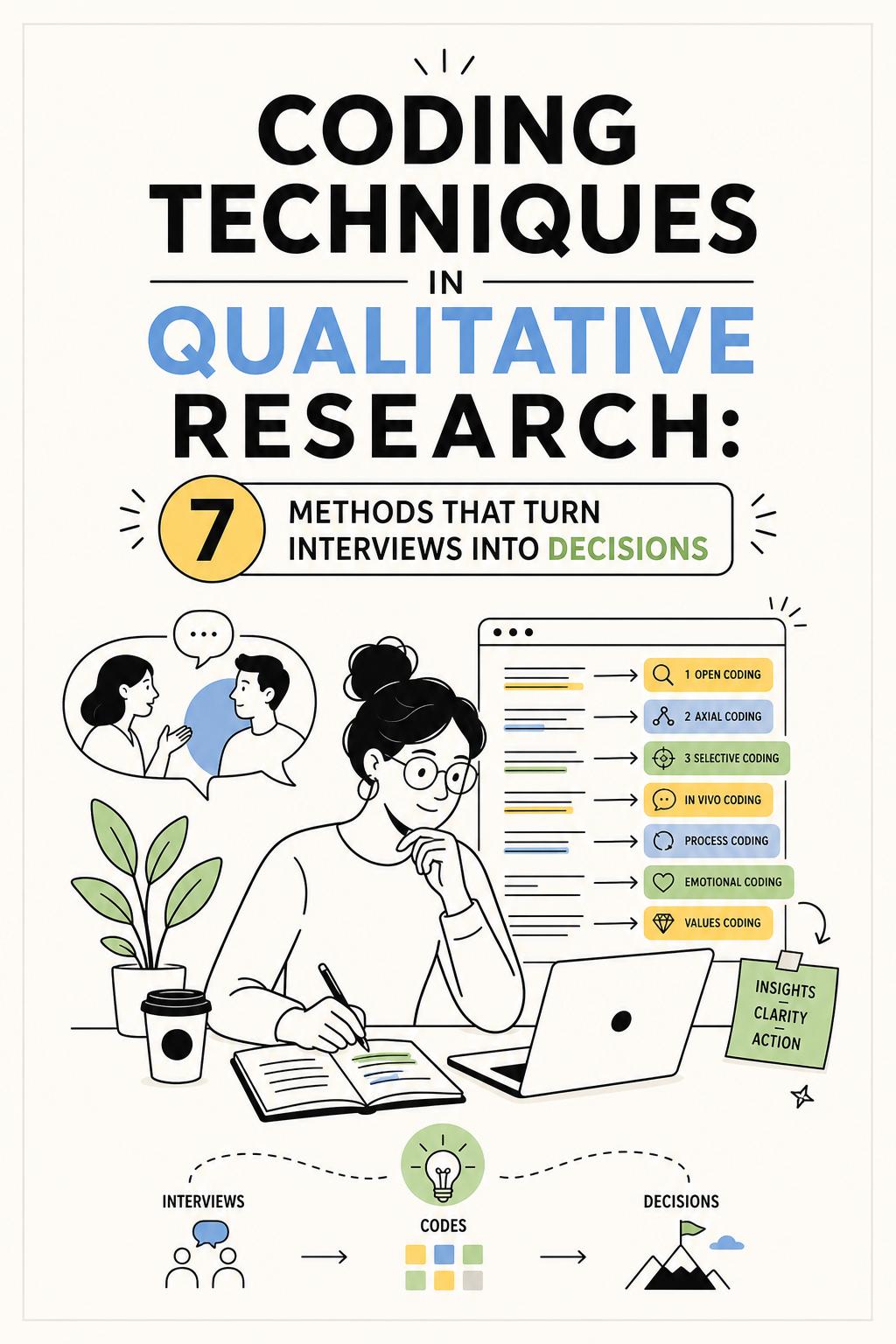
The most damaging qualitative research mistake is also the most common: treating coding as a filing task. A team interviews 15 customers, highlights hundreds of passages, creates 60 codes, and ends with a slide that says, “Users need a simpler experience.” After two weeks of work, nobody can say which moment is confusing, for whom, or what should change first.
I have watched smart product teams mistake a crowded codebook for rigor. It is not rigor. It is avoidance. When every comment gets a label, no pattern has to earn its place. The result is a report full of quotes and a roadmap still driven by the loudest stakeholder in the room.
The point of coding techniques in qualitative research is not to document everything participants said. It is to identify the decision logic behind what they did: what triggered action, what created hesitation, what workaround exposed a product gap, and what tradeoff they were trying to manage. Good coding turns interviews into evidence. Great coding makes that evidence difficult to ignore.
Why Most Qualitative Coding Produces Weak Findings
The default approach is topical coding. Researchers label passages “onboarding,” “pricing,” “feature request,” “support,” or “competitor.” Topic codes are useful for locating material, but they are a poor endpoint for analysis because they flatten fundamentally different problems into the same bucket.
Take “pricing feedback.” One participant may not understand plan limits. Another may lack budget authority. A third may believe the product costs too much because they have not reached the moment of value. A fourth may be willing to pay more but cannot use annual contracts. Those are four different mechanisms, requiring four different interventions. Calling them all “pricing” creates the illusion of a single problem.
Another common failure is coding words instead of behavior. Participants often explain their decisions after the fact, and their explanations can sound convincing without being accurate. Someone may say, “I wanted more features,” while their actual workflow shows they abandoned the product because they could not confidently share an output with their manager. Their stated request is more features; their barrier is professional risk.
Frequency is also routinely misused. If 12 of 18 people mention an issue, pay attention. But do not confuse prevalence with priority. A problem mentioned by only three enterprise administrators may still matter more than a common annoyance if it blocks a six-figure rollout, creates a compliance failure, or destroys trust at a critical decision point.
The better approach is to code for mechanisms and conditions, not just topics and counts.
The Mental Model: Code for Decisions, Not Conversations
Every useful qualitative finding should explain a decision. That decision may be buying, adopting, inviting teammates, abandoning setup, escalating to support, exporting data, or returning to an old workflow. Your codes should help reconstruct the chain of events around it.
Use this simple model: Context → Trigger → Tension → Behavior → Consequence.
For example, a participant says: “I downloaded the report as a PDF and sent it to my director because she does not have access to the platform.” A basic code might be “reporting.” That is not wrong; it is simply incomplete.
- Context: A director needs to review results but does not use the product directly.
- Trigger: The participant needs approval before moving forward.
- Tension: The live product does not fit the stakeholder’s access or review habits.
- Behavior: The participant exports a static artifact.
- Consequence: Important context is lost, and the product becomes harder to champion internally.
The analytic code might be: Uses static exports to bridge a stakeholder access gap. That code leads to a meaningful product question: should the team improve PDF exports, or create a lightweight review experience for non-users? Coding is valuable because it helps distinguish symptoms from the system that produces them.
7 Coding Techniques in Qualitative Research Worth Using
1. Descriptive Coding: Build the Map Before You Make the Argument
Descriptive coding applies short labels to the basic subject of a passage: “trial setup,” “budget approval,” “data export,” “team handoff,” or “mobile workflow.” It is useful in large studies, multi-researcher teams, and early familiarization because it makes a messy dataset navigable.
But descriptive coding should be your first pass, not your conclusion. It answers, “What are participants discussing?” It does not answer, “Why does this matter?” Researchers get into trouble when they present descriptive categories as insights.
2. In Vivo Coding: Preserve Language That Reveals a Mental Model
In vivo coding uses a participant’s exact phrase as the code. Use it when wording reveals how people frame a problem, describe a job, or signal an emotional barrier. “I am not ready to invite the team into a mess” is far more revealing than “collaboration concern.”
In vivo codes are especially valuable in exploratory research, brand positioning, jobs-to-be-done work, and AI product research, where internal terminology can distort what customers actually believe is happening. They preserve customer language before your organization translates it into feature language.
Use this technique selectively. A codebook full of exact quotes is not analysis. Save in vivo codes for phrases with strategic meaning, then connect them to a broader behavioral pattern.
3. Process Coding: Follow What People Actually Do
Process coding labels actions with gerunds: “checking with finance,” “rebuilding in a spreadsheet,” “seeking reassurance,” “waiting for approval,” “comparing alternatives,” or “working around permissions.” For UX, product, and B2B research, this is often the highest-value technique.
People’s opinions are volatile; their workflows are harder to fake. A participant may say a dashboard is intuitive, yet export the data every Friday and recreate the calculations in Excel before presenting them. The praise tells you the interface is pleasant. The behavior tells you the output is not trusted enough for a high-stakes decision.
In one study with operations managers, I had 14 interviews and only six business days to deliver a directionally reliable answer. Participants repeatedly called the analytics interface “easy to use.” Process coding exposed a more important pattern: 11 of 14 were recalculating metrics outside the product before sharing results. The issue was not usability. It was a missing audit trail. The product team stopped prioritizing dashboard polish and focused on calculation transparency, source visibility, and shareable evidence.
4. Emotion Coding: Find the Stakes Hidden Behind Feature Requests
Emotion coding identifies anxiety, embarrassment, uncertainty, urgency, relief, loss of control, or fear of blame. Some researchers avoid it because it sounds subjective. That is a mistake. In real buying and adoption decisions, emotion often explains why a minor friction becomes a deal-breaker.
Code tensions such as “avoiding visible failure,” “protecting credibility,” “needing defensible evidence,” “feeling exposed by missing knowledge,” and “trading speed for certainty.” These codes are particularly powerful when users must explain their choices to a manager, client, procurement team, or cross-functional partner.
I once heard a product manager say, “I cannot walk into planning with a pile of anecdotes.” The superficial interpretation would be that she needed more customer feedback. The deeper issue was that she needed evidence leadership would accept as credible. We coded this as needs decision-ready proof, not “feedback volume.” That distinction led to a recommendation to connect recurring qualitative themes to segments, product behavior, and business outcomes.
5. Values Coding: Identify What People Are Protecting
Values coding captures principles participants are defending: autonomy, fairness, speed, consistency, privacy, craftsmanship, certainty, or customer empathy. It is useful when teams face genuine design tradeoffs rather than straightforward usability defects.
For example, administrators may insist on detailed permissions not because they love complexity, but because they are protecting accountability. Individual contributors may resist those same permissions because they are protecting speed. The finding is not that one group wants controls and another wants simplicity. The finding is that the product must separate governance from everyday momentum.
6. Contradiction Coding: Treat Mismatches as Data, Not Noise
Contradictions are frequently the richest moments in an interview. Code when participants say one thing but do another, praise a process they bypass, or describe a feature as unimportant while repeatedly returning to it.
Useful contradiction codes include “states preference for automation but manually verifies output” and “claims low need for collaboration but relies on informal review.” These mismatches often reveal trust gaps, social constraints, or habits that participants cannot articulate directly.
7. Pattern Coding: Turn Fragments Into Explanations
Pattern coding is a second-cycle technique. It groups first-cycle codes into an explanatory category. “Searching Slack,” “asking a veteran colleague,” “reusing old decks,” and “rebuilding prior analyses” may become relying on informal organizational memory.
This is the moment where coding becomes analysis. A pattern code should make a claim about what is happening across participants. If your final report only repeats first-cycle labels, you have organized the data but not interpreted it.
A Two-Cycle Workflow That Produces Defensible Findings
Do not begin by building an enormous codebook. Begin by naming the decision the research must inform. “Understand onboarding” is too vague. “Why do qualified trial users fail to invite a teammate within seven days?” gives your analysis a useful center of gravity.
- Write the decision question. Name the user, behavior, timeframe, and business consequence.
- Read three to five interviews without coding every line. Write a memo after each: What happened? What changed the participant’s behavior? Where did behavior contradict their explanation?
- Create a provisional first-cycle code set. Combine descriptive, process, emotion, contradiction, and in vivo codes. Keep the initial set tight.
- Calibrate with a shared sample. If multiple researchers are coding, apply codes to the same two interviews and resolve differences in definitions before scaling.
- Create second-cycle pattern codes. Group related codes, identify causal links, and name the underlying mechanism rather than the topic.
- Search for negative cases. Deliberately examine people who did not fit the dominant pattern. A finding that cannot explain exceptions is usually too simplistic.
- Write findings in decision language. State who is affected, what mechanism is occurring, what evidence supports it, and what action follows.
Build a Codebook That Stops Meaning From Drifting
A codebook is not bureaucratic overhead. It is how you prevent “trust,” “pain point,” and “friction” from becoming meaningless catch-all labels halfway through a study. Each code needs a clear definition, inclusion criteria, exclusion criteria, an example, and a note on whether it is descriptive or interpretive.
For instance, define seeking reassurance as: “An attempt to validate a decision through another person, source, or signal before proceeding.” Include asking a manager, looking for peer examples, comparing against a known tool, or checking historical results. Exclude routine collaboration that does not involve uncertainty.
On an eight-day project involving 24 interviews and three researchers, our original “trust” code became a warning sign. It included security concerns, distrust of AI-generated output, uncertainty about data freshness, and fear a manager would challenge a recommendation. Once we split the code, the strongest pattern was clear: participants did not primarily distrust the system; they lacked a way to explain and defend its output to others. One vague code had concealed the most actionable finding in the study.
AI Can Accelerate Coding, but It Cannot Own the Interpretation
AI can rapidly cluster repeated ideas, retrieve evidence, compare segments, and surface outlier statements across dozens of interviews. That is valuable, especially when research teams need to understand why a metric moved and must review participant feedback before the next planning cycle.
But AI-generated themes are often topical by default. They may summarize “users mentioned onboarding” without identifying whether the underlying problem is premature configuration, weak value demonstration, missing stakeholder approval, or distrust of the data. Researchers must set the analytic frame, inspect source evidence, challenge neat summaries, and decide whether a pattern changes a product decision.
Research-grade AI-native qualitative analysis is most useful when it preserves that control: researchers can define the question, interrogate themes, trace every claim back to participant evidence, and run AI-moderated interviews with appropriate guardrails. It can also support targeted user intercepts at key product moments, such as after a failed activation event or repeated export behavior, to capture the why behind product analytics. Speed is useful; unexamined automation is not.
What a Strong Finding Looks Like
A strong finding is not a quote, a theme, or a percentage. It is a testable explanation with consequences.
“Users want easier onboarding” is weak because no one can reasonably disagree, and it does not tell the team where to act. This is stronger: “Experienced users postpone workspace setup because governance questions appear before they see a useful result. They interpret the product as administrative work, so they delay inviting teammates until they can justify the effort.”
That finding identifies the audience, mechanism, and design tradeoff. It suggests a specific action: demonstrate value before asking users to configure governance, while preserving controls for administrators who need them.
Good qualitative coding does not make research look quantitative. It makes human evidence specific enough to change a decision.
The standard is simple: if your coding techniques cannot reveal the tradeoffs people are managing, you are tagging transcripts, not doing analysis. Code what people are trying to accomplish, what they are protecting, and what forces them into workarounds. That is where the decisions are.
Choosing the right coding method matters, but so does the software you use to apply it consistently across a growing dataset. Compare your options in our guide to the 5 qualitative data analysis tools that actually work, or try Usercall to see how automated coding can speed up these exact techniques.
Related: in vivo coding step-by-step · inductive vs deductive coding approaches · turning codes into a usable codebook