
Industry Specific Research: Why Your Generic Interview Guide Is Failing You
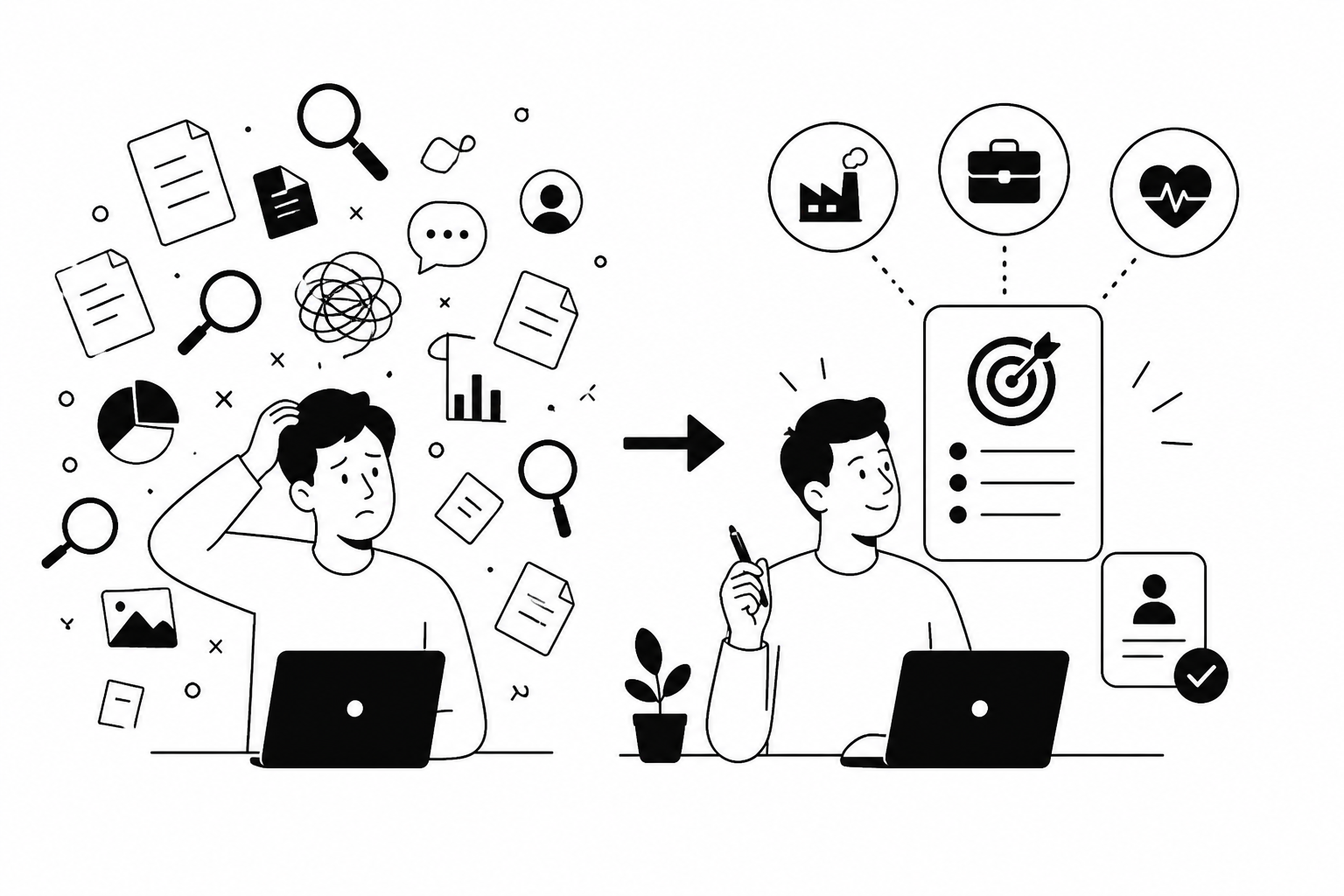
I once watched a researcher run the exact same discovery script for a fintech client and an edtech client, back to back, in the same week. Same questions. Same probes. Same "walk me through the last time you..." opener. The fintech interviews felt like pulling teeth. The edtech interviews felt like therapy sessions where nobody wanted to leave. Same researcher, same skill level, wildly different outcomes.
That was the moment I stopped believing in "universal" research methodology. There is no such thing as a generic interview that works everywhere. Healthcare users talk differently than SaaS buyers. Teachers describe pain points in a completely different vocabulary than a CFO evaluating a payments product. If you're running research the same way across every vertical, you're leaving insight on the table, and you probably don't even know it because you don't have a baseline to compare against.
After a decade of running qualitative studies across close to a dozen industries, I've learned that the methods stay roughly the same (interviews, diary studies, usability tests) but the execution has to flex hard by vertical. Below is what I've learned works, industry by industry, and where most teams get it wrong.
Why "One Size Fits All" Research Breaks Down by Vertical
Every industry has its own decision-making structure, its own emotional stakes, and its own jargon. A B2B buyer is rarely the end user. A patient is rarely thinking in "features." A student doesn't separate "the product" from "the class" the way a software user separates the app from their job.
If you want a deeper breakdown of how methods actually shift by sector, from stakeholder mapping to interview cadence to recruitment channels, I'd start with this guide to UX research across industries and how product teams adapt methods by vertical. It's the closest thing I have to a master framework, and everything below builds on top of it.
The short version: the method doesn't change much. The context, the language, the stakeholders, and the trust-building required to get honest answers change completely.
B2B: You're Not Interviewing the User, You're Interviewing a Committee
The single biggest mistake I see product teams make in B2B research is treating the interview subject like a consumer. They're not. They're one node in a buying and usage committee that might include a champion, a budget holder, an IT gatekeeper, and three end users who never got asked their opinion before the contract was signed. I ran a study for a workflow automation company where we thought we were talking to "the user." Turned out the person on the call hadn't touched the product in four months. Her direct report used it daily and had opinions that would have completely changed our roadmap. We almost shipped a redesign based on secondhand impressions.
In B2B research, you have to explicitly ask who else touches this product and why, then go get those people. You also need to separate "what would make you renew" from "what would make you recommend this to a peer," because in B2B those are frequently different people answering different questions in your buyer's head.
For a full playbook on running B2B interviews that actually influence your roadmap instead of just confirming what sales already told you, read this guide to B2B customer research and how to run interviews that shape your roadmap.
Fintech: Trust Is the Research Variable Nobody Measures
Fintech research has a unique problem: people lie about money. Not maliciously, but out of habit. They round up their savings, downplay their debt, and describe their financial behavior as more organized than it actually is. If you take these answers at face value, you'll build a product for a customer who doesn't exist. The fix is behavioral anchoring. Instead of asking "how do you manage your budget," ask "walk me through exactly what you did the last time a bill surprised you." Concrete, recent, specific. Vague questions get vague, aspirational answers. Specific questions get truth.
Compliance and security concerns also shape everything about fintech research logistics, from how you handle screen recordings to how explicit you need to be about data handling before someone will even agree to a call. I've had fintech participants ask more questions about our recording policy than about the actual incentive.
If you're building or refining a research process for a financial product, this guide on fintech user experience research and what financial product teams need to discover what users actually need covers the recruitment and framing issues that are unique to money-related products.
Healthcare: Map the Journey Before You Map the Product
Healthcare is the one vertical where I tell every new researcher on my team the same thing before their first study: forget the product for the first twenty minutes. Understand the journey first. Patients don't experience healthcare as a series of app screens. They experience it as a terrifying, confusing, emotionally loaded sequence of events: symptom, appointment, diagnosis, treatment, follow-up, billing surprise. Your product is a tiny slice of that timeline, and if you don't understand the whole arc, you'll optimize a feature that solves a problem the patient stopped caring about three steps ago. I worked on a patient portal project where the team was obsessed with reducing clicks to schedule an appointment. Turned out the real drop-off point was three days before scheduling, when patients were still deciding whether their symptom was "worth bothering a doctor about." No amount of UI polish on the scheduling flow was going to fix that.
Journey mapping isn't optional in healthcare research, it's the foundation everything else sits on. This research guide to patient journey mapping for healthcare product teams walks through how to structure that mapping work properly, including how to handle the emotional sensitivity that comes with health-related interviews.
Education and EdTech: Your Real User Isn't Always Your Buyer, Or Even in the Room
Education research has a structural quirk that trips up almost every team coming from consumer or B2B backgrounds: the person using the product (the student), the person choosing it (a teacher, an administrator, sometimes a parent), and the person paying for it (a district, an institution) are often three completely different people with three completely different sets of priorities. A teacher cares about classroom management and curriculum alignment. A student cares about whether the assignment is confusing or boring. An administrator cares about compliance and reporting. If you only interview one of these groups, you get a third of the picture and think you have the whole thing.
I also learned the hard way that educators have almost zero tolerance for research that feels like it's wasting their time. Teachers are busier than most B2B executives I've interviewed, and they will disengage from a session the second it feels irrelevant to their actual classroom reality.
For the specific methods and interview techniques that work with educators and edtech stakeholders, this practical guide to educational research methods for educators and edtech teams is worth reading before you write a single interview question.
If your product specifically involves online courses or learner-facing content, the feedback loop looks different again. Learners rarely tell you directly that a course is failing them, they just stop showing up. Catching that requires a different feedback structure than a standard NPS survey. This guide to collecting and acting on online course feedback breaks down how to build a feedback loop that catches disengagement before it becomes churn.
Startups: Research Before You've Built Anything to Research
Every vertical above assumes you have an existing product with existing users. Startups in the pre-product or early-product phase have a different problem entirely: how do you do rigorous customer research when you don't have customers yet? The founders I've worked with who skip this stage almost always build something nobody asked for. The founders who do it well treat customer discovery as seriously as fundraising, because it determines whether there's anything worth fundraising for.
The mistake I see constantly is founders pitching their idea during discovery interviews instead of listening for problems. If you describe your solution before you've fully understood the problem, every participant will politely tell you your idea sounds great. That's not signal, that's social politeness. Good discovery interviews spend 90% of the time on the problem and barely mention the solution at all. I once sat in on a founder's customer discovery call where he described his product idea in the first two minutes. Every single interview after that was useless, because participants just reacted to his pitch instead of describing their actual workflow and frustrations. We had to scrap three weeks of "research" and start over with a no-pitch rule.
For a structured approach to this stage, this founder's guide to startup market research and customer discovery before you build lays out how to run discovery interviews that actually reduce your risk instead of just validating your existing assumptions.
A Quick Comparison: What Changes by Industry
| Industry | Who you actually need to talk to | Biggest research trap | What to prioritize |
|---|---|---|---|
| B2B SaaS | Buyer, champion, and daily end user separately | Assuming the interviewee is the primary user | Mapping the full buying and usage committee |
| Fintech | Actual account holders, not just "power users" | Taking self-reported financial behavior at face value | Behavioral anchoring and recent, specific recall |
| Healthcare | Patients across the full care journey, not just app users | Optimizing a feature that solves the wrong moment in the journey | Full journey mapping before product-level questions |
| Education | Teachers, students, and administrators separately | Treating one stakeholder's feedback as the whole picture | Respecting time constraints and classroom context |
| Startups | Prospective customers with the target problem, pre-product | Pitching the solution during discovery | Problem depth over solution reaction |
The Common Thread Across Every Vertical
Despite all these differences, there's one thing that holds true no matter the industry: the quality of your insight is capped by how honest your participants feel safe being. A patient won't admit confusion about their diagnosis to someone who feels clinical and rushed. A teacher won't admit a curriculum tool is confusing if she feels like she's being tested. A CFO won't admit budget uncertainty to someone who seems like they're selling something. Building that safety takes consistent moderation quality, patience with silence, and enough interview volume that you're not over-indexing on one loud participant. That's exactly where most teams fall down, not because they don't know the right questions, but because they can't run enough consistent, well-moderated interviews across enough of the right people to see real patterns.
That's the problem we built Usercall to solve. It runs AI-moderated voice interviews that adapt in real time to what each participant says, across whatever vertical you're studying, and automatically organizes the themes and quotes so you're not manually coding transcripts at 11pm before a stakeholder readout. Whether you're running fintech discovery, patient journey interviews, or teacher feedback sessions, Usercall gives you the interview consistency and scale that industry-specific research actually requires. Try it on your next study and see how many rounds of research you can run in the time it used to take you to schedule one.