
Market Research Fieldwork and AI-Moderated Interviews
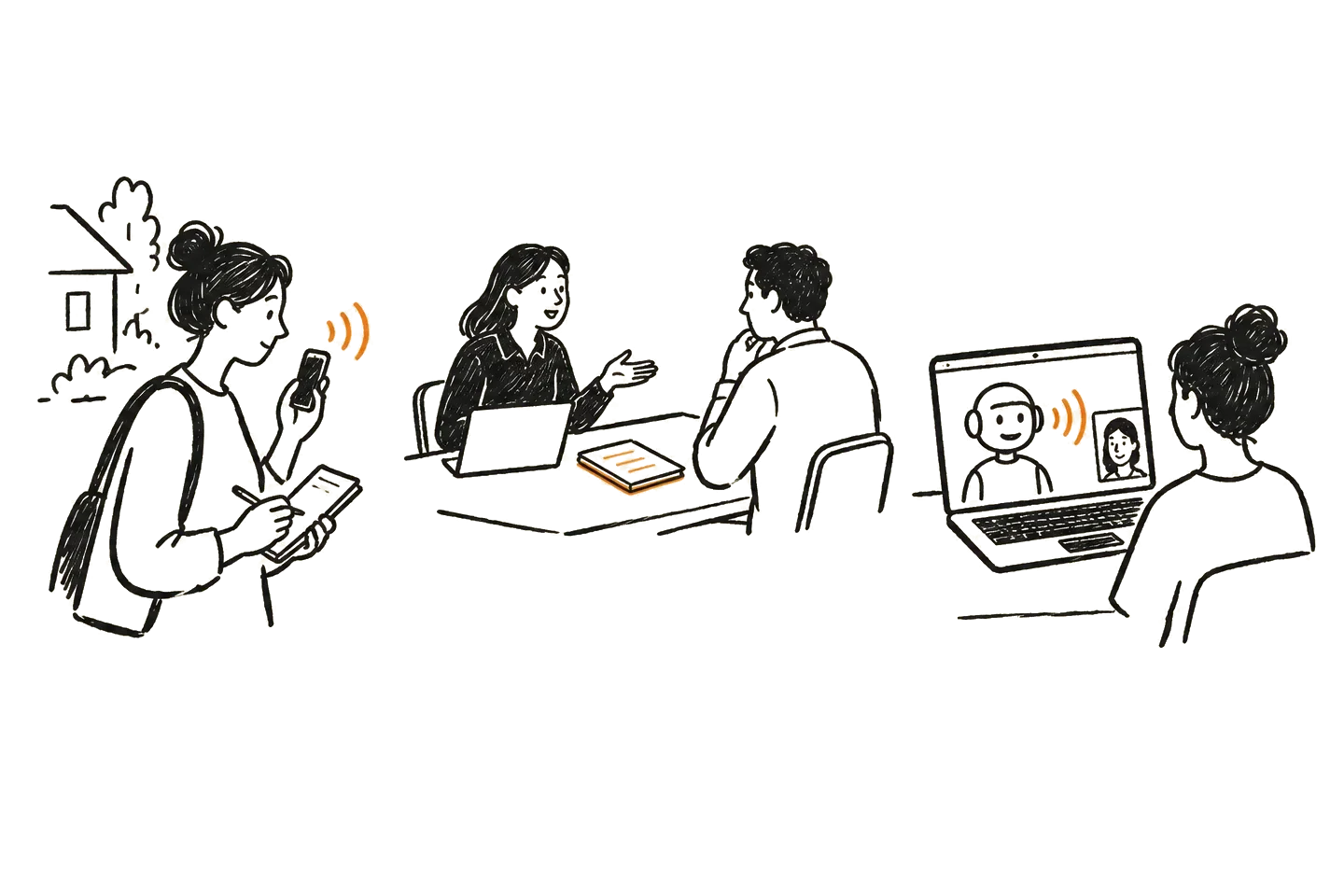
Market research fieldwork is the stage of a study where data is collected from participants. A fieldwork partner can recruit and screen people, run interviews or surveys, and hand back the data. Agencies can also run AI-moderated interviews under their own name.
What is market research fieldwork?
Market research fieldwork is the work of collecting data from the people a study is designed to reach. It sits between study design and analysis. The research team decides what it needs to learn, fieldwork gathers the responses, and the team interprets what they mean.
The phrase "fieldwork market research" refers to the same stage. It can cover surveys, interviews, focus groups or visits to people in their own environments. The method depends on the questions, the audience and the evidence the team needs.
A fieldwork survey is a survey being carried out with participants, whether online, by phone or in person. It differs from desk research, which uses information that already exists rather than collecting new responses for the study.
For an agency, fieldwork is often the part of a client project delivered by a specialist partner. The agency usually keeps the client relationship, study design, analysis and final story. The partner works behind the scenes to collect the data.
The boundary matters when you plan the work. Your team may write the questions and define the audience, while the partner finds people who fit and runs the sessions. Agree on that split before launch, so both teams know who owns each decision.
What does a fieldwork agency do?
A fieldwork agency carries out the data collection work agreed in the brief. It may only find participants, or it may also run sessions and deliver research files.
Depending on the project, a fieldwork partner may:
- Find people who match the audience in the brief and screen them against the agreed criteria.
- Schedule sessions and communicate with participants about what to expect.
- Arrange participant incentives and keep track of payments.
- Run or host interviews, groups or surveys.
- Check the quality of responses and flag issues during fieldwork.
- Arrange transcription or translation where needed.
- Deliver data files, recordings and transcripts in the agreed formats.
Not every partner offers every service. A team that runs online surveys may not provide in-person fieldwork, while an interview partner may not host focus groups. Ask what the partner will do and what remains your responsibility.
Agree on how issues will be handled. For example, decide who should be told if available participants do not match the screener, or if a response raises a quality concern. Your team can then decide what to do before the data reaches the client.
Also agree on the handoff. If your team will analyse the interviews, it needs to know whether it will receive recordings, transcripts or both. If the partner will provide summaries, ask what evidence will accompany them. The answer affects how your researchers check and use the findings.
Which fieldwork method should you use?
Choose a fieldwork method based on the depth of response you need, the people you need to reach and whether the research calls for a conversation, a group or an in-person visit.
| Method | What it is | Good for | Watch out for |
|---|---|---|---|
| Online survey | Participants answer a questionnaire online. | Collecting structured responses to the same questions. | Answers may leave little room to explore why someone responded that way. |
| CATI phone interviews | An interviewer conducts a computer-assisted telephone interview. | Structured questions where a phone conversation is useful. | Interviewer availability and phone access can affect the plan. See our guide to CATI surveys. |
| CAPI in-person interviews | An interviewer records answers on a tablet or laptop during an in-person session. | Structured research where meeting in person matters. | Field teams need to reach the relevant locations. See our guide to CAPI interviews. |
| In-depth interviews | A moderator speaks with one participant at a time. | Exploring experiences, decisions and detailed views. | Scheduling and moderator availability need attention. |
| Focus groups | A moderator leads a discussion with a group. | Hearing how people respond to ideas in a group setting. | Group discussion is different from a private conversation with each person. |
| AI-moderated interviews | An AI moderator conducts a voice interview with each real participant. | One-to-one conversations using a consistent guide across participants and markets. | They are not group sessions or in-person visits, and they do not replace a human moderator for every topic. |
Methods can work together. An agency might use a survey for structured responses and interviews to explore the reasons behind them. For work that depends on observing people in context, an in-home or ethnographic visit may be a better fit than a remote interview.
The method also affects the brief you give a partner. A survey needs a questionnaire and a plan for collecting responses. An interview study needs a guide, a decision about who will moderate, and agreement on the files your team will review. In-person work also needs a plan for reaching the relevant locations.
When comparing methods, consider what you need to hear or see, not just when you need the files. A group discussion, a private interview and a visit can each answer different kinds of questions. Choose the partner after you know which kind of evidence the study needs.
How do you choose a fieldwork partner?
Choose a partner by checking whether it can reach the right people, collect dependable data and deliver what your client project needs. Ask for clear answers on the work itself, not just the proposed timeline.
- Participants and screening: Where will participants come from? How will the partner apply the screener and check that people fit the brief?
- Quality: What checks happen during collection? How are incomplete, unsuitable or questionable responses handled?
- Markets and languages: Can the partner cover the locations and languages in the study? How will responses be translated for the research team?
- Timing: When can fieldwork start, and what could affect delivery? How will the partner flag a problem while there is still time to respond?
- Privacy and consent: How are participants informed, and how are data, recordings and transcripts stored, shared and retained?
- Deliverables: Will you receive raw data, transcripts, recordings or summaries? Ask for the file formats and the level of detail you need for analysis.
- Branding: Will participants see the partner's name or yours? If the work is for a client, check what the client will see too.
- Pricing: What does the quote cover, and which parts of the work are separate? Check the treatment of recruitment, languages, translation and deliverables.
Use the same questions when comparing a managed service with a platform your team will run. The division of work may be different even when the research method looks similar. Make sure you know who recruits, who prepares the guide and who reviews the responses.
For client work, check branding on the participant-facing experience as well as on anything you plan to share with the client. A partner may work behind the scenes, but the brief should state whose name people will see. Do not assume that every service offers white-label delivery.
Timing needs a practical discussion too. Scheduling across time zones, moderator availability and translation can all affect the plan. Ask how the partner will keep you informed if the work takes a different course from the one in the brief.
How do you brief a fieldwork partner?
A fieldwork brief tells the partner who to reach, what to collect and what to hand back. Share the decisions that are already fixed, and flag the ones where you need the partner's input.
- Objectives: Explain the client's questions and how the findings will be used. Include the decisions the study needs to support.
- Audience and screener: Describe who should take part, who should be excluded and the questions used to check eligibility.
- Quotas: Set out any required mix of participants, including which groups must be represented and how you want progress reported.
- Markets and languages: List the locations and languages in scope. Specify the language in which your team needs the findings.
- Guide or questionnaire: Share the questions, any materials participants will see and the areas where follow-up questions matter.
- Timing: Give the planned launch and delivery dates, along with any dependencies that could change them.
- Deliverables: State whether you need recordings, transcripts, data files, quotes or summaries, and how they should be shared.
- Branding: Explain whose name participants and the client should see, and whether the partner needs to stay behind the scenes.
Agree on who can approve changes once fieldwork starts. If a screener needs adjusting or a market is hard to reach, decide how the partner will raise the issue and record the decision. Tell the partner what your team needs to know when the files are handed over for analysis.
Before launch, check the participant-facing materials as well as the internal brief. A guide can be sound on paper but still need clearer wording for the people answering it. Make sure the instructions, consent information and questions fit the audience.
Be specific about deliverables. If the client expects a report but your partner will only deliver transcripts, your team needs time to analyse those transcripts and write the report. If you need quotes for a deck, say so. Ask how the supporting evidence will be delivered and who will have access to it.
For a multi-market brief, distinguish the languages participants will use from the language your research team needs for analysis. Also say whether the same guide will be used in each market. This gives the partner a clear starting point for discussing translation and delivery.
How can agencies run white-label AI-moderated interviews?
Agencies can use Usercall to run one-to-one voice interviews under their own name, with no Usercall branding. Each participant is a real person, and the AI moderator asks the questions and follows up when an answer needs more detail.
- Write the guide. Start with the client's objectives and turn them into a flexible voice-based interview guide. You can add mockups and control probing. Each session follows the same structure.
- Set the branding. Run the interviews under your agency's name, with no Usercall branding. Check the participant-facing experience against the client brief before sharing it.
- Find participants. Bring your own users with no panel fees, or we can recruit for you. Set out the audience and screening requirements before collection begins.
- Launch one link. Share the interview link with participants. They respond on their own time, so you do not need to schedule or join each call. Interviews can run in parallel across markets.
- Review the evidence. Usercall transcribes interviews, tags and clusters themes, and highlights quotes. Review the themes alongside the linked quotes before deciding what they mean for the client.
- Build the deliverable. Export quotes, themes, summaries and supporting evidence for a client deck or report. Your team remains responsible for interpretation and the story.
The same guide can run in 50+ languages, and findings come back in English. Many teams deliver initial themes and summaries within 24 to 48 hours of launching interviews. That is not a guaranteed turnaround for every study, so plan around the needs and timing of your project.
See sample interviews and a real report to understand the material your team can review. The researcher still decides which findings matter and how to explain them to the client.
This approach can fit exploratory work, concept and product testing, or brand and message testing. It can also sit alongside a survey in a mixed-method project. The interview guide should reflect what the agency needs to learn, whether that is a reaction to a concept or a closer look at an experience.
When reviewing results, start with the study objectives and follow themes back to the quotes behind them. Usercall also lets you search by keyword, topic or theme. That gives your team ways to find supporting evidence before selecting what belongs in the client's report.
When are AI-moderated interviews not the right fieldwork?
AI-moderated interviews are not the right choice when the study depends on group interaction, being physically present or the judgment of a skilled human moderator during the conversation.
Use a group method when you need to hear people respond to one another. Keep in-person or in-home fieldwork when the research depends on seeing an environment or observing what someone does there. A remote voice interview cannot provide the same view.
A human moderator may also be the better choice for very sensitive topics, complex senior stakeholder conversations or sessions where live rapport is central to the work. The choice is about the kind of conversation the research requires, not just speed.
Whatever method you choose, a researcher still needs to frame the study and interpret the findings. Tools can help collect and organise responses, but they do not replace the agency's judgment or its relationship with the client.
Usercall for agency fieldwork
Usercall helps agencies run white-label, one-to-one AI-moderated interviews for client studies. The AI moderator speaks with real people, while your team sets the guide and uses the evidence to build the client story.
Bring your own users with no panel fees, or we can recruit for you. Recruiting reaches 95M+ people across our panel partners in 151 countries. The same guide can run in 50+ languages, and every plan includes every language.
Choose self-serve and run the study in the app, or choose managed and we run the study for you, from setup to report. Usercall is from $89 a month, and your first interview is free. There is no sales call.
Usercall transcribes each interview and links themes back to the quotes behind them. Data is encrypted and GDPR-compliant, and you control access and retention. Learn more about Usercall for research and brand strategy agencies.
FAQ
What does fieldwork mean in market research?
Fieldwork means collecting data from participants for a market research study. It comes after study design and before analysis.
What does a fieldwork agency do?
A fieldwork agency carries out an agreed part of data collection. Its work may include finding and screening participants, running sessions, checking quality and delivering research files.
What is a fieldwork survey?
A fieldwork survey is a survey conducted with participants to collect new responses. It can be carried out online, by phone or in person.
Can agencies white-label AI-moderated interviews?
Yes. Agencies can use Usercall to run AI-moderated interviews under their own name, with no Usercall branding.
How much does market research fieldwork cost?
Fieldwork costs depend on the method, audience, markets, languages and services included. Usercall is from $89 a month, and your first interview is free. Choose self-serve and run it in the app, or managed and we run the study for you, from setup to report.
What is the difference between a fieldwork agency and a research agency?
A fieldwork agency is hired to carry out data collection. A research agency usually owns the study design, client relationship, analysis and final story, and may hire a fieldwork partner to collect the data.
Usercall at a glance
Usercall is a self-serve AI-moderated interview platform. An AI moderator runs one-to-one voice interviews with real people, and every theme links back to the quotes behind it.
Real people, AI moderator.
Every participant is a real person. Only the interviewer is AI.
We can recruit participants for you, or you can bring your own. Recruiting reaches 95M+ people across our panel partners in 151 countries.
50+ languages.
Every plan includes every language.
Concept tests.
15-30+ interviews, back in 48 to 72 hours.