
Narrative Analysis in Qualitative Research: How to Do It, With Examples
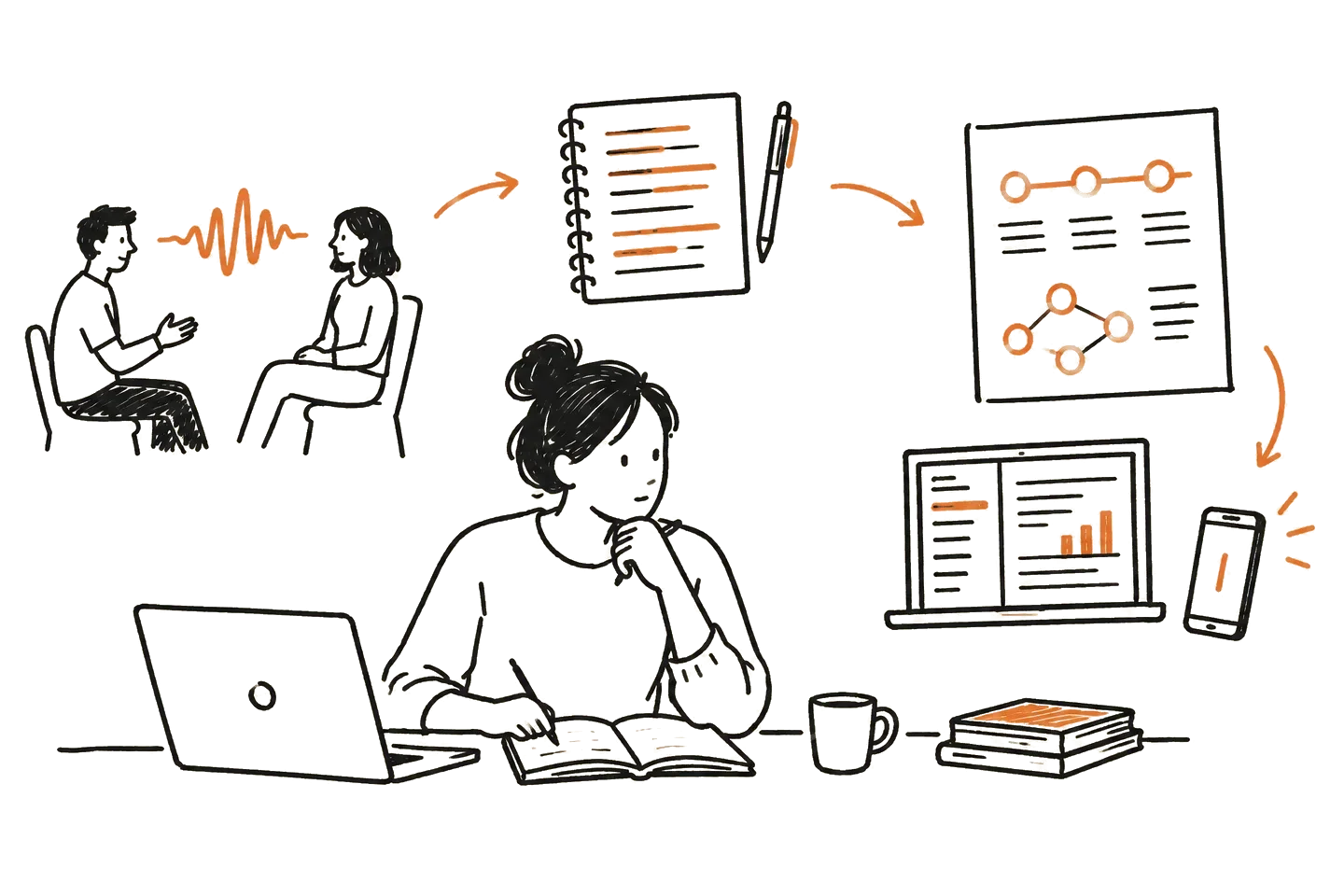
Narrative analysis in qualitative research is a family of methods that studies how people make sense of experience through stories. It looks at what happened, the order in which it is told, how the teller presents themselves and others, and the context of the telling.
What is narrative analysis in qualitative research?
Narrative analysis treats stories as the unit of analysis. Instead of starting by cutting an account into separate topics, you read it as a whole and ask how its parts work together.
A researcher might study an interview about a career change, a diary about illness, or a written account of migration. The analysis can attend to events, turning points, relationships, and the meaning the teller gives to what happened. It can also consider the person listening and the setting in which the story is told.
Narrative inquiry is the wider research approach that studies experience through stories (Clandinin and Connelly, 2000). Narrative analysis is the analysis of those stories.
Polkinghorne (1995) makes a distinction between analysis of narratives and narrative analysis. The first looks across stories for common themes. The second brings data together into a story that explains an outcome. State which kind of work you mean when you describe your analysis.
If you are still choosing a method, compare this approach with the wider menu of qualitative data analysis methods.
When should you use narrative analysis?
Use narrative analysis when your question depends on how someone tells an experience, not just which topics they mention.
It is a good fit for questions about identity, change over time, and turning points. You might ask how people describe an illness, make sense of a career change, or tell the story of moving to a new place. Education and organizational change can also suit a narrative approach when the sequence and meaning of events matter.
For example, a question about how someone came to see themselves as a student invites a different reading from a question about common barriers faced by students. The first leaves room to examine a particular story over time. The second may be better served by an approach that looks for patterns across accounts.
Narrative analysis is less useful when your main aim is to count responses or make a statistical generalization. It also depends on having material rich enough to support a reading of stories. Short answers that contain little sequence or context may not give you what you need.
The work takes time and involves interpretation. Choose it because its attention to the whole account helps answer your question, not simply because your data came from interviews. If you want to understand what happened before and after a turning point, preserving that order may be as important as identifying the topics the person mentions.
Four approaches to narrative analysis
Narrative approaches attend to different aspects of a story. Riessman (2008) sets out thematic, structural, dialogic or performance, and visual approaches.
Thematic narrative analysis
Thematic narrative analysis asks what is told. You look at the subject and meaning of a story while keeping the account connected to its teller and context. This is not the same as treating every passage as an isolated piece of a topic that appears across the dataset.
Structural analysis
Structural analysis asks how a story is put together. You might examine the order of events, the point at which the account changes direction, and how the teller explains why an event matters. Labov and Waletzky's model offers one way to look at parts of an oral narrative (Labov and Waletzky, 1967).
Dialogic and performance analysis
Dialogic and performance analysis considers who a story is told to, how and why it is told, and the interaction around it. An interview account is not produced in isolation. The researcher's prompt and responses are part of the context in which the participant tells the story.
Visual analysis
Visual analysis considers images as part of narrative research. If your material includes images, explain how they relate to the stories and why a visual approach helps answer your question.
How to do narrative analysis, step by step
A useful workflow moves from a question about experience to close reading within each case, then to comparison across cases. These steps are a guide, not a fixed protocol.
- Set a narrative question. Ask about experience over time, identity, or meaning. Make sure the way a person tells an account could help answer the question. A question about what a turning point meant to someone is more suited to this approach than a request for a list of common problems. Decide what you need to learn from a whole story before you start collecting or coding material.
- Collect accounts that invite stories. Open, life story, and episodic interviews can give people room to describe events in their own order. Written accounts, diaries, letters, and other personal documents can also be useful. An open prompt such as "Tell me about the time when..." gives a participant space to choose where to begin. The account they give may include events and connections you did not anticipate in your question.
- Prepare the material carefully. Transcribe interviews with your question and approach in mind. Keep the order of the account, and retain pauses or repeated words where they matter to your analysis. Make clear how you prepared the transcript. If you attend to the interaction during an interview, keep the prompts with the responses so you can return to them while reading.
- Read each account whole. Read each transcript or document several times before settling on a reading. Note your first impressions, but return to the full account to check them. Pay attention to what comes before and after a passage that seems important. Ask how the teller connects events and where they explain why an event mattered.
- Find the stories within each account. Mark where a story appears to start and end. An interview may contain more than one story, and a boundary may not always be obvious. Record why you included a passage so you can revisit that choice later. Keep the surrounding transcript available: the words before or after a story may help explain why the participant told it.
- Analyze with a chosen approach. Depending on your question, examine what is told, how the account is structured, or how the telling is shaped by its audience and setting. You can use a structural model as a prompt, but do not force every account into the same shape. Note how the teller presents themselves and other people, and check that reading against the whole story.
- Write a summary for each case. Describe the story's sequence, important events, the teller's position, and your interpretation. Keep the summary connected to the transcript so you can check whether your reading fits the account as a whole. Distinguish what the person said from the meaning you have drawn from it. This makes your reasoning easier to revisit.
- Compare cases and write the findings. Once you have read individual accounts, look for similarities and differences across them. Use longer excerpts where they help readers see the story, and reflect on your own role in producing and interpreting it. Keep differences between cases visible, even when you discuss something they share.
Narrative analysis example
This narrative analysis example is illustrative. The excerpt is made up to show how different readings of the same account can work. It is not real interview data.
"My first term taught me that asking for help could change things. I was the first in my family to go to university, and I arrived in a city I didn't know. At first I sat at the back of every class and went straight home. Then I missed a deadline because I couldn't work out what the assignment wanted. I thought that meant I didn't belong there. A tutor talked me through the task, and I handed in the next one on time. That conversation mattered because I stopped seeing questions as proof I was failing. Now I still get nervous, but I ask."
A structural reading
Labov and Waletzky's model describes parts that can appear in an oral narrative. The table shows one possible mapping. Not every story contains every part, and another reader might draw a boundary differently.
| Part | Role | Illustrative excerpt |
|---|---|---|
| Abstract | What the story is about | "My first term taught me that asking for help could change things." |
| Orientation | Who, when, and where | "I was the first in my family to go to university, and I arrived in a city I didn't know." |
| Complicating action | What happened | "Then I missed a deadline because I couldn't work out what the assignment wanted." |
| Evaluation | Why it matters | "That conversation mattered because I stopped seeing questions as proof I was failing." |
| Resolution | How the story ended | "A tutor talked me through the task, and I handed in the next one on time." |
| Coda | Return to the present | "Now I still get nervous, but I ask." |
The first sentence supplies the time, the first term, as well as the abstract. The evaluation follows the resolution in this excerpt. The table helps inspect the account, but it does not mean that every part must appear in a fixed order.
A thematic narrative reading
One possible reading is a story about a change in what asking for help means. The teller moves from treating uncertainty as a sign of not belonging to seeing questions as something they can ask despite feeling nervous. The missed deadline, conversation with the tutor, and present-day reflection work together to make that change visible.
This reading depends on the connection between events, not just the mention of help. The tutor's conversation matters because of how the teller describes their earlier uncertainty and their later response to it.
A dialogic reading
Suppose the made-up account was told to a researcher who had asked about the first term. A dialogic reading would consider how that prompt and audience may shape the account. The teller's opening sentence offers a lesson to the listener, while the final sentence connects the past event to the present. The excerpt alone cannot tell us everything about why it was told this way.
How a thematic analysis code list would differ
A thematic analysis of the same excerpt might code passages as unfamiliar setting, not belonging, difficulty with an assignment, tutor support, and asking for help. Those codes could then be considered alongside coded passages from other accounts. The list makes topics easier to compare, but on its own it does not show how this teller connects the missed deadline to a change in meaning.
Narrative analysis vs thematic analysis
The main difference is that narrative analysis starts with stories and their telling, while thematic analysis looks for patterns of meaning across a dataset.
| Feature | Narrative analysis | Thematic analysis |
|---|---|---|
| Focus | How a person makes sense of and tells an experience | Patterns of meaning across the data |
| Unit of analysis | A story or account, read as a whole | Segments of data considered across the dataset |
| What you code or mark | Story boundaries or parts relevant to the chosen approach | Segments relevant to patterns of meaning |
| Sample | Often smaller, with attention to depth within cases | Depends on the question and design, with attention across the dataset |
| Output | Case readings and comparisons that retain sequence and context | Themes that describe patterns across accounts |
| Good for | Questions about identity, change, and how events are told | Questions about shared or differing patterns across people |
Thematic analysis can make cross-case patterns visible, but separating passages from their stories can lose sequence and turning points. Narrative analysis keeps that context in view, but is time-consuming and interpretive. For more on thematic analysis, see the Braun and Clarke thematic analysis guide (Braun and Clarke, 2006).
You can combine the approaches if both serve your question. For example, you might make a thematic pass across the data, then read selected cases narratively. Explain what each pass contributed and how you selected the cases. A code can help you return to relevant material, but the narrative reading still needs the surrounding account.
How to keep narrative analysis rigorous
Make your interpretive choices visible and check them against the whole account. Rigor does not mean pretending that there is only one possible reading.
Keep an audit trail of how you selected material, marked story boundaries, and moved from transcripts to case summaries and comparisons. Record changes in your thinking as well as the decisions you kept. Name the narrative approach you used so readers know what you attended to.
Case summaries give you a way to check your interpretation before comparing participants. Return to the transcript when a summary seems to leave out a change in direction or a detail that complicates your reading. Keep notes on what you changed and why.
Write reflexive memos about your role in the interview and analysis. Consider how your prompts, responses, assumptions, and relationship with the participant may have shaped the account. A story told in an interview is produced in an interaction, not simply lifted unchanged from someone's experience.
Use longer excerpts when they allow readers to follow the sequence and assess your interpretation. Check each reading against the full transcript, including passages that complicate it. A supervisor or second reader can help you see where a claim needs more support or where another reading is possible.
Take care with identifiable details. A story's sequence and context can make a person recognizable even if their name is removed, so consider what you can include without exposing them. There is a balance between giving readers enough context to follow your interpretation and protecting the person who told the story.
Narrative analysis software
No software does narrative analysis for you. The narrative reading is interpretive work that remains the researcher's job.
General-purpose qualitative data analysis software such as NVivo, ATLAS.ti, or MAXQDA can help researchers code segments, write memos, and organize data by case. For narrative work, useful jobs include keeping transcripts whole and readable, marking story boundaries or structural parts, and keeping case notes alongside the material you compare.
Excerpts are easier to check when you can trace them to the speaker and the question that prompted them. You may also want to compare case summaries without losing the full accounts they came from. Decide which of these jobs matter for your approach before choosing software.
If you are also comparing coding options, see the thematic analysis tools guide.
Where Usercall fits
Usercall qualitative analysis can support the thematic or first-pass coding side of a project. You can upload interview transcripts in .txt or .docx format, focus group transcripts, open-ended survey items, or an existing codebook in .csv format. Usercall drafts codes and themes against your research question or codebook. Describe this use as AI-assisted first-pass coding, reviewed and refined by the researcher.
Each excerpt keeps its speaker and the question that prompted it, and you can open a participant's coded transcript. You can start with your own codebook and merge, split, rename, or remove codes. Usercall can also be used as a second-coder check against your own coding.
Usercall has no narrative analysis feature. It does not detect stories, map plots, or read structure or positioning. You must find and interpret the stories yourself, returning to each whole account rather than relying on the coded excerpts alone.
You can anonymize participants before or during analysis. Data is encrypted and never used to train models. Usercall can code transcripts in 50+ languages and export theme summaries, quote tables, and the codebook for an appendix.
Usercall is available from $89 a month, and your first interview is free. Students and grant-funded researchers can ask about pricing. Choose self-serve, where you run it in the app, or managed, where we run the study for you, from setup to report. Learn more about Usercall for academic research and evaluation.
Writing up narrative analysis in your thesis
Your thesis should show how you moved from whole accounts to an interpretation that answers your research question.
In the methods chapter, name your narrative approach and explain why it fits the question. Describe your material, how you invited or selected accounts, how you prepared transcripts, and how you identified the start and end of stories. Explain how you wrote case summaries, compared cases, and kept an audit trail.
Be specific about software. If you used Usercall for coding, you could describe that part as "AI-assisted first-pass coding, reviewed and refined by the researcher." Then explain separately how you carried out the narrative reading. Do not imply that the software identified or interpreted the stories.
In the findings chapter, present cases with enough context for readers to follow each account. Longer excerpts can show the sequence and support your interpretation. Explain how the excerpt supports your reading rather than leaving it to stand on its own. When you compare cases, retain important differences rather than reducing every story to the same pattern.
Discuss the limits of your reading, your role in producing the accounts, and the care taken with identifiable details. Explain that the findings are interpretive rather than intended for statistical generalization. For a broader look at reporting analysis, see qualitative data analysis for a dissertation.
References
- Braun, V., and Clarke, V. (2006). Using thematic analysis in psychology. Qualitative Research in Psychology.
- Clandinin, D. J., and Connelly, F. M. (2000). Narrative Inquiry: Experience and Story in Qualitative Research. Jossey-Bass.
- Labov, W., and Waletzky, J. (1967). Narrative analysis: Oral versions of personal experience.
- Polkinghorne, D. E. (1995). Narrative configuration in qualitative analysis. International Journal of Qualitative Studies in Education.
- Riessman, C. K. (2008). Narrative Methods for the Human Sciences. Sage.
FAQ
What is narrative analysis?
Narrative analysis is a family of qualitative methods that studies stories and how people tell them. It considers elements such as sequence, meaning, the teller's position, and context.
What is the difference between narrative analysis and thematic analysis?
Narrative analysis reads stories as whole accounts, often attending to sequence and context within each case. Thematic analysis looks for patterns of meaning across a dataset.
What is an example of narrative analysis?
An illustrative example is reading a made-up student's account of their first term to see how they connect a missed deadline, a conversation with a tutor, and a change in how they ask for help.
How many participants do you need for narrative analysis?
Narrative studies often use small samples, but the appropriate size depends on your question, the depth of the accounts, and your design. Discuss your choice with your supervisor.
Is there narrative analysis software?
Software can help you organize cases, code passages, and write memos, but no tool does the interpretive narrative reading for you. Usercall has no narrative analysis feature.
Can you combine narrative and thematic analysis?
Yes. You might examine themes across a dataset and then read selected cases as whole stories, provided you explain how each approach serves your question.
Usercall at a glance
Usercall is a self-serve AI-moderated interview platform. An AI moderator runs one-to-one voice interviews with real people, and every theme links back to the quotes behind it.
Real people, AI moderator.
Every participant is a real person. Only the interviewer is AI.
We can recruit participants for you, or you can bring your own. Recruiting reaches 95M+ people across our panel partners in 151 countries.
50+ languages.
Every plan includes every language.
Concept tests.
15-30+ interviews, back in 48 to 72 hours.